




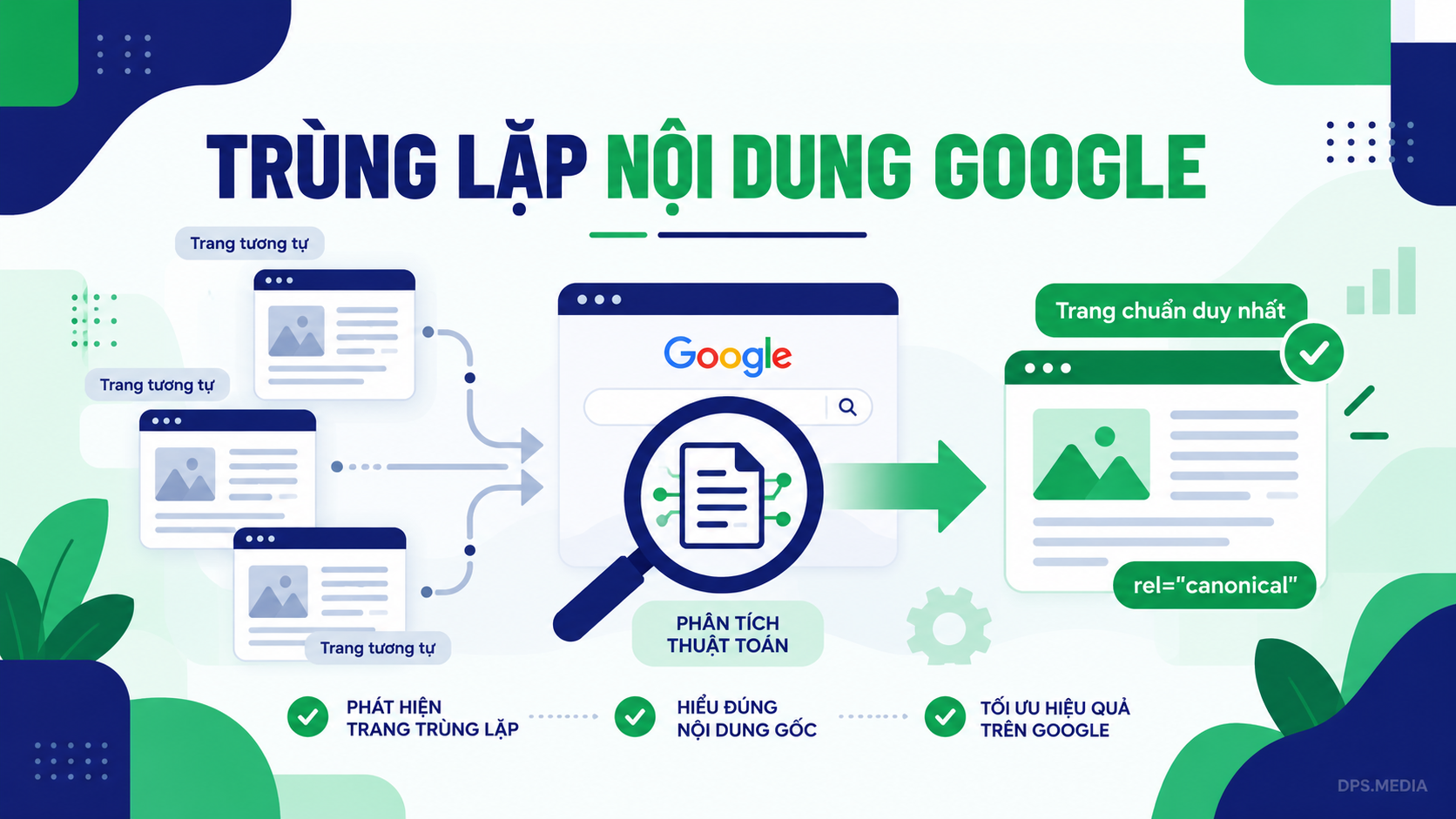

For years, the concern about a “punishment verdict” from Google for duplicate content has existed within the webmaster and SEO community. Many people believe that just a few identical paragraphs between pages or accidentally allowing a website to generate variant URLs will immediately push keyword rankings to the bottom of search results.
The reality is completely different. As early as 2008, Google's specialist Susan Moskwa published an article clarifying the issue on the Google Webmaster Central Blog with a straightforward message: there is absolutely no separate algorithmic penalty called a duplicate content penalty for ordinary technical cases. After more than a decade of algorithm development, Google representatives such as Gary Illyes and John Mueller have repeatedly reaffirmed this principle. The article below will decode the nature of the issue Google duplicate content, point out the actual losses your website may face and provide the most thorough technical solution.
The Truth About the “Duplicate Content Penalty” from Google's Perspective
Google understands very well that on the Internet, duplicate content is natural and unavoidable. Print version pages, terms of service pages, press releases distributed simultaneously, or product variants in online stores all share similar passages of text. Therefore, the search engine does not design an algorithm to “punish” websites for this reason.
Instead of penalizing, Google applies clustering and canonicalization. When Googlebot detects multiple web pages with nearly identical content on the same domain (or across different domains), the system groups them together. From that group, the algorithm automatically selects a single representative URL that it considers the best to return to users on the search results page.
All signals related to authority, inbound links (PageRank), and anchor text from secondary URLs in the group will be consolidated into the selected canonical page. This means you are not demoted or given a Manual Action, but duplicate pages simply will not be displayed independently in search results.

If It Isn't Penalized, What Harm Does Duplicate Content Cause to SEO?
Many people breathe a sigh of relief when they learn there is no direct penalty, but then carelessly leave duplicate URLs on their website. This is a dangerous mistake because, even without a penalty, your website still has to bear three silent but very serious losses:
1. Wasted Crawl Budget
Gary Illyes has repeatedly emphasized that duplicate content wastes Googlebot's resources. Every website has a certain crawl limit depending on its authority and server response speed. If a website generates tens of thousands of duplicate URLs (due to filters, campaign tracking codes, pagination), Googlebot will spend most of its time repeatedly crawling identical content instead of discovering and indexing new articles or important product pages.
2. Link Equity Dilution
Imagine you have an excellent analysis article that exists simultaneously at both addresses https://example.com/bai-viet/ and https://example.com/bai-viet/?source=facebook. Half of the external websites link to the first URL, while the other half point to the second URL. Because no canonical page is clearly specified, Link Equity is split in two instead of being concentrated on a single source to compete for top positions.
3. Keyword Cannibalization
When pages with similar content and keywords coexist without distinguishing signals, Google's algorithm may fluctuate when deciding which page deserves to rank at the top. The result is constantly changing rankings, or worse, Google chooses to display a low-converting secondary page instead of your primary sales page.
Distinguishing Technical Duplication from “Scaled Content Abuse”
The boundary between “not being penalized” and “being severely penalized” lies in the intent and scale of content deployment. To protect your website, you need to clearly distinguish between these two completely opposite states:
| Comparison Criteria | Technical Duplication (Harmless) | Scaled Content Abuse (Penalized) |
|---|---|---|
| Nature | Caused by technical CMS mechanisms, URL parameters, and HTTP/HTTPS protocols. | Intentionally creating large numbers of identical pages to manipulate search rankings. |
| Typical Behavior | Category filters, print versions, and multi-channel distributed articles with attribution. | Scraping articles from other websites, using AI to publish thousands of local pages by changing only the district/province name. |
| How Google Handles It | Automatically clusters them and displays only 1 representative URL. No penalty. | Applies a Spam algorithm or Manual Action, removing the pages from the index. |
In the March 2024 Spam policy update, Google officially introduced the concept of Scaled Content Abuse (Scaled Content Abuse). This policy applies to every method of content creation – regardless of whether it is written in bulk by humans, produced using scraping tools, or generated by artificial intelligence (AI). If you intentionally produce large numbers of web pages with similar content without providing any additional value to users, the website will certainly face the most severe algorithmic penalties.
4 Techniques for Handling Duplicate Content According to Google Search Central
To ensure that search engines accurately understand your website structure and concentrate all strength on important landing pages, you need to apply the technical solutions standardized in Google Search Central's official documentation on consolidating duplicate URLs:
1. Declare the Canonical Link Tag (rel=”canonical”)
The tag rel="canonical" is a powerful signal that tells Google which version is the original and should be prioritized for indexing. Even for standalone pages, setting a self-referencing canonical is also a required standard to prevent the website from being appended with unwanted query parameters.
2. Use a Permanent 301 Redirect
If you restructure your website, change article URLs, or consolidate multiple old pieces of content into a single in-depth article, a 301 redirect is the optimal choice. A 301 command tells search bots that the old URL has permanently moved to the new address, while transferring nearly all of the old page's ranking strength to the new page.
3. Manage Query Parameters and the robots.txt File
For URLs generated by product sorting features, price filters, or UTM campaign tracking codes, you can configure crawling restrictions through the file robots.txt or add the tag on filtered pages. This helps preserve the entire Crawl Budget for pages that generate actual revenue.
4. Add Unique Value (Value-Add Content)
If you must publish similar pages (for example, introducing services in different geographic areas), don't lazily copy content and change only the local name. Add real data for each branch: actual office photos, the list of responsible staff, pricing adjusted for the local area, and authentic feedback from local customers.
Real-World Case: A Lesson in Handling Duplicate Content at a Business
To make this easier to visualize, consider the case of an office fashion brand in Ho Chi Minh City. Its website has more than 3,000 products but appears with more than 45,000 URLs in the Google Search Console report. The cause is the system automatically creating separate URLs for each color and size option (for example: ?color=navy&size=L).
As a result, Googlebot spent weeks crawling variant URLs, while newly launched collections still had not been indexed even after a month. The technical team intervened in two steps: first, assigning canonical tags on all variant pages pointing directly to the original product URL; second, configuring the robots.txt file to prevent bots from crawling size-filter parameter strings. After just 3 weeks, the number of spam pages was completely removed from the index, and organic traffic to the main product categories had grown again by more than 28%.

Conclusion and Sustainable SEO Optimization Solutions with DPS.MEDIA
Duplicate content is not an invisible “death sentence” as baseless rumors suggest. The core of the issue lies in the ability to optimize technical infrastructure and the strategy for distributing website signals. When you properly understand how Googlebot operates, you will no longer have unfounded fears and will instead know how to leverage technical tools to concentrate strength on core landing pages.
If your business is struggling with indexing errors, URL structure conflicts, or wants to build an in-depth content development strategy that completely avoids the risk of being caught by algorithmic crawls, take a look at reputable comprehensive SEO services at DPS.MEDIA. With extensive hands-on experience since 2017 and an internationally standardized technical optimization process, DPS.MEDIA is committed to delivering sustainable ranking growth and tangible business performance for enterprises.
Contact information for in-depth consultation:
Hotline / Zalo: 0961545445
Address: 56 Nguyen Dinh Chieu, Tan Dinh Ward, District 1, Ho Chi Minh City
Website: https://dps.media
Ý kiến bạn đọc (9)
Đăng nhập để bình luận
Đăng nhập nhanh 1-chạm bằng Google để chia sẻ ý kiến của bạn về bài viết.
Bằng cách đăng nhập, bạn đồng ý với điều khoản và chính sách cộng đồng.
Chưa có bình luận nào. Hãy là người đầu tiên chia sẻ cảm nghĩ!
Đăng nhập / Tạo tài khoản
Đăng nhập với Google để gửi bình luận và tương tác cùng cộng đồng.
Tiếp tục là đồng ý với điều khoản sử dụng và chính sách bảo mật của DPS Media.