




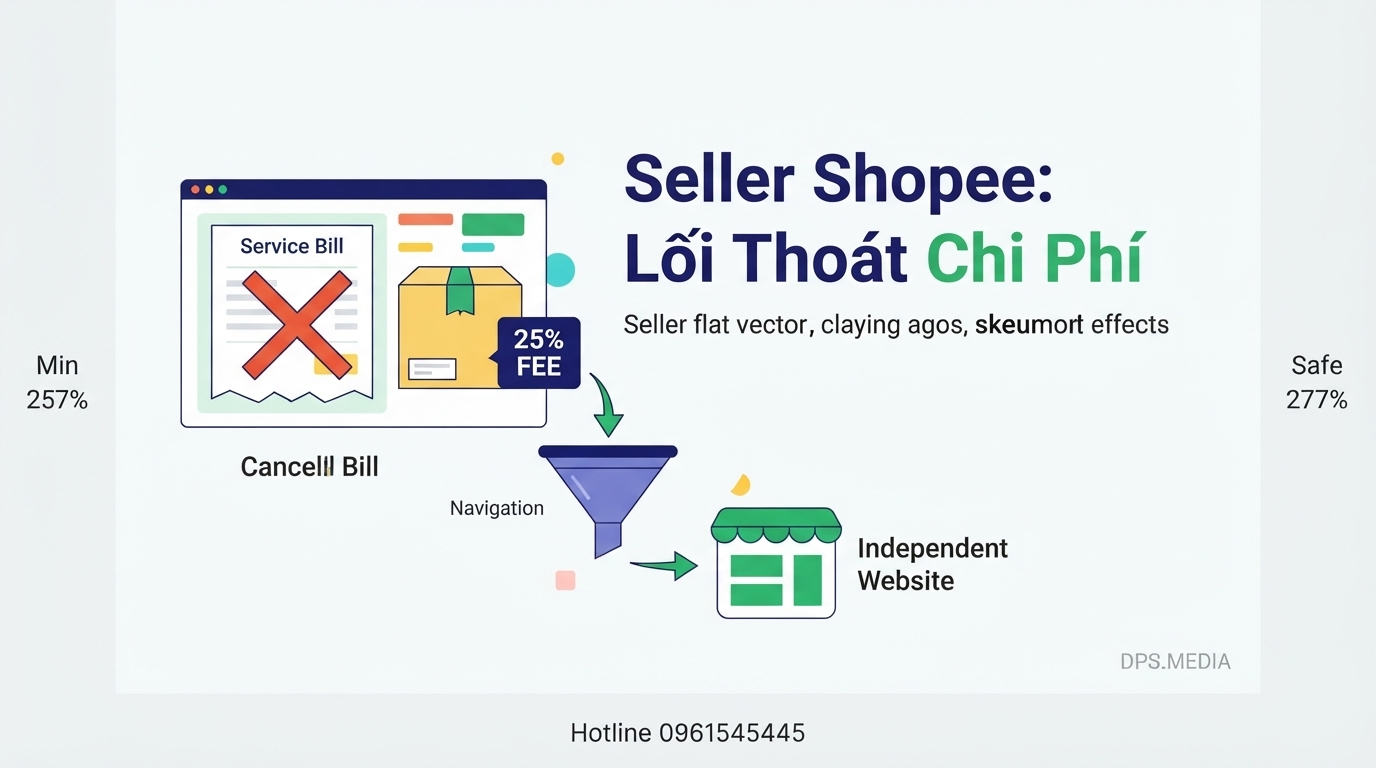

A stark reality that anyone doing business on an e-commerce platform can clearly feel is that as many as 90% of Shopee sellers are slowly but surely heading toward collapse. The golden waves of explosive sales growth in 2018–2019 and 2021–2022 are now nothing more than fading memories. Many shop owners who once generated billions of VND in monthly revenue have quietly left the game, switched to real estate brokerage, or thrown themselves into becoming TikTok creators in search of new sources of income.
The biggest paradox right now is that orders may still be coming in steadily and the warehouse may still be packing shipments nonstop, yet the business owner's bank balance at the end of the month keeps shrinking, sometimes plunging deep into the red as all kinds of costs pile up. Selling thousands of orders a day, yet having no money to show for it. What does this mean?
At DPS.MEDIA, through our work with partners and the implementation of comprehensive e-commerce store optimization services for retail partners, we have found that the line between surviving and disappearing from online marketplaces no longer depends on who is willing to offer deeper discounts, but rather on cash flow management and customer retention strategies across independent digital asset channels.
The steel punches draining Shopee sellers' profit margins
The era of easy selling, when simply listing a product could generate organic orders, has officially come to an end. In 2026, e-commerce sellers are struggling to cope with an unprecedented surge in costs.
Marketplace fees skyrocketing from 2% to as high as 20–25%
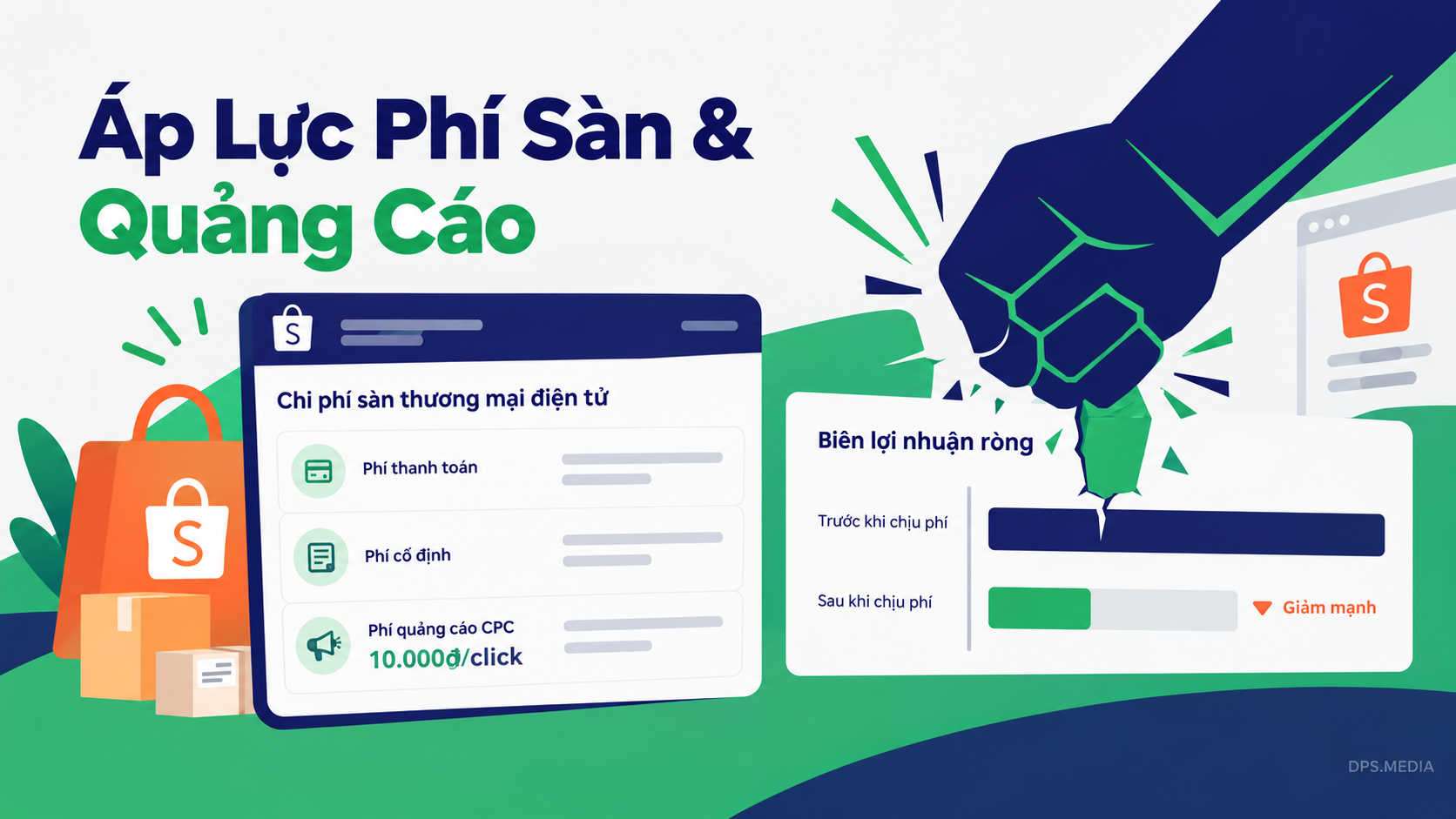
During 2018–2019, marketplaces supported sellers at almost no cost, with payment processing fees ranging from just 1% to 2%. Today, marketplace fees have become an enormous burden. Every successful order now incurs payment processing fees (approximately 3.6%–4%), fixed category fees (4%–5%), and mandatory service packages for those seeking to remain competitive, such as Freeship Xtra and Hoàn xu Xtra (approximately 8%–12%).
Total marketplace fees deducted directly from the listed selling price can easily reach 20%–25%. If a product line has a gross profit margin below 30%, sellers are virtually guaranteed to incur losses after paying for packaging labor, cardboard boxes, tape, and warehouse depreciation.
Advertising bids (CPC) increasing 6–7 times and the Auto-ROAS trap
Organic traffic on marketplaces has been almost entirely eliminated. To gain impressions, stores are forced to compete in Shopee Ads keyword bidding wars. Previously, the cost per click (CPC) ranged from just VND 500 to VND 800, but bids for keywords in home goods, fashion, and accessories have now surged to VND 5,000–10,000 per click.
Even more concerning, automated advertising features optimized for ROAS targets continuously drain budgets at an alarming rate during off-peak hours. Many store owners wake up after a single night to find tens of millions of Vietnamese dong deducted from their advertising accounts, while the revenue from orders is insufficient to cover the cost of goods.
Tax management pressure and the 15-day return and refund policy
In addition to direct marketplace costs, legal compliance requirements have also tightened considerably. According to integrated data from the E-commerce Information Portal of the General Department of Taxation, all revenue and transaction reconciliation records for each online store are automatically transferred to the tax authorities, bringing the era of undeclared sales to a complete end.
In addition, the regulation extending the return period to 15 days for the reason of ‘no longer needed’ has caused the return rate to surge from 2% to 8%–12%. Returned products are often found with torn packaging, dirt, or even swapped components, forcing sellers to bear the full cost of two-way shipping as well as losses from damaged goods.
The Shoptida Story: When Renting Land Turns into a Trap in the Blink of an Eye
Looking back at the journey of brands that once dominated the marketplaces is the most valuable lesson for anyone doing business online.
In 2019, the Shoptida brand exploded onto the scene with remarkable speed, selling just one line of thermal printers and reaching VND 2 billion in monthly revenue. At the time, the founder thought they had mastered every e-commerce sales secret. During the 2021 lockdowns, when everyone was staying home, Shoptida set another record with its power outlet product line, peaking at thousands of orders per day thanks to an affiliate strategy that drove traffic from TikTok to Shopee.
However, the game changed at breathtaking speed. The massive influx of overseas manufacturers selling directly at unbelievably low prices squeezed profit margins to the limit. This was followed by waves of quality-standard inspection (TCCL) policy enforcement and increasingly strict algorithm changes, resulting in all three Shop Mall stores being simultaneously locked while they were at the peak of their sales. The entire cash flow, workforce, and inventory became stuck after just a few system notifications.
The bitter lesson is this: E-commerce marketplaces are ultimately just rented land. You can spend hundreds of millions of VND on advertising every month to bring customers in to shop, but all of that customer data belongs to the marketplace, not to you. When the landlord decides to raise the rent, change the rules of the game, or reclaim the premises, businesses built on rented land will be the first to collapse.
A Way Out for the 10% of Sellers Who Survive: Shifting from Rented Land to Owned Media
Who are the 10% of sellers that still survive and generate sustainable profits on marketplaces today? They are not necessarily the best at ‘running cheap ads’ or ‘squeezing every last drop out of promotional vouchers,’ but rather those who realized early on that: E-commerce marketplaces only serve as a customer acquisition channel at the very top of the sales funnel (Top of Funnel).
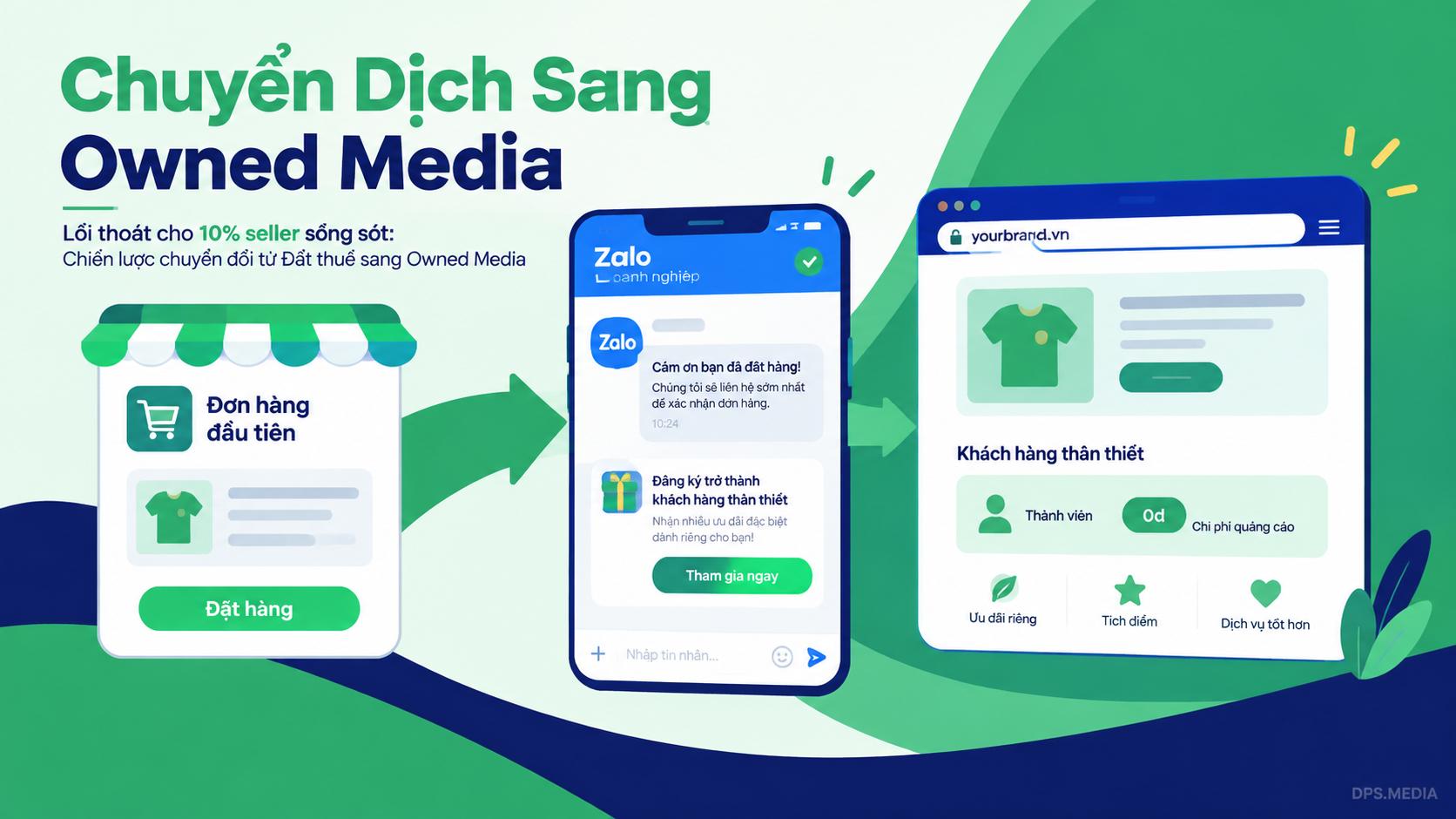
To escape the vicious cycle of cutting prices and bleeding margins, smart businesses adopt a model that shifts customers from rented platforms to privately owned digital assets (Owned Media):
- Accepting break-even on the first marketplace order: Treating the 20–25% marketplace fees and Shopee Ads costs as the Customer Acquisition Cost (CAC) for acquiring new customers. The goal is to secure the first order and the buyer’s contact information.
- Retain customers for life on Zalo OA: Include a thoughtfully designed thank-you card, a QR code to activate electronic warranty coverage, or a member gift inside the package to encourage customers to scan the code and register as followers. Combined with professional Zalo OA management services, businesses can automatically send order tracking notifications, offer repurchase discount codes, and run remarketing campaigns with nearly zero reach costs.
- Build a Brand Website to Capture Organic Search: Instead of relying on fluctuating advertising bids every day, owning an independent platform through SEO-standard WordPress website design services combined with comprehensive multi-channel SEO services will bring in customers with genuine purchase intent from Google. On their own website, businesses retain 100% of their revenue without having to share any commission fees with marketplaces.
3 Action Pillars to Help Businesses Weather the Cost Storm
If you feel that your store is struggling under rising costs, here are 3 urgent conversion steps you should take immediately:
Pillar 1: Restructuring the Product Portfolio (Hero SKU Funnel)
Do not put all your key products on marketplaces and engage in price-cutting wars. Categorize your product portfolio into 3 distinct groups:
- Traffic Product (Traffic SKU): Competitive pricing, thin profit margins, used to drive engagement and positive reviews on Shopee.
- Cashflow Product (Cashflow SKU): Sold as part of a combo or bundled with a flash deal to increase the average order value (AOV) and offset platform fees.
- Premium / Exclusive Product (Profit SKU): Exclusively distributed through the Website and consulted via Zalo OA, with superior after-sales policies.
Pillar 2: Automating Customer Care Processes and Repeat Purchase Loops
Customers who shop on marketplaces often have a habit of immediately forgetting your brand after receiving their package. Turn the packaging box into a gateway for connection. Integrate an automated workflow to send a message asking about their satisfaction 3 days after delivery, provide product storage instructions, and send a repurchase discount code right when the product is nearing the end of its usage cycle.
Pillar 3: Measuring Business Performance Using LTV Instead of ROAS
A trader's mindset looks only at the return on ad spend (ROAS) of each individual order. An entrepreneur's mindset looks at Customer Lifetime Value (LTV). A customer who makes a first order worth VND 200,000 on Shopee can generate VND 2,500,000 in revenue over the following year if you nurture them well within your own ecosystem.
Frequently Asked Questions About Shopee Selling Costs (FAQ)
What fees does Shopee currently charge sellers, and what percentage do they account for?
Currently, the total cost of a successfully completed order on Shopee typically ranges from 20% to 25% of the listed selling price. The main fees include payment fees (3.6%–4%), fixed fees (4%–5% depending on the product category), and service fees for Freeship Xtra and Coin Cashback Xtra packages (8%–12%). When packaging, return rates, and Shopee Ads are also included, total costs can reach 35%–45% of the order value.
How can customers be moved from Shopee to Zalo OA without violating marketplace policies?
Sellers must never send phone numbers or external links through Shopee's internal chat channel because their accounts may be immediately suspended. The safest approach is to include a QR code in physical packaging materials: a thank-you card, handwritten note, electronic warranty activation sticker, or exclusive gift voucher for the next purchase, allowing customers to voluntarily scan the code to register their interest with the Zalo OA.
Should businesses stop selling on Shopee altogether and focus exclusively on their Website?
You should not abandon marketplaces entirely. Shopee remains a place with a huge built-in customer traffic base. Businesses should maintain funnel products on Shopee to reach new customers with the goal of breaking even, then focus on building an SEO-optimized WordPress Website and a Zalo OA channel to maximize customers' lifetime value with zero marketing costs.
How does DPS.MEDIA help Shopee sellers transition to a new business model?
DPS.MEDIA provides comprehensive solutions, from optimizing E-commerce store operations and designing SEO-friendly WordPress Websites, to implementing comprehensive SEO services to attract sustainable organic traffic, and setting up automated customer care systems on Zalo OA to help businesses retain customers and escape the pressure of marketplace fees.
DPS.MEDIA JOINT STOCK COMPANY
📍 Address: 56 Nguyen Dinh Chieu, Tan Dinh Ward, Ho Chi Minh City
📞 Hotline / Zalo: 0961 545 445
✉ Email: marketing@dps.media
🌐 Website: https://dps.media
🏢 Tax code: 0318700500 | VCB: 1051160909
Ý kiến bạn đọc (9)
Đăng nhập để bình luận
Đăng nhập nhanh 1-chạm bằng Google để chia sẻ ý kiến của bạn về bài viết.
Bằng cách đăng nhập, bạn đồng ý với điều khoản và chính sách cộng đồng.
Chưa có bình luận nào. Hãy là người đầu tiên chia sẻ cảm nghĩ!
Đăng nhập / Tạo tài khoản
Đăng nhập với Google để gửi bình luận và tương tác cùng cộng đồng.
Tiếp tục là đồng ý với điều khoản sử dụng và chính sách bảo mật của DPS Media.