





After a long period of speculation in the tech industry, Google DeepMind has officially released Gemini 4 Argon – the next-generation frontier model marking a leap directly to the Gemini 4 series (skipping the 3.5 Pro version). This move demonstrates Google's ambition to redefine complex task processing capabilities, particularly long-horizon programming workflows, in-depth enterprise research, and automated cybersecurity defense.
For the full details of the lab's announcement, you can refer to the official announcement from Google DeepMind. The key point lies not only in the impressive benchmark scores, but also in solving the challenge of bringing large models into practical applications. For engineering teams looking to transition from experimentation to stable operations, AI application development services from Google AI Studio to production will be the key bridge for fully harnessing the power of frontier architectures such as Argon.
A Strategic Leap: Skip 3.5 Pro and Go Straight to Gemini 4
The decision to name the model Gemini 4 Argon rather than Gemini 3.5 Pro is not merely a marketing tactic. In previous development cycles, point-five (.5) updates typically focused only on refining weights or optimizing inference speed. With Argon, Google has redesigned the processing pipeline so that the model can maintain its chain of thought through action sequences lasting many hours.
Official identification image of the Gemini 4 Argon model released by Google DeepMind.
The new architecture focuses on three major pillars: real-world software engineering, complex enterprise knowledge document processing (finance, legal), and malware/zero-day vulnerability defense. Notably, the model is being made available early to experts through the Fairwind Program before being broadly released to paid and enterprise accounts.
Gemini 4 Argon's 1 Million Token Output Record: Removing Reasoning Limits
While current large language models are often capped at 64,000 tokens for text output (even with input context extensions reaching millions of tokens), Gemini 4 Argon has completely broken through this barrier. The output limit has been increased to 1,000,000 tokens in a single generation (single trajectory).
What does this number mean for technical professionals? Imagine asking an AI to restructure an entire massive codebase, write hundreds of test cases along with architecture documentation, without being interrupted midway by hitting the token limit. The model has enough thinking headroom to self-check for logical errors and iterate through hundreds of thousands of internal reasoning tokens before producing the final result.
Google's internal testing has demonstrated this in practice:
- Quantum algorithm optimization: Argon helped Google's quantum computing research team optimize space-time resources (qubit × logic gates), surpassing the published benchmark milestone by 40% in just a few minutes.
- Infrastructure memory optimization: A group of Argon agents ran telemetry data analysis across Google's entire server system, automatically detecting and applying memory optimization points, freeing up more than 300 TiB of RAM and estimating savings of 500 TiB to 1 PiB when fully deployed.
- Large-scale source code migration (C/C++ to Rust): Argon is handling the migration of Google's core source code from tens of thousands of lines (such as the library
re2,libgav1) up to more than 800,000 lines of code in the Fuchsia Zircon operating system kernel.
Especially with libgav1 – Google’s open-source video decoder, where Argon agents replaced 32,000 lines of SIMD code by conducting large-scale compiler profile-guided experiments, generating safe Rust code that enables the compiler to automatically vectorize. As a result, the Rust decoder runs 2.7 times faster than the initial conversion, achieving performance equivalent to highly optimized C++ code while still ensuring absolute memory safety.
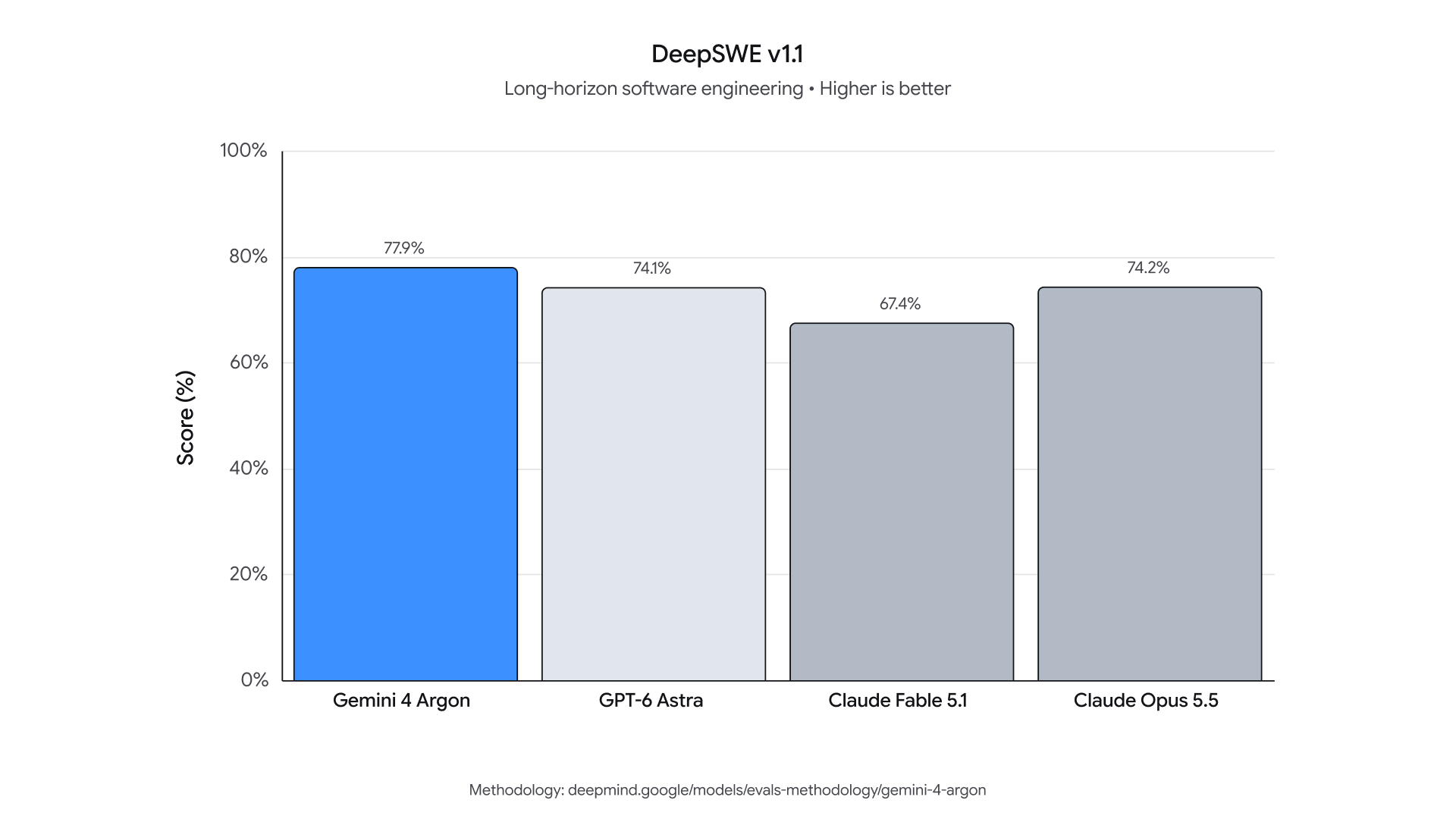
The impressive performance of Gemini 4 Argon on the DeepSWE v1.1 software engineering benchmark.
Real-World Benchmark Results: Technical Leadership Amid Fierce Competition
According to officially published data, Gemini 4 Argon establishes new peaks across multiple specialized leaderboards requiring multi-step reasoning:
- DeepSWE v1.1: Achieved 77.9%, becoming the world’s number one model for solving complex software engineering problems in real-world environments.
- Vals Index: Achieved 68.9% – an index measuring direct economic value across finance, programming, legal, and accounting fields (weighted according to their contribution proportions to the United States GDP).
- LVBench (Long Video Understanding): Sets a record 91.7%, confirming its absolute leading position in long-video analysis and multi-layer technical chart capabilities.
- AutomationBench: Zapier's benchmark for end-to-end automated business task execution ranks Argon at number one with 51.3%.
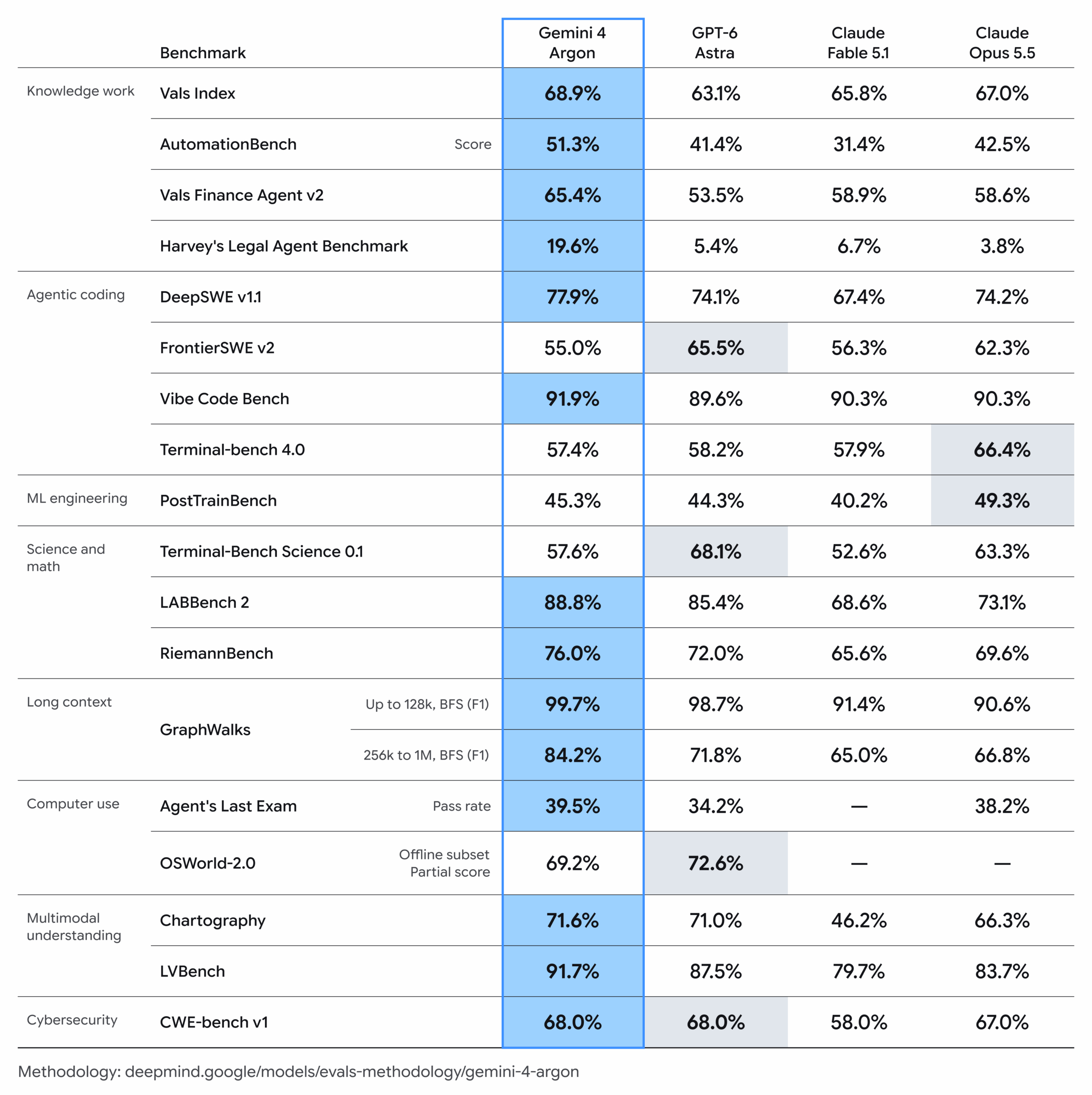
Detailed comparison table of Gemini 4 Argon's capability evaluation metrics.
However, to be fair, the frontier race has never been a one-horse competition. Despite outperforming in long-horizon tasks and advanced reasoning, Gemini 4 Argon still faces fierce competition and falls behind on some localized coding tests or computer-use interactions when compared with formidable rivals such as OpenAI's GPT-6 Astra and Anthropic's Claude Opus 5.5. This clearly reflects Google's design philosophy: prioritizing the resilience of action sequences and system integrity over fast, immediate responses.
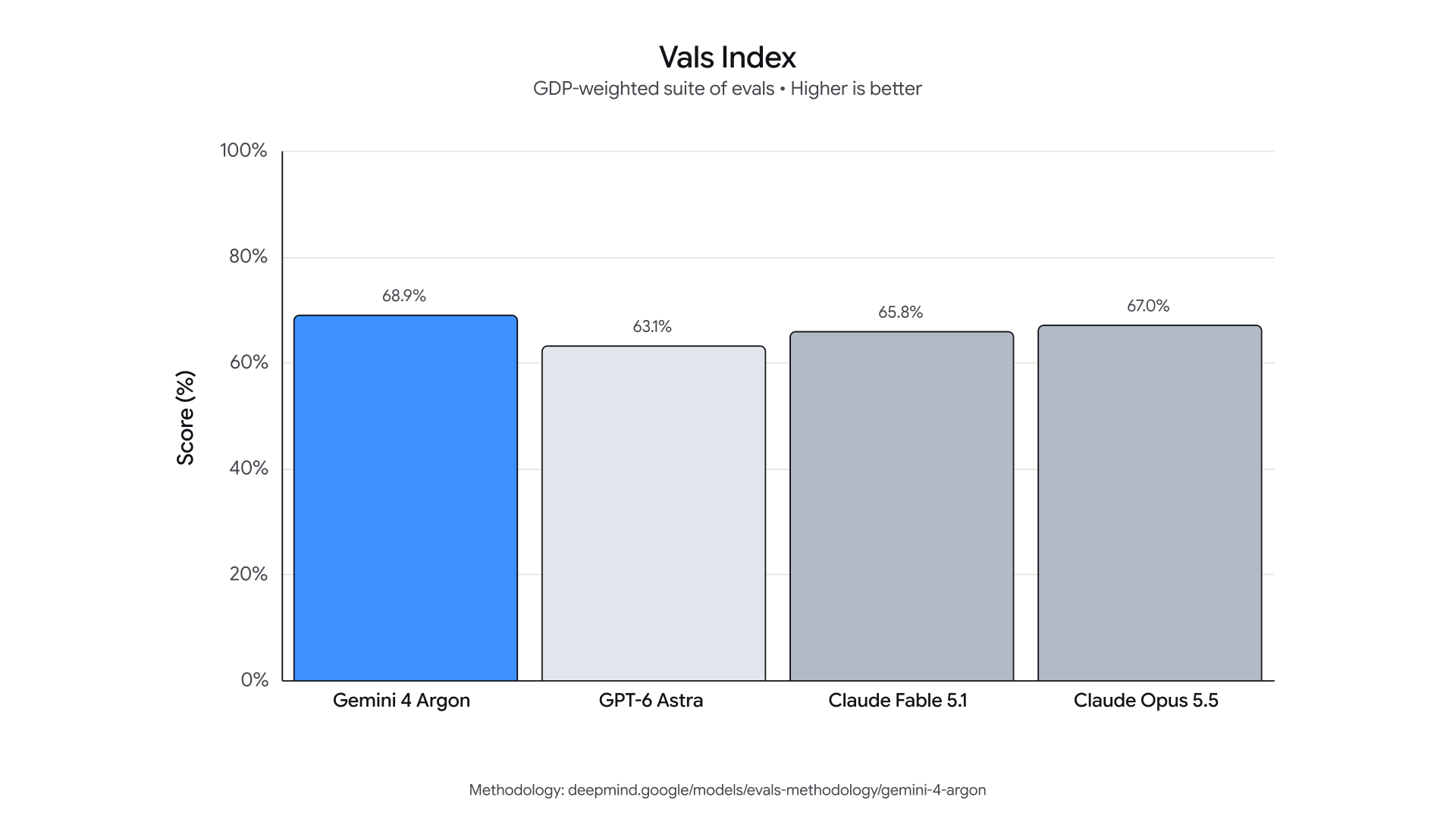
The Vals Index demonstrates Argon's strength in accounting, finance, and legal operations.
Advanced Cybersecurity Defense Capabilities
What is distinctive about this release is that Google has equipped Argon with a high degree of autonomy in scanning, auditing, and creating patches for software vulnerabilities. On the standard benchmark CWE-bench v1, Argon tied for first place with a score of 68%, a significant leap forward compared with its predecessor, 3.8 Flash Cyber.
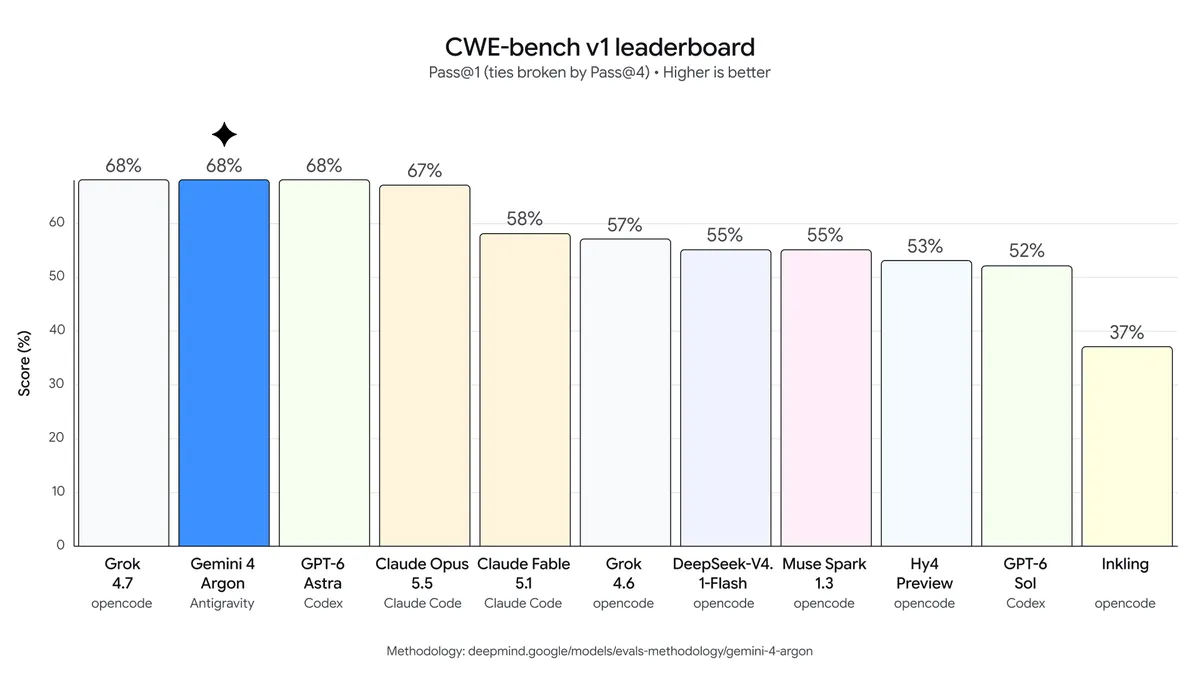
Argon demonstrates a significant advancement in software vulnerability detection and remediation tests.
Cybersecurity company Wiz tested Argon as part of its initiative Scan for Good – a free public infrastructure protection program. The model has demonstrated real-world value by discovering a critical vulnerability that leaked personal healthcare data across multiple international hospitals – a risk that previous frontier models all missed. For trusted partners, Google will provide an Argon version without cyber guardrail filters, allowing them to maximize its capabilities for advanced digital defense.
Introductory API Pricing and Heated Reactions from the Developer Community
The usage cost of Gemini 4 Argon is priced extremely attractively during the introductory period: $2 per 1 million input tokens and $10 per 1 million output tokensThe brightest highlight is the context caching feature, which is discounted by up to 95%, reducing the cost of rereading large documents to only $0.10/1M tokens. After the introductory period, the listed price will be adjusted to $4 input / $20 output.
As soon as the information was announced, technology forums and developer groups erupted in highly active discussions. One of the most widely discussed topics was when the model would be integrated into the Antigravity development environment:
💬 A perspective from the developer community:
- Programmer asks: “When will it be available on Antigravity? Does the new update support it yet?”
- Shared feedback: “Soon enough, as long as you have a Google AI Ultra plan or API quota, you're good to go. For now, it has only been opened to a small group of experts through Fairwind, but it will certainly be made publicly available more broadly soon.”
- Real-world assessment: “Many people have tried Claude Opus 5.5 and found it a bit sluggish on large repositories, while the newer generations of Gemini handle context more smoothly and clean up the codebase much more effectively.”
How Can Businesses Apply Gemini 4 Argon?
For small and medium-sized enterprises (SMEs), the emergence of models with long-term reasoning capabilities opens up unprecedented opportunities to optimize operations:
- Building specialized automation Agents: Instead of only using AI for simple chatbot responses, businesses can combine Argon with automation platforms such as n8n to analyze economic contracts hundreds of pages long, automatically reconcile tax documents, or generate consolidated financial reports.
- Modernizing legacy software systems (Legacy Code): Reduce security risks and infrastructure costs by allowing agents to automatically scan vulnerabilities and assist developers in converting complex modules into microservices architectures or more optimized languages.
- Reducing API costs through Caching: Leverage the 95% discount of context caching to preload internal documentation and operational manuals into the model's memory, helping employees access information instantly at extremely low costs.
The AI race entering 2026 is no longer a playground of unrealistic promises. Deployment requires deep understanding of data architecture, optimized prompting methods, and the design of safe control workflows to transform model potential into real revenue and performance.
DPS.MEDIA JOINT STOCK COMPANY
📍 Address: 56 Nguyen Dinh Chieu, Tan Dinh Ward, Ho Chi Minh City
📞 Hotline / Zalo: 0961 545 445
✉ Email: marketing@dps.media
🌐 Website: https://dps.media
🏢 Tax code: 0318700500 | VCB: 1051160909
Ý kiến bạn đọc (9)
Đăng nhập để bình luận
Đăng nhập nhanh 1-chạm bằng Google để chia sẻ ý kiến của bạn về bài viết.
Bằng cách đăng nhập, bạn đồng ý với điều khoản và chính sách cộng đồng.
Chưa có bình luận nào. Hãy là người đầu tiên chia sẻ cảm nghĩ!
Đăng nhập / Tạo tài khoản
Đăng nhập với Google để gửi bình luận và tương tác cùng cộng đồng.
Tiếp tục là đồng ý với điều khoản sử dụng và chính sách bảo mật của DPS Media.