




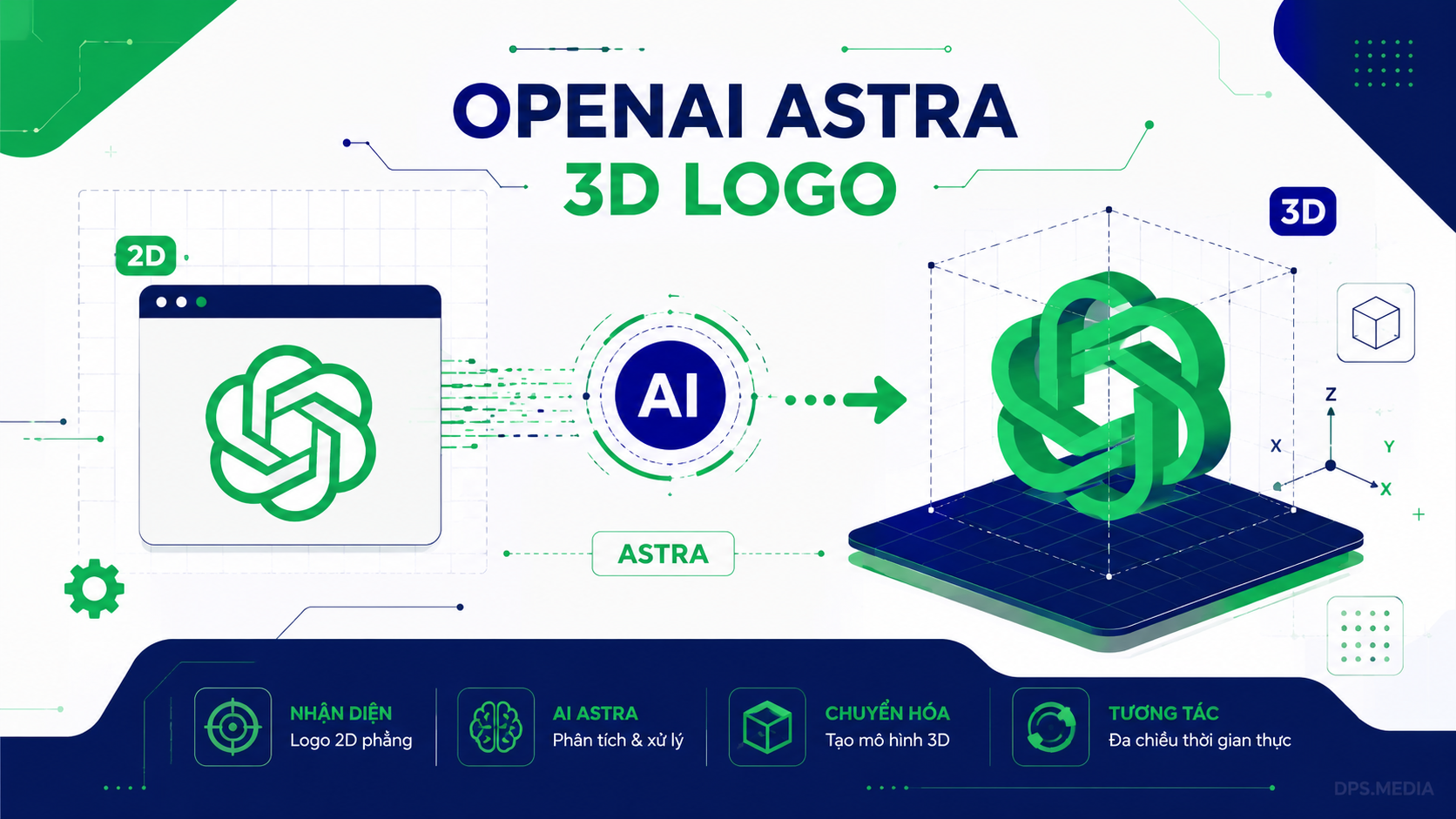

The event where OpenAI unveiled the next generation of its model, named OpenAI Astra (or GPT-6 Astra) in early September 2026 marked a pivotal shift in the artificial intelligence industry. Rather than stopping at the role of a conventional text-answering chatbot, Astra is positioned as a “Computer Operator” – a multimodal Agentic AI system capable of autonomously operating software, analyzing visual interfaces, and handling extended sequences of advanced technical tasks.
At DPS.MEDIA, we do not approach technology updates through dry theoretical reports. As soon as OpenAI opened access, the agency's engineering team decided to challenge Astra with a difficult yet highly practical task: Transform a flat 2D logo image file into a smoothly interactive 3D model on the web.
The result surprised the entire project team. In exactly 5 minutes, starting from an original image file, Astra analyzed the shapes, constructed spatial curves, wrote the complete Three.js source code, and packaged it as an independent Web Component. You can directly experience DPS.MEDIA's interactive 3D logo space right in your browser to verify the product's smoothness.
GPT-6 Astra: When AI Goes Beyond the Chat Window to Master 3D Space
According to OpenAI's official announcement of GPT-6 Astra, this model achieved record-breaking scores on professional capability benchmarks: 95.9% on BenchCAD (a computer-aided engineering graphics design benchmark), 99.9% on ARC-AGI-3, and 97.6% on the FrontierMath Tier 4 scale. It is also the first model to reach the “Critical” cybersecurity threshold under OpenAI's Preparedness Framework.
What makes it different when processing spatial geometry? With previous models, asking them to write 3D rendering code with Three.js often produced very clumsy results: faulty polygon meshes, inverted normals, or AI that could only draw monotonous cubes. In contrast, Astra's Spatial Computing capabilities allow it to “see” a 2D image as a structure with depth, automatically interpolate Bézier boundaries, and calculate bevels accurately down to the micrometer.
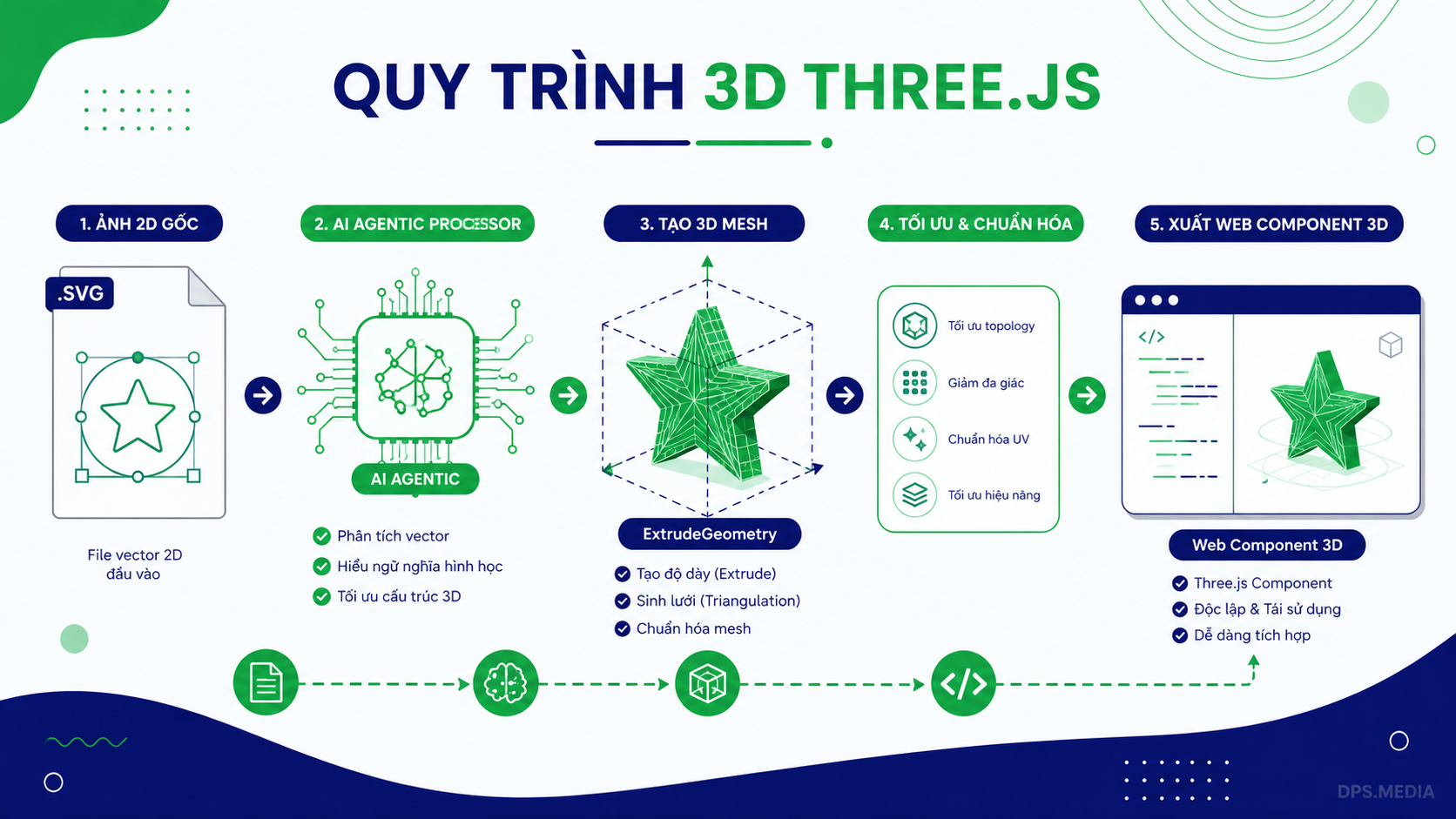
Real-World Test at DPS.MEDIA: 5 Minutes From a Static Image to a Complete 3D Logo
The implementation of the 3D Brand Experience project at the DPS.MEDIA office took place entirely automatically under the coordination of a systems engineer across 4 consecutive stages:
1. Extracting Bézier vector boundaries (Minute 0 – 1): Load the DPS.MEDIA brand identity symbol consisting of two primary color blocks: green #2DB561 and navy blue #292A6D. Astra analyzes the pixel matrix, identifies closed curves, and outputs precise Path2D coordinates, completely eliminating jagged image edges.
2. Extruding ExtrudeGeometry in Three.js (Minute 1 – 2): From the 2D vector, the AI automatically applies the algorithm THREE.ExtrudeGeometry. It sets the block depth (depth = 0.26), a 45-degree bevel on the border edges, and creates a natural contact shadow beneath the model base.
3. Setting Up the Material System and Interactive Controls (Minute 2 – 4): To let users freely personalize the experience, Astra directly builds an intuitive control panel comprising 3 groups of properties:
- Camera Presets: Seamlessly switch between Perspective, Front, and Artistic Angled views.
- Materials: Choose between smooth Satin with subtle reflectivity, modern brushed steel Metal, or elegant minimalist Matte.
- Motion Dynamics: Choose floating motion, continuous 360-degree rotation, a unique disassembled-piece effect, or a completely static mode.
4. Packaging as an Independent Standard Web Component (Minute 4 – 5): The key step for real-world deployment is that Astra does not stop at a standalone demo page. The model automatically packages all Three.js logic into a Custom Element named
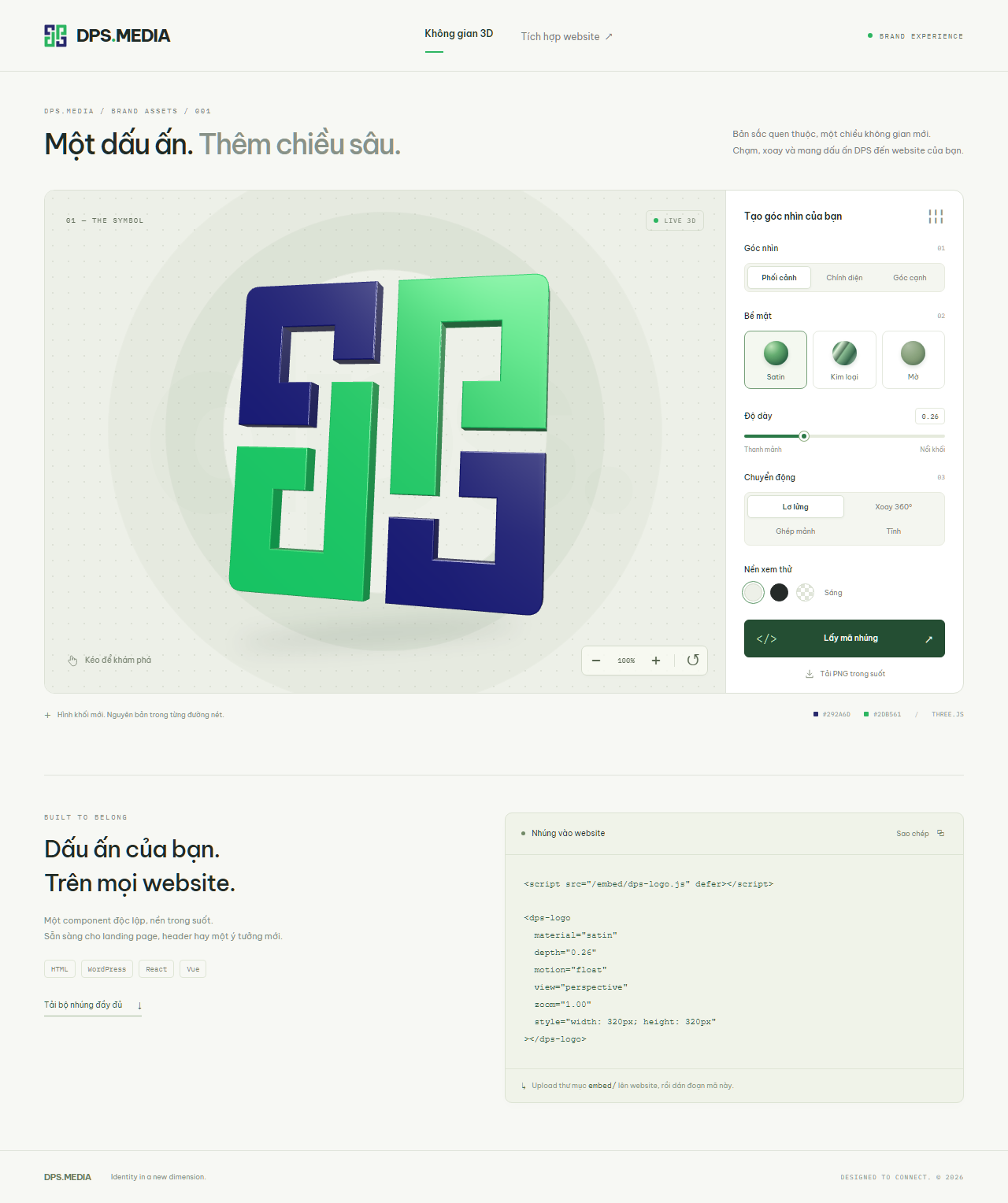
The interactive 3D logo customization studio at DPS.MEDIA, created and fully optimized by OpenAI Astra in 5 minutes.
Process Comparison: Traditional 3D Modeling Versus the Power of OpenAI Astra
To clearly see the resource savings of this solution, compare the traditional 3D modeling process with the new AI-powered approach:
| Comparison Criteria | Traditional 3D Process | Solution with OpenAI Astra |
|---|---|---|
| Production Time | 2 – 3 working days (with back-and-forth between the Designer, 3D Artist, and Web Developer) | Only 5 – 10 minutes automatically |
| Personnel & Tools | Requires Blender/Maya modeling specialists and a high-performance GPU workstation | Only 1 engineer is needed to steer prompts on a cloud platform |
| Web File Size | glTF / GLB model files weighing 4MB – 15MB, slowing page load speed | Ultra-lightweight pure Three.js code (< 80KB), loads instantly |
| Dynamic Customization | Difficult to change parameters directly on the web; textures must be baked again from scratch | Change colors, depth, and materials instantly through HTML tag attributes |
Embedding a 3D Logo Into a Website: One Line of Code, a Breakthrough in Brand Identity
What makes this experiment particularly valuable for businesses is its immediate applicability. Instead of installing bulky libraries, you only need to download the source-code folder and embed an extremely short snippet of code into any website:
The code above runs smoothly on all content management platforms, from WordPress and standalone Landing Pages to modern frameworks such as React and Vue. Thanks to the transparent canvas background, the 3D icon blends naturally into the website interface without disrupting the layout.
For the user experience, an interactively rotatable brand logo can significantly increase time spent on the page (Time on Site / Dwell Time) – one of the positive signals that search algorithms value when ranking websites. In addition, the studio integrates high-resolution transparent-background PNG rendering at any rotation angle, helping communication teams export design assets quickly with just one click.
Bringing AI Automation Into Practical Operations with DPS.MEDIA
The successful experiment with OpenAI Astra is clear evidence that the boundary between creative ideas and technology products is being shortened more than ever. However, no matter how powerful an AI tool may be, it still requires systems design thinking, the ability to standardize input data, and experience in optimizing real-world user experiences.
At DPS.MEDIA, we not only research advanced AI models but also apply them directly to every business solution: from SEO-optimized web design and AI automation services, building multichannel content ecosystems to optimizing marketing processes with n8n workflows.
If you want to make your business's brand identity more dynamic, modern, and ready to lead the digital era, contact our team of experts today for advice on the most suitable practical implementation roadmap.
CONTACT INFORMATION FOR AI & MARKETING SOLUTION CONSULTATION AT DPS.MEDIA
Hotline / Zalo: 0961545445
Address: 56 Nguyen Dinh Chieu, Tan Dinh Ward, District 1, Ho Chi Minh City
Official website: https://dps.media
Experience the 3D studio: https://dps.media/dpsmedia-3d-by-astra/
Ý kiến bạn đọc (9)
Đăng nhập để bình luận
Đăng nhập nhanh 1-chạm bằng Google để chia sẻ ý kiến của bạn về bài viết.
Bằng cách đăng nhập, bạn đồng ý với điều khoản và chính sách cộng đồng.
Chưa có bình luận nào. Hãy là người đầu tiên chia sẻ cảm nghĩ!
Đăng nhập / Tạo tài khoản
Đăng nhập với Google để gửi bình luận và tương tác cùng cộng đồng.
Tiếp tục là đồng ý với điều khoản sử dụng và chính sách bảo mật của DPS Media.