





Artificial intelligence (AI) is evolving at a pace that is disrupting every traditional rule. Every few months, a new AI model emerges, blurring the line between a seasoned professional and a beginner who knows how to write prompts. Facing this wave of technology, the biggest question that weighs on my mind every morning as I walk into the office is: Digital agencies in the AI era where are they headed if they continue clinging to their former glory?
I first became interested in and discovered the world of marketing back in 2007. After more than a decade of observing the market and gaining hands-on experience, I officially embarked on the journey of building and running an agency in 2020. Having gone through two agencies over the challenging and turbulent past six years, I feel the pressure of this AI wave more clearly and intensely than ever before. I am writing this article not as an expert preaching theory, but as a hands-on industry practitioner – sharing my reflections with colleagues across the industry and with the entire team at the comprehensive digital marketing service ecosystem at DPS.MEDIA so that we can all understand why the company is determined to transform itself every single day.
Memories of 2007–2010: The Golden Age of Lucrative Digital Services
Looking back at 2007–2010, when I was just beginning to explore marketing and step into the digital world, the digital services market was truly a gold mine, offering profit margins that today's generation of founders and young marketers would find hard to imagine:
- A Flash animated banner: A designer could spend a day working on a design and easily earn several hundred USD.
- A campaign microsite: A visually stunning experience with an emotional storyline, completed in 10 days, could cost upwards of USD 10,000 (15 years ago, this was a fortune).
- A fanpage content post: A manually written post of around 500 words published on a brand's page could command a fee of USD 20 per article.
- Facebook and Google Ads campaigns: Agencies simply multiplied the original click cost by three or four to cover operating expenses, and major clients were still willing to approve annual contracts.
Back then, the formula for agency success was relatively simple: deep expertise, an extensive partner network, and flexible service capabilities were all it took to attract more projects than the team could handle. The workforce was young, personnel costs were reasonable, and everyone was willing to work day and night to complete projects.
The Current Earthquake: Costs Have Doubled While Service Prices Have Been Cut in Half
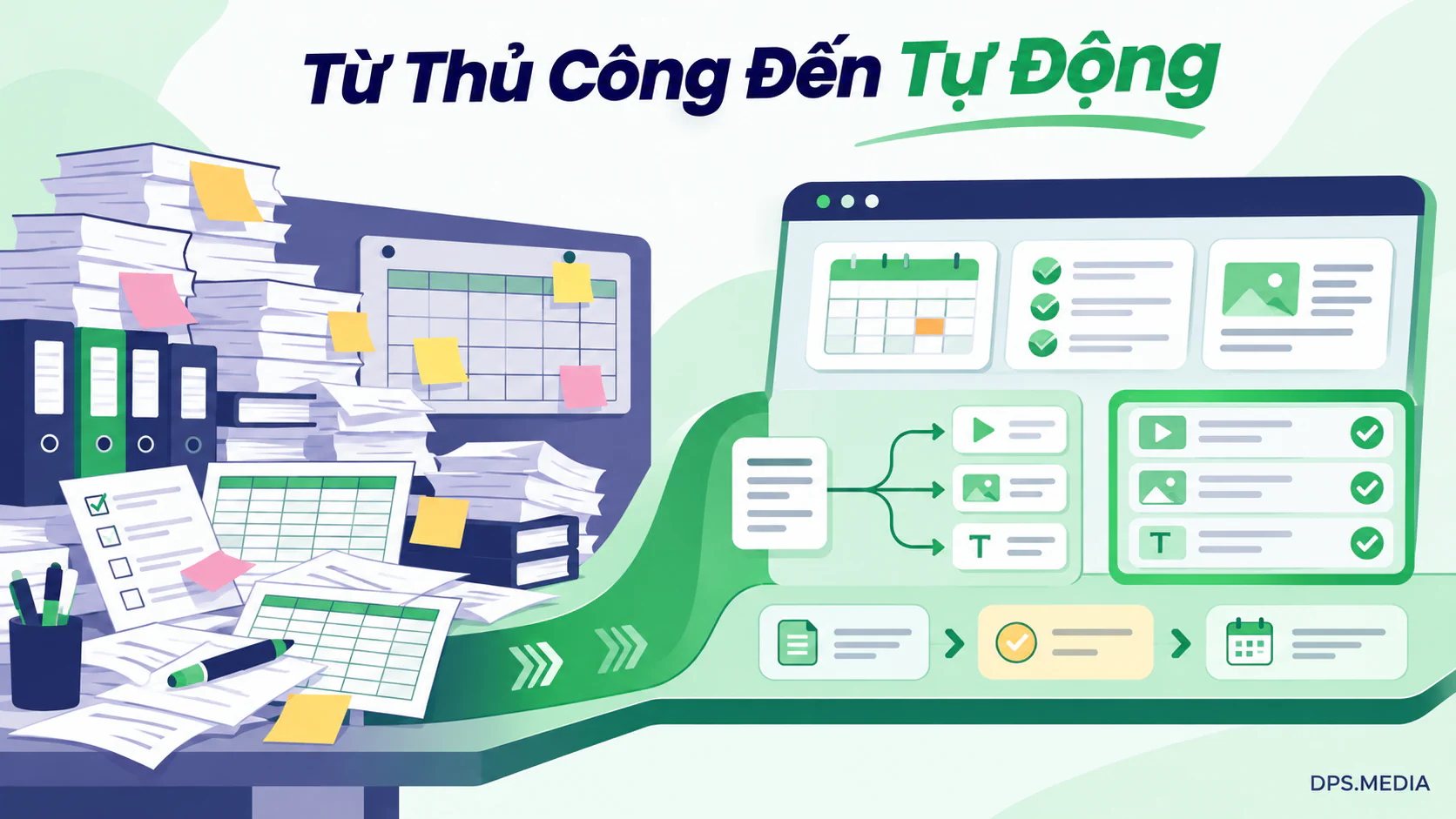
Now, let's return to today's reality. The AI wave has swept through the industry like a storm, wiping out the safe zone of traditional agencies. Customers are becoming increasingly tech-savvy, while content and image generation tools are becoming widely accessible. As a result, customers increasingly expect the prices of all digital services to be cut in half.
Yet the harsh paradox is that while service prices have fallen by 50%, the entire cost of running a business has doubled. This includes office rent, salaries and bonuses, employee insurance and benefits, as well as increasingly stringent legal compliance requirements and tax policies. This “sandwich effect” of mounting pressure has pushed many companies into a situation where they work harder but see their net profits steadily shrink.
This is a pivotal moment for the entire industry. Technology is not the problem; our slowness to adapt is. Those who proactively embrace AI will discover an ocean of new opportunities to optimize costs and accelerate revenue growth. Conversely, those who remain complacent, conservative, and attached to outdated processes are unlikely to survive the next few rounds of model updates.
| Comparison Criteria | Traditional Agency | AI-Era Digital Agency (New Model) |
|---|---|---|
| Staff scale | Large workforce (50–100 people), with escalating operating costs | Ultra-lean teams (15–25 people), with 5x productivity per employee |
| Pricing Model | Selling man-hours and producing elaborate, long-term plans | Selling tangible results (Done-for-you / Performance) |
| Implementation speed | Several weeks to an entire month per campaign | Immediate daily execution and real-time responses |
| Core Competitive Advantage | Acting as an intermediary, running ads and taking a % markup | Owning proprietary platforms, automated toolchains, and exclusive AI Agents |
8 Practical Steps DPS.MEDIA Is Taking to Transform in the AI Era
Faced with the pressure to survive, we have chosen not to complain or cut employee benefits. Below are eight practical strategic directions that my team and I at DPS.MEDIA are urgently implementing every day to turn challenges into a springboard for growth:
1. An “AI-First” Culture: Treat AI as the First Collaborator for Getting Work Done
At DPS.MEDIA, we have established an unwritten rule: before manually doing any task, employees must first try using AI to handle it. Every employee in the company, from programmers and ad specialists to designers, is provided with an officially licensed Pro account funded by the company.
Initially, traditional departments such as Administration, Accounting, and Human Resources were somewhat hesitant and reluctant to change – a perfectly natural psychological response. However, after receiving direct guidance from management and consistent support throughout the first week, everyone began to see the magic. Tasks such as invoice reconciliation, candidate CV screening, and drafting procedural documents, which previously took an entire morning, can now be completed in just 15 minutes. Once employees understand that AI is not taking away their jobs but freeing them from tedious tasks, enthusiasm naturally takes off.
2. A “Zero-Headcount Growth” Mindset: Build Agents Instead of Rushing to Hire People
Revenue growth does not necessarily have to go hand in hand with aggressive recruitment. Whenever a new workload arises, the first question managers should ask is not: “How many more people do we need to hire?”, but rather: “Can this problem be packaged into an AI Agent or an automated n8n workflow to achieve an equivalent result?”.
Keeping the organization lean is the best way to protect the business against market fluctuations while safeguarding competitive incomes and long-term stability for core employees who remain committed to the company.
3. Put Employees on the Front Lines: Where People Create Unique Value
We must have the courage to face the truth: very soon, 80% of the work currently performed by people typing behind computer screens within four office walls will be handled more smoothly by AI. If managers continue allowing employees to remain comfortable at their desks, they are indirectly pushing their own people toward obsolescence within the next two to three years.
At DPS.MEDIA, we proactively guide and train our employees to move to the front lines: meeting customers directly, listening to their needs, providing strategic consulting, and helping solve real-world business challenges. Work on the streets, around dining tables, and in every corner of everyday life – where empathy, human emotions, trust-building, and the ability to generate real revenue are essential – represents the territory where humans remain irreplaceable by AI. Stepping outside their comfort zones is the only path for employees to elevate their personal value.
4. Restructure Around Performance: Results Are the Fairest Measure
The era of measuring work by the number of hours spent swiping in and out has come to an end. It does not matter how many hours you spend in the office. The only thing that defines your value is the final result of your work and the contribution it makes to customers and the company.
Applying AI and data to KPI monitoring and performance evaluation is not about creating pressure or scrutinizing employees. It is about creating an absolutely fair playing field. Those who genuinely work hard and deliver breakthrough value will receive the most deserving compensation, without being held back by subjective, one-size-fits-all evaluations.
5. Develop AI-First Services: Optimize Speed, Costs, and Continuity
Today's customers expect everything to be faster and cheaper, while maintaining consistent quality and more frequent publishing schedules. If an agency still takes three days to prepare a quotation, two days to write an article, and one week to approve images, as it did in the past, it will be eliminated before it even gets started.
Only by restructuring the entire service delivery process around an AI-First approach – from idea generation and scriptwriting to graphic design and video production – can we offer customers marketing solutions that cost more than 50% less while delivering results five times faster.
6. The “Done-For-You” Model: Customers Pay Only for Tangible Results
The days when agencies could charge consulting fees for elaborate slide decks containing hundreds of pages packed with industry jargon are over. Today's customers care about one fundamental question: “How many leads will this solution generate, how much will it reduce costs, and can its performance be measured transparently?”.
The agency of the future is one that dares to commit to results and provides end-to-end support through the Done-for-You model. Customers pay for actual business outcomes, and the agency only wins when its customers win.
7. Streamline and Specialize: Focus on Core Strengths
An agency that tries to do everything will be the first to be crushed when specialized AI models emerge. Customers do not need a company that does a little bit of everything at an average level; they are looking for the number-one expert in a specific niche.
The smartest strategy is to concentrate all resources on one or two of the company's core strengths (such as SEO conversion optimization, n8n workflow automation, or corporate channel management), then use AI to develop that expertise to a level competitors cannot copy or catch up with.
8. Own Your Platform / Product: Escape the Trap of Being Merely an Intermediary
Purely brokerage-based or intermediary business models will be among the first to be swept away by AI. If you only do things that anyone with a ChatGPT account can do, you have no competitive moat whatsoever.
Every service company seeking sustainable growth must own at least one proprietary tool, platform, or technology product. This is the economic moat that protects the business and enables its competitive capabilities to continuously improve without being limited by the number of employees.
The Future Landscape: Where Are Lean, AI-Powered Agencies Headed?
The future of the digital marketing services industry will no longer belong to cumbersome “labor factories” employing hundreds of people. Instead, we will witness the dominance of elite teams comprising 15–20 experts working alongside dozens of specialized AI Agents. Together, they will manage project workloads and generate revenue equivalent to that of a 100-person company in the past.
The AI tsunami is not here to eliminate the service industry. It is here to filter out inefficient operating models and dependent mindsets. For business owners like us, this is a constant reminder to keep learning and restructuring. For young professionals, it is a golden opportunity to break free from tedious administrative work and rise to become strategic problem-solving experts.
Frequently Asked Questions About the Future of Digital Agencies in the AI Era (FAQ)
Can traditional agencies really be completely replaced by AI?
AI will not replace agencies, but agencies that master AI will replace those that continue relying on outdated manual workflows. Customers will always need human empathy, strategic thinking, and accountability.
What Skills Do Agency Office Staff Need to Avoid Being Replaced by AI?
Employees need to shift from a mindset of “mechanical execution” to one of “mastering tools and connecting with people.” The two most important skills are: (1) The ability to orchestrate AI Agents to accelerate work; and (2) Communication, negotiation, and real-world customer understanding skills.
How Can SMEs Benefit from Partnering with an AI-First Agency?
Businesses will receive marketing solution packages costing 50% to 80% less than traditional models, with implementation timelines shortened from weeks to days. Most importantly, they will receive services driven by actual business results rather than superficial reports.
Company Information & Connect with DPS.MEDIA
Whether you are a business owner looking for lean digital marketing transformation solutions or an industry colleague interested in exchanging practical experiences of applying AI to business operations, the DPS.MEDIA team is always ready to connect and work alongside you.
DPS.MEDIA JOINT STOCK COMPANY
📍 Address: 56 Nguyen Dinh Chieu, Tan Dinh Ward, Ho Chi Minh City
📞 Hotline / Zalo: 0961 545 445
✉ Email: marketing@dps.media
🌐 Website: https://dps.media
🏢 Tax identification number: 0318700500 | Vietcombank (VCB): 1051160909

Ý kiến bạn đọc (9)
Đăng nhập để bình luận
Đăng nhập nhanh 1-chạm bằng Google để chia sẻ ý kiến của bạn về bài viết.
Bằng cách đăng nhập, bạn đồng ý với điều khoản và chính sách cộng đồng.
Chưa có bình luận nào. Hãy là người đầu tiên chia sẻ cảm nghĩ!
Đăng nhập / Tạo tài khoản
Đăng nhập với Google để gửi bình luận và tương tác cùng cộng đồng.
Tiếp tục là đồng ý với điều khoản sử dụng và chính sách bảo mật của DPS Media.