





Google DeepMind has officially opened public access to its AI content identification tool at synthid.com. Instead of being integrated only behind the scenes within Google Cloud Vertex AI services, users worldwide can now directly upload an image, audio clip, or video to check for digital watermarks generated by AI.
For businesses looking for AI application development solutions for enterprises to automate content production and media management, the arrival of SynthID Detector marks a turning point: from probabilistic guessing to verification through cryptographic signatures.
What is SynthID Detector and how does the technology work?
Before SynthID Detector was launched, most AI detection tools on the market operated through heuristic detection mechanisms. They scan text or image pixels for recurring patterns or unusual levels of smoothness. This approach has a major drawback: a very high false positive rate, frequently misidentifying human-created works.
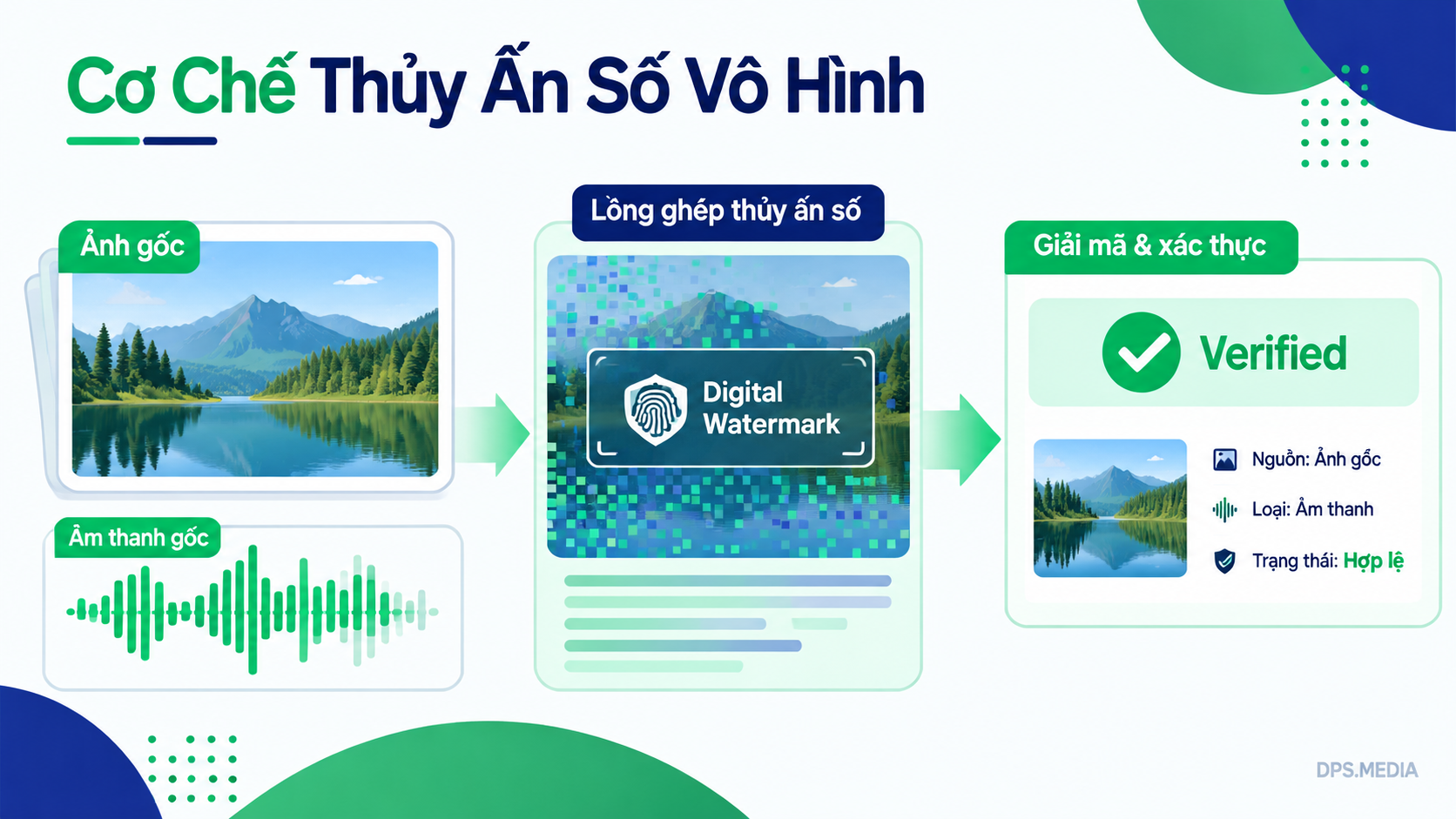
Google DeepMind's SynthID takes a completely different approach: Imperceptible Digital Watermarking. Instead of analyzing content after generation, the technology intervenes directly during the AI model's data generation stage:
- Image: Embedding subtle digital signals directly into the pixel data of the Imagen model that are invisible to the naked eye.
- Audio: Embedding digital signatures into the audio frequency spectrum (spectrogram) of the Lyria model without distorting the sound or degrading acoustic quality.
- Text: Adjusting the probability distribution of tokens as a large language model (LLM) generates sentences, creating hidden cryptographic patterns beneath the text.
- Video: Simultaneously embedding watermarks into each frame and the audio stream of the Veo video generation model.
SynthID's key strength is its resilience to common editing operations. According to Google DeepMind's technology documentation, even if an image is cropped, compressed, brightness-adjusted, or given basic color filters, SynthID's decoding algorithm can still detect the original trace.
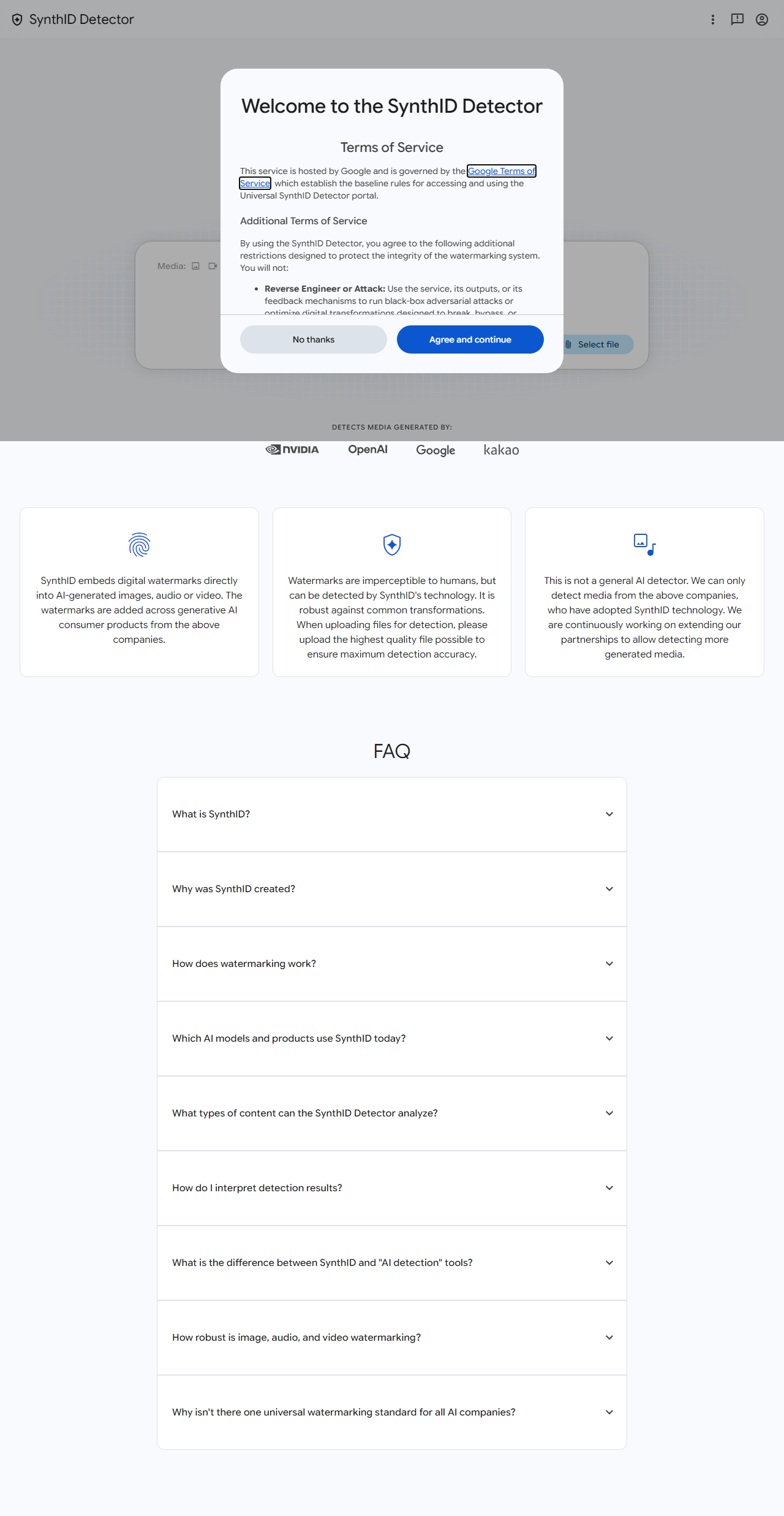
The visual inspection interface at synthid.com with a drag-and-drop feature for quickly checking multimedia files.
Real-world experience at synthid.com: Simple but tightly secured
The interface at synthid.com is designed with a minimalist approach. Users sign in with a Google, Apple, or OpenAI account, then drag and drop a file into the inspection area.
The system supports real-time checking of three formats: images (JPEG, PNG, WebP), audio (MP3, WAV), and video (MP4). The algorithm analyzes the signature within seconds and returns the confidence level of the digital watermark.
Google's privacy policy is clearly stated:
- Immediate file deletion: The original media file you upload is deleted from the server immediately after analysis is complete.
- Temporary signature storage: The system only stores the digital signature hash associated with the account for 24 hours to manage daily quota limits and automatically block spam.
- Protection against adversarial attacks: The terms of service prohibit using this portal to scrape data or conduct experiments designed to break the watermark structure.
Not an all-purpose tool: Practical limitations you need to know
Many people mistakenly believe that SynthID Detector can detect every AI-generated image on the internet. In reality, that is not the case. Google has publicly disclosed the limitations:
1. Only identifies models belonging to the collaborative alliance: SynthID cannot detect images from older versions of Midjourney or Stable Diffusion running offline without this standard enabled. Currently, the tool focuses on the ecosystems of Google, OpenAI, NVIDIA, Kakao, and soon Apple.
2. Accuracy decreases under heavy interference: Although it is highly resilient to image compression, sensitivity decreases if the file is captured again from another screen (screen recapture) or if audio is compressed at an extremely low bitrate.
3. Results are probabilistic and supplementary: Google recommends that SynthID results should not be treated as the sole legal evidence, but should be cross-checked against the publication context and accompanying C2PA metadata.
DPS.MEDIA's perspective: What should businesses prepare for the wave of AI authentication?
At DPS.MEDIA, when consulting on marketing strategy and automation for businesses in Vietnam, we see that the boom in AI-generated content brings both opportunities and brand risks.
In practice, for a fashion brand such as Hera Boutique, they previously hired freelance designers to create lookbooks and encountered image-detail errors due to careless AI use. After standardizing the workflow, the business did not ban AI but required transparent digital asset provenance to avoid the risk of violating Meta and TikTok advertising policies.
From a practical perspective, DPS.MEDIA recommends 3 core considerations for business owners:
- Proactively label content and maintain transparency: Platforms such as YouTube, Facebook, and TikTok are tightening rules on labeling AI-generated content. Using tools with standardized watermarks helps you proactively disclose AI use and protect your media channels from the risk of reduced reach.
- Do not rely entirely on uncontrolled AI: AI is an excellent lever for brainstorming ideas and producing preliminary materials. However, core brand identity assets and in-depth articles still require the expertise of specialists to preserve genuine emotion. You can learn more about SEO-standard article writing services to understand how to combine human expertise with technology.
- Build an internal review process: Businesses should develop a habit of cross-checking: checking metadata (C2PA standard), checking digital watermarks through portals such as SynthID, and thoroughly reviewing content before launching major campaigns.
Optimize safe and sustainable digital marketing effectiveness with DPS.MEDIA
Artificial intelligence is reshaping digital marketing. Successful businesses are not those that use AI the most, but those that know how to apply technology intelligently, responsibly, and safely for brand reputation.
DPS.MEDIA is proud to accompany businesses on their digitalization journey — from comprehensive SEO and professional Fanpage management to n8n automation solutions and AI integration that anticipates emerging trends. Every solution we implement is geared toward measurable results and sustainable safety.
DPS.MEDIA JOINT STOCK COMPANY
📍 Address: 56 Nguyen Dinh Chieu, Tan Dinh Ward, Ho Chi Minh City
📞 Hotline / Zalo: 0961 545 445
✉ Email: marketing@dps.media
🌐 Website: https://dps.media
🏢 Tax identification number: 0318700500 | VCB: 1051160909
Ý kiến bạn đọc (9)
Đăng nhập để bình luận
Đăng nhập nhanh 1-chạm bằng Google để chia sẻ ý kiến của bạn về bài viết.
Bằng cách đăng nhập, bạn đồng ý với điều khoản và chính sách cộng đồng.
Chưa có bình luận nào. Hãy là người đầu tiên chia sẻ cảm nghĩ!
Đăng nhập / Tạo tài khoản
Đăng nhập với Google để gửi bình luận và tương tác cùng cộng đồng.
Tiếp tục là đồng ý với điều khoản sử dụng và chính sách bảo mật của DPS Media.