



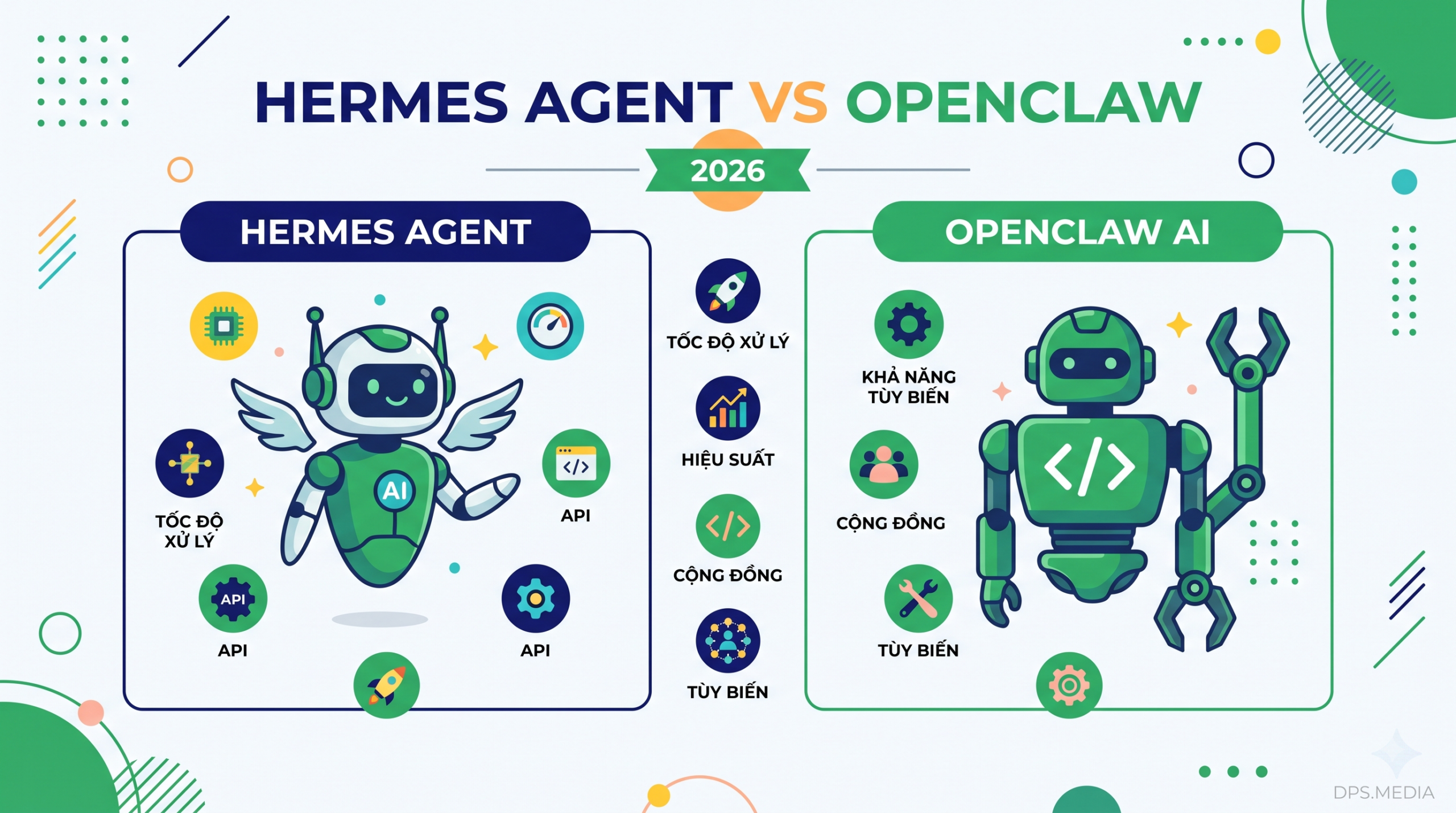

Amid the wave of enterprise automation in 2026, self-hosted AI Agents are rapidly moving from the laboratory into real-world environments. No longer limited to simple question-and-answer chatbots, these systems can now learn on their own, connect to multi-channel APIs, and execute complex chains of tasks without manual intervention. When searching for the optimal solution for businesses, the two most prominent names always put head-to-head are Hermes Agent vs OpenClaw. Both follow an open-source model, allowing self-hosting on basic-configured VPSs to maximize cost efficiency. However, their design philosophies and directions are completely different.
Overview of Hermes Agent and OpenClaw
What is Hermes Agent?
Developed by Nous Research – the team behind the renowned Hermes family of large language models – Hermes Agent was first launched in February 2026 and quickly became a technological phenomenon. As of August 2026, the project has reached v0.20.0 (The Herald Release), introducing a series of revolutionary improvements: real-time conversational voice integration, direct TTS streaming, and on-device wake words.
The core philosophy of Hermes Agent is continuous self-improving learning. Its distinctive feature is that after each work session, the agent evaluates its performance, distills thinking patterns into skills written in Markdown format, and stores them in long-term memory for reuse in subsequent tasks. In addition, version v0.17.0 (“The Reach Release”) expanded direct connectivity to iMessage, WhatsApp, and Telegram, alongside support for package distribution through PyPI starting with v0.14.0. Businesses can learn more from the official Hermes Agent source code on GitHub to better understand this architecture.
In addition, Nous Research is developing a companion repository called hermes-agent-self-evolution. This project leverages the DSPy library and the GEPA (Genetic-Pareto Prompt Evolution) algorithm to continuously optimize the agent's prompts and code through a feedback-driven evolutionary search mechanism. As a result, the agent's performance improves significantly after each real-world operating cycle.
What is OpenClaw?
Unlike its counterpart, OpenClaw (formerly known as Warelay and later Moltbot) was launched in late 2025 by the OpenClaw Foundation, positioning itself as a multi-channel AI operating system (Gateway-first). OpenClaw focuses on solving orchestration challenges and connecting to an ecosystem of more than 50 popular chat channels through the ClawHub plugin library.
During April and May 2026, the project received significant community feedback regarding code bloat and instability. The development team quickly introduced a restructuring strategy: simplifying the runtime core and moving all non-essential integrations into independent plugins. Version v2026.6.11, released on June 30, 2026, was the solution to this problem, improving connection stability and fixing model configuration issues. By August 2026, OpenClaw further strengthened its position by launching native app versions for Android and iOS and optimizing performance on Windows. You can learn more at the OpenClaw repository.
Detailed Comparison of Hermes Agent vs OpenClaw
For a more visual perspective, let us compare the two platforms based on the following practical operational criteria:
| Comparison Criteria | Hermes Agent (Nous Research) | OpenClaw (OpenClaw Foundation) |
|---|---|---|
| Core focus | Self-learning, deep personalization, and self-evolution. | Multi-channel connectivity (Gateway) and agent team orchestration. |
| Multi-channel connectivity | Rapidly expanding since v0.17.0 (Telegram, WhatsApp, iMessage). | The connectivity king with 50+ messaging applications and CRM systems. |
| Autonomy | Very high. Self-analyzes, self-corrects, and writes new skills on its own. | Good, but operates according to predefined rules and workflow diagrams. |
| Memory | Multi-layer memory (FTS5 + LLM summary) that stores user habits. | Traditional database storage, with shared memory for the entire team. |
| Deployment & Operations | Requires initial skill configuration and works well with local LLMs through Ollama. | Easier to set up thanks to an intuitive configuration interface and many ready-made plugins. |
From the comparison table above, the fundamental difference is easy to see. Hermes Agent focuses on the depth of artificial intelligence – where a single agent can learn on its own to handle increasingly complex tasks. Meanwhile, OpenClaw is optimized for breadth – connecting disparate systems and delegating work to subordinate agents.
Process Automation Solutions for SMEs
For small and medium-sized enterprises (SMEs) in Vietnam, installing and optimizing open-source AI Agent systems such as Hermes Agent or OpenClaw is far from simple. The biggest barriers lie in system programming skills, API cost optimization, and building workflows tightly integrated with popular platforms such as Zalo, Fanpage, or Google Sheets.
To solve this problem, many businesses have chosen to work with professional service providers. With hands-on implementation experience since 2017, DPS.MEDIA's AI automation and integration services have helped numerous SMEs successfully integrate AI systems into their real-world operations.
Real-World Case Study: Automation at Nha Ky Cosmetics (Nha Ky Cosmetics)
To give you a clearer picture, consider the story of Nha Ky Cosmetics. The store was overwhelmed with messages across all three channels – Zalo OA, Facebook Fanpage, and Telegram – from wholesale agents. Monthly revenue was strong, but the three-person customer service team was constantly exhausted from repeatedly answering questions about price lists, inventory, and shipment status.
After conducting an assessment, DPS.MEDIA built an extremely effective hybrid solution:
- Using OpenClaw as a multi-channel gateway to collect all messages from Facebook, Zalo, and Telegram into a centralized management system.
- Integrating a sub-agent powered by Hermes Agent and connected through the Gemini Flash model API to respond to customers. When faced with questions about the benefits of new products or complex skincare routines, Hermes Agent automatically researches the internal database. After each successful case, it automatically summarizes the response into a new skill and stores it in memory.
Actual results after 2 months of operation: Average response time decreased from 8 minutes to just 12 seconds. The automated order-closing rate for wholesale customers asking about prices reached 24.5%. More than 32 working hours per week were saved for chat support staff, allowing them to focus on consulting on more specialized, higher-margin skincare treatment cases. VPS operating costs were only about $15 per month, far cheaper than hiring an additional night-shift employee.
Should Businesses Choose Hermes Agent or OpenClaw?
The choice depends entirely on your business's current operational structure:
- Choose Hermes Agent if you need a market research assistant, personal programmer, or self-learning assistant to automate highly personalized tasks.
- Choose OpenClaw if your business has multiple customer communication channels and needs a robust framework for routing messages, connecting with a CRM, and distributing work among multiple chatbots.
If you are looking for a solution to optimize operations, reduce staffing costs, and enhance customer experience with AI Agents, contact DPS.MEDIA now via Hotline/Zalo 0961545445 or address: 56 Nguyen Dinh Chieu, Tan Dinh Ward, District 1, Ho Chi Minh City to receive consulting and a tailor-made solution designed specifically for your business. We are committed to accompanying you in delivering the most tangible results for your business!
Ý kiến bạn đọc (9)
Đăng nhập để bình luận
Đăng nhập nhanh 1-chạm bằng Google để chia sẻ ý kiến của bạn về bài viết.
Bằng cách đăng nhập, bạn đồng ý với điều khoản và chính sách cộng đồng.
Chưa có bình luận nào. Hãy là người đầu tiên chia sẻ cảm nghĩ!
Đăng nhập / Tạo tài khoản
Đăng nhập với Google để gửi bình luận và tương tác cùng cộng đồng.
Tiếp tục là đồng ý với điều khoản sử dụng và chính sách bảo mật của DPS Media.