







Gemini 3.6 Flash along with two specialized variants, 3.5 Flash-Lite and 3.5 Flash Cyber, has just been officially introduced by Google. This upgrade focuses on solving the two biggest challenges for developers: optimizing agent operating costs and increasing task processing speed without compromising output quality.
According to official announcement from the Google Blog, Flash 3.6 not only excels in programming benchmarks but also significantly reduces wasted tokens in multi-step workflows.
Gemini 3.6 Flash: Optimized costs and reduced token consumption
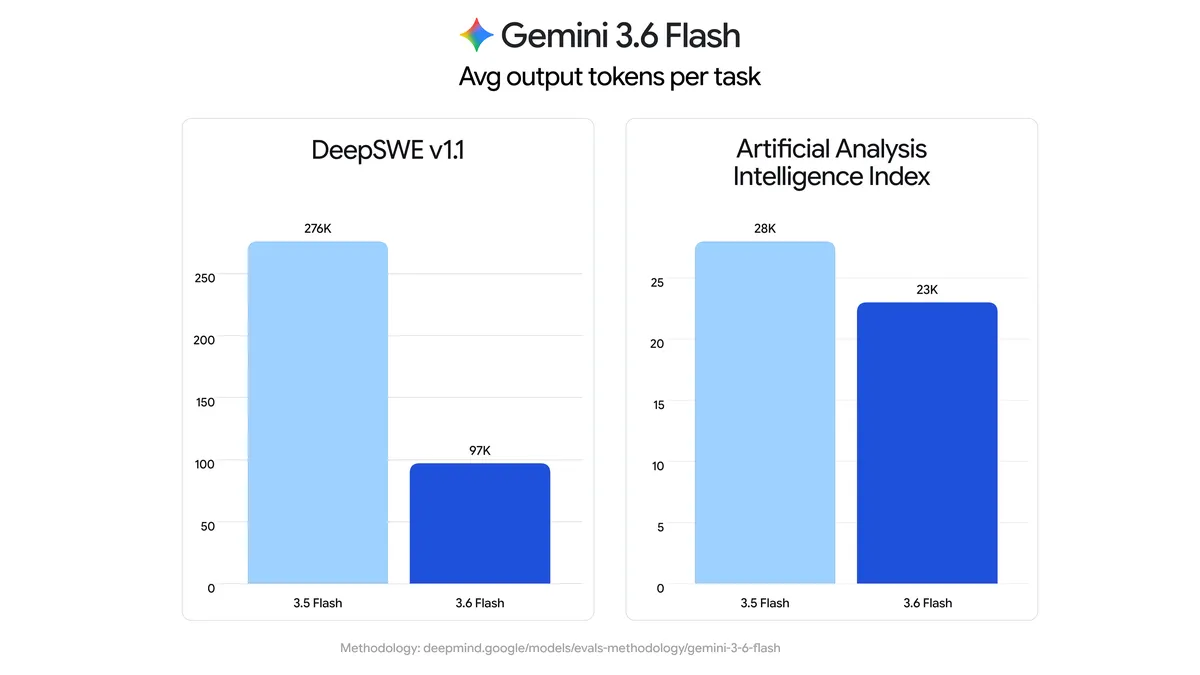
Anyone building AI Agents knows the headache of continuous reasoning loops causing API bills to skyrocket. Gemini 3.6 Flash was created to address this issue directly. According to statistics from the Artificial Analysis Index, 3.6 Flash consumes 17% fewer output tokens than its predecessor, 3.5 Flash.
Google has set highly competitive pricing: $1.50 per 1 million input tokens and $7.50 per 1 million output tokens. By reducing unnecessary reasoning steps and limiting unnecessary tool calls, the actual cost per agent task has dropped significantly.
Real-world performance across benchmarks
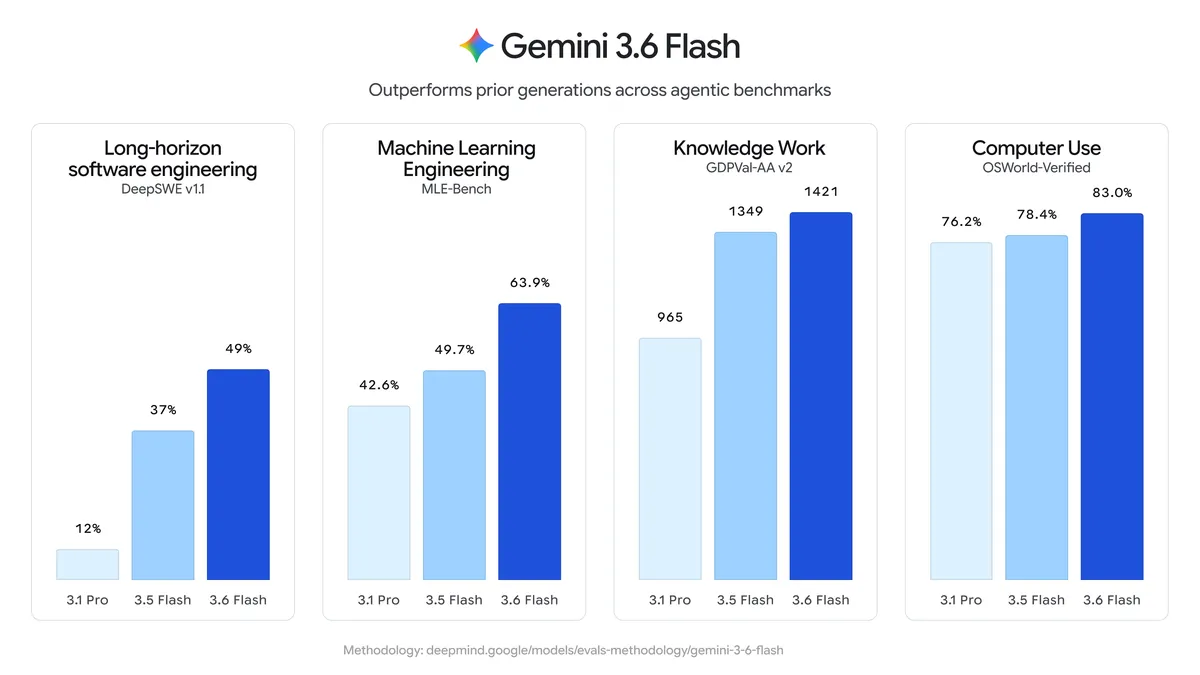
Despite being more cost-efficient, 3.6 Flash delivers clear improvements across many complex scenarios:
- Advanced programming: DeepSWE results reached 49% (compared to 37% for 3.5 Flash), reducing erroneous code edits and shortening execution loops. Machine learning research results on MLE Bench increased to 63.9%.
- Computer Use: The OSWorld-Verified score increased from 78.4% to 83.0%. This feature is now built in as a client-side tool in the Gemini API and Gemini Enterprise.
- Knowledge processing & multimodal capabilities: Achieved a score of 1421 on GDPval-AA v2. Enterprises such as Hebbia and Harvey reported that the model extracts tables, analyzes documents, and prepares financial reports with high accuracy.
Gemini 3.5 Flash-Lite: 350 tokens per second for high-load systems
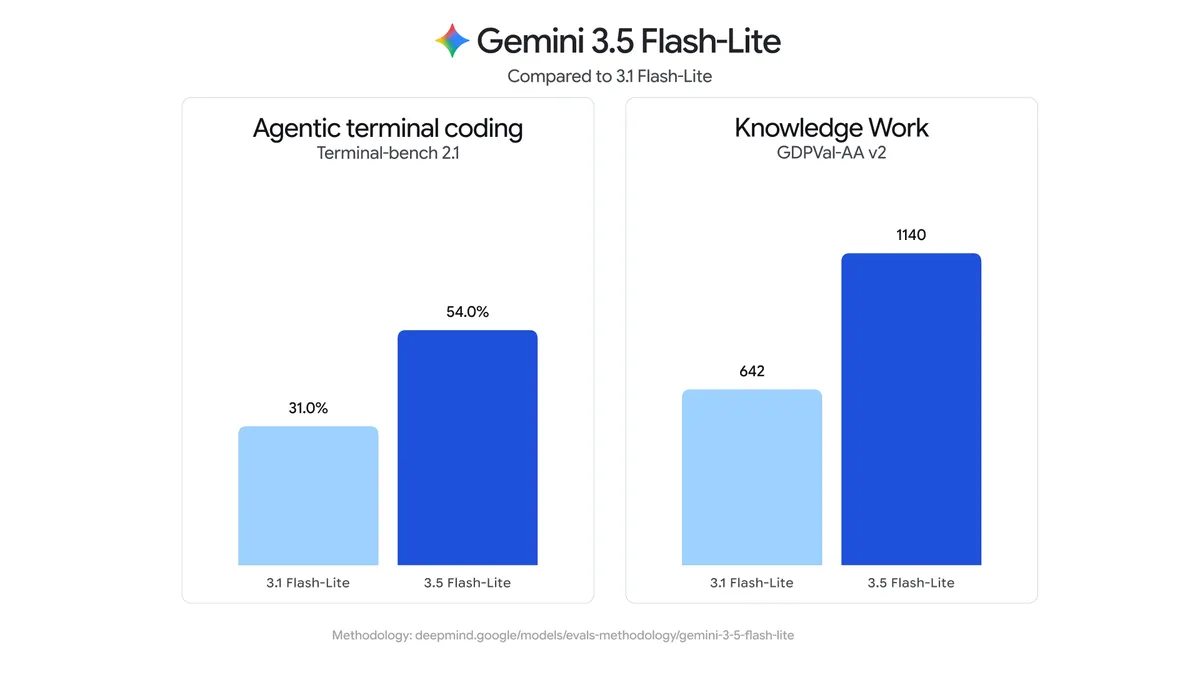
If you need an ultra-fast response model for powering agent search or processing millions of invoices every day, 3.5 Flash-Lite is the answer. With processing speeds of up to 350 output tokens per second, it is the fastest model in the 3.5 series.
Pricing for 3.5 Flash-Lite is $0.3 per 1M input tokens and $2.5 per 1M output tokens. Despite its low cost, this model still outperforms the older Gemini 3 Flash in SWE-Bench Pro tests (54.2% versus 49.6%) and Terminal-Bench 2.1 (54% versus 31%).
Gemini 3.5 Flash Cyber: A security vulnerability hunting assistant
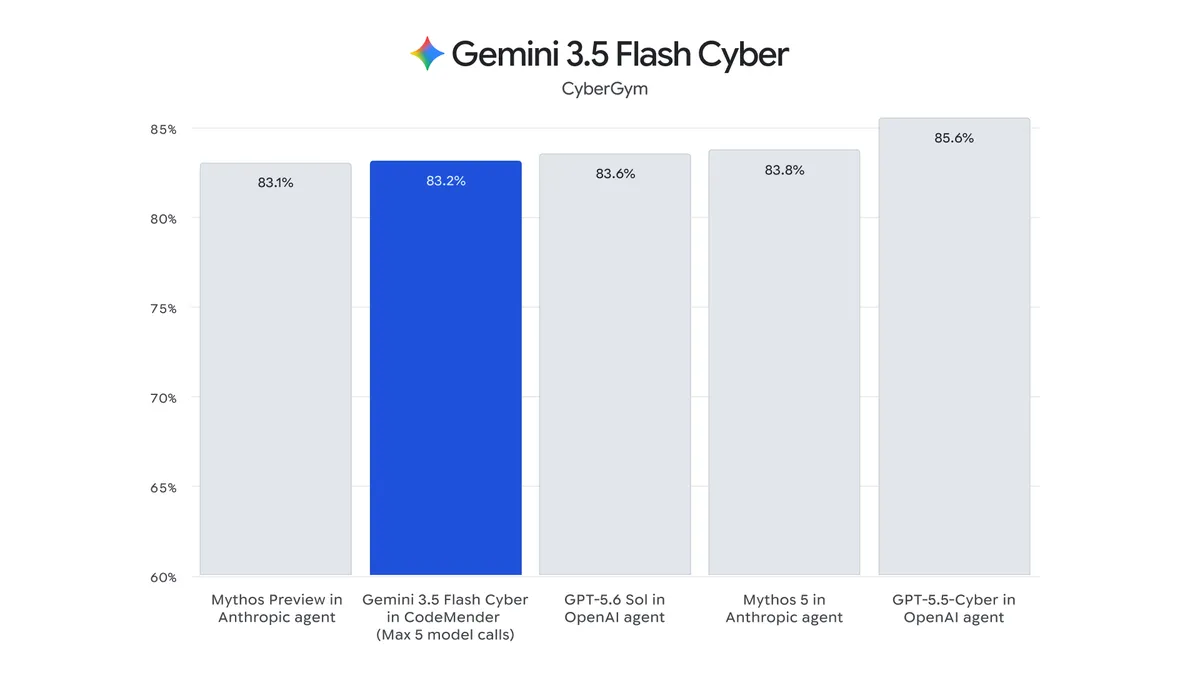
Alongside the two public releases, Google introduced Gemini 3.5 Flash Cyber, a model fine-tuned specifically for cybersecurity. When combined with the CodeMender security agent, the system can automatically detect, test, and patch software vulnerabilities before attackers can exploit them.
Due to the sensitive nature of cybersecurity technology, Google stated that 3.5 Flash Cyber is currently available only on a limited basis to government agencies and trusted partners through the CodeMender testing program.
Try and deploy the new AI models in real-world applications
Starting today, developers can try Gemini 3.6 Flash and 3.5 Flash-Lite on Google AI Studio, Android Studio, and the Google Antigravity platform. In addition, Google confirmed that it has begun pre-training for the Gemini 4 generation and will soon expand the 3.5 Pro release.
If your business wants to apply the latest AI models to automate processes or optimize customer growth campaigns, please refer to high-quality Digital Marketing services of DPS.MEDIA for guidance on the most suitable implementation roadmap.

Ý kiến bạn đọc (9)
Đăng nhập để bình luận
Đăng nhập nhanh 1-chạm bằng Google để chia sẻ ý kiến của bạn về bài viết.
Bằng cách đăng nhập, bạn đồng ý với điều khoản và chính sách cộng đồng.
If the article is accurate, 3.6 Flash is notable for both reducing tokens and raising benchmark scores. But for agents running many rounds, would a 17% reduction in tokens translate into equivalent real cost savings?
I wouldn't convert 1:1, though. Costs also depend on the number of model calls, tools, and context length. If the agent previously reasoned in a roundabout way, the actual savings could be quite significant.
For our internal agent, the most expensive part is usually repeated call loops and long context. Only if 3.6 Flash can reduce both of these costs will the difference be clearly visible on the invoice.
Flash-Lite reaching 350 tokens per second sounds well suited to high-load systems, but does that speed come at a cost to accuracy? For example, if a chatbot must handle thousands of conversations at once, should we prioritize Lite or the full Flash version?
I'll choose based on the task. For simple questions, classification, or real-time responses, Lite is a great fit; but for tasks that require multi-step reasoning, it's still better to let the more powerful Flash handle them.
Exactly, a speed of 350 tokens/second is mainly valuable for large workloads. If each request is complex, being faster alone doesn't necessarily make it more effective than a slower model that needs fewer reruns.
A 17% reduction in tokens may sound small, but across millions of requests this figure becomes significant, especially for agents running continuously.
The 3.5 Flash Cyber section is quite interesting. If it is used to help find vulnerabilities, the key point is still its ability to tell real bugs from false alarms; a high benchmark score doesn't tell the whole story.
Pricing of $1.50 for input and $7.50 for output still needs to be calculated based on actual workload. For a simple chatbot, a newer model is not necessarily needed, but for multi-step agents, it is worth benchmarking.
Chưa có bình luận nào. Hãy là người đầu tiên chia sẻ cảm nghĩ!
Đăng nhập / Tạo tài khoản
Đăng nhập với Google để gửi bình luận và tương tác cùng cộng đồng.
Tiếp tục là đồng ý với điều khoản sử dụng và chính sách bảo mật của DPS Media.