




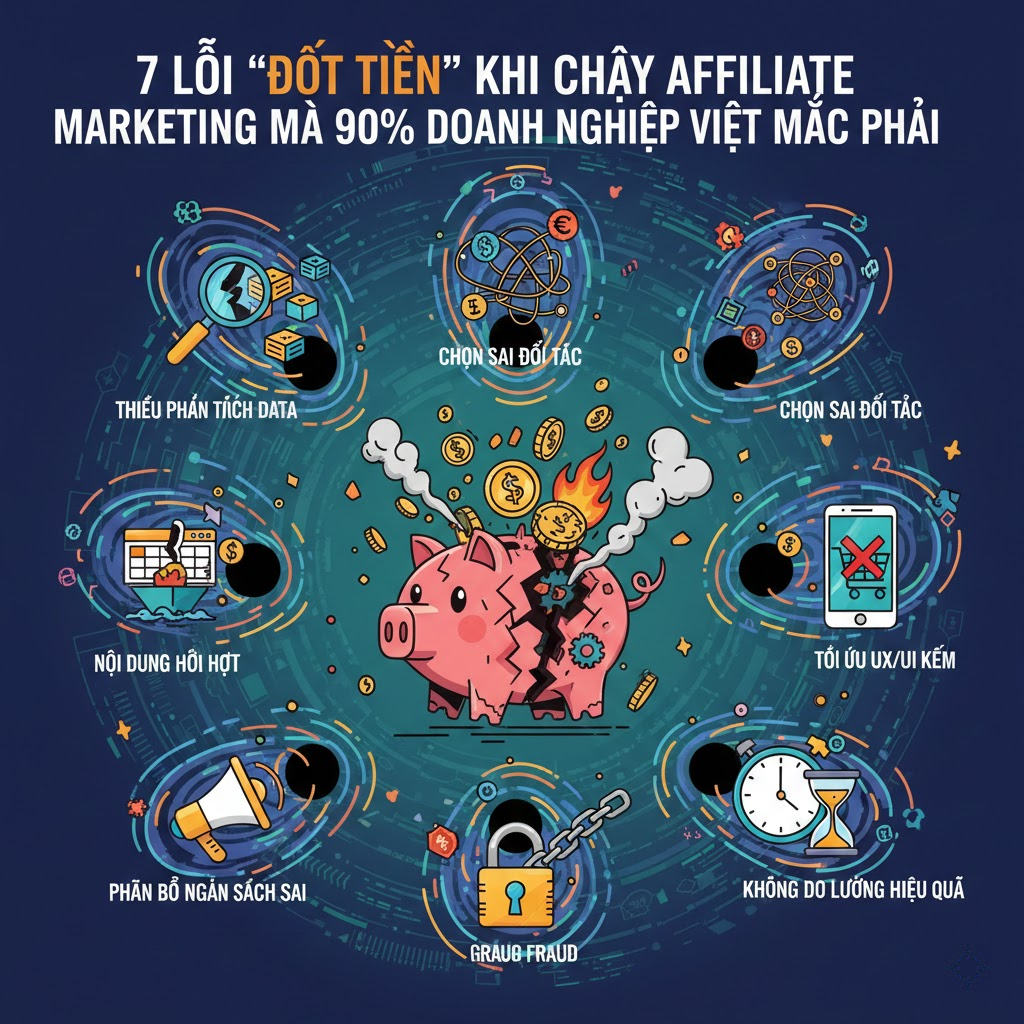

Affiliate Marketing (Affiliate Marketing) is being considered a “lifebuoy” for the sales of many small and medium enterprises (SMEs) in the context of increasingly expensive paid advertising. However, the harsh truth is that not everyone participating in this playground brings home a net profit.
Many business owners mistakenly believe that they only need to open a campaign Affiliate Marketing, set the commission level and wait for orders to pour in. This is a fatal misconception leading to the budget “evaporating” quickly without bringing real value.
According to 2024 statistics, up to 90% of Vietnamese businesses fail or suffer losses in the first 6 months of implementing this marketing channel. The main cause comes from a lack of foundational knowledge and the absence of a methodical risk management strategy.
Tại DPS.MEDIA, với kinh nghiệm thực chiến từ năm 2017 hỗ trợ hơn 5.400 khách hàng, chúng tôi đã chứng kiến hàng trăm kịch bản “đốt tiền” vô nghĩa. Các chuyên gia của chúng tôi nhận thấy các lỗi này lặp đi lặp lại một cách có hệ thống.
This article will expose the 7 most serious mistakes when implementing Affiliate Marketing. We will provide deep insights, realistic data, and specific solutions so that you do not follow in the “failed footsteps” of those who went before.
1. Affiliate Marketing commission strategy is inflexible and unattractive
The most common mistake when starting to do Affiliate Marketing is building a commission policy based on intuition. Many businesses either set the rate too low, making Publishers (promoters) uninterested, or set it too high, eroding the entire marginal profit.
A safe Affiliate Marketing success requires a delicate balance between the Publisher's interests and the business's (Advertiser) profit. If you just copy your competitor's commission rate without calculating based on your own cost structure, you are certain to fail.
Consequences of inaccurate commission pricing
When commission levels are not carefully calculated, the immediate consequence is that the business's cash flow will be seriously affected. Good Publishers will leave you for competitors with better policies. Conversely, commission rates that are too high will attract a large amount of junk traffic or fraud for profit-seeking.
Below is a comparison table of common commission models in Affiliate Marketing and the accompanying risks:
| Commission Model | Advantages | Disadvantages/Risks | Suitable Industries |
|---|---|---|---|
| CPS (Cost Per Sale) | Only pay when there is a successful order | Difficult to attract Publishers if conversion rate is low | E-commerce, Retail |
| CPL (Cost Per Lead) | Attract a large number of potential customers | Easy to get fake lead spam, low lead quality | Real Estate, Finance, Education |
| CPO (Cost Per Order) | Optimize by order | High risk of order cancellation if not controlled | Cosmetics, Functional Foods |
| CPI (Cost Per Install) | Rapid app user growth | Retention rate is usually low | Mobile App, Game |
Realistic example of pricing mistakes
Example 1: A fashion brand in Ho Chi Minh City (An old client who once asked DPS.MEDIA for re-consulting) initially set the commission rate Affiliate Marketing at 5% for all orders. This level was much lower than the industry average of 10-15%. The result was that after 3 months, only 5 Publishers registered and the revenue brought in was almost zero.
Example 2: A functional food company set a commission rate of up to 40% to compete. However, they forgot to calculate the Cost of Goods Sold (COGS) and operating costs. When the campaign Affiliate Marketing exploded, sales skyrocketed but net profit was heavily negative because the cost paid to Publishers was too large.
Signs of a failed commission strategy:
- The number of Publishers registering for the campaign is extremely low or not growing.
- Publishers register but are inactive, accounting for over 80%.
- Actual CPA (Cost Per Action) is higher than the allowed profit margin of the product.
- Publishers constantly complain or request an increase in revenue sharing.
- Competitors attract all the quality Publishers (Top Publishers).
- Order cancellation rate from the Affiliate Marketing source is unusually high due to Publishers forcing orders.
Expert Advice: Build a commission policy according to the Tier model (stepped). Offer extra rewards for Publishers who reach high revenue milestones to encourage them, while keeping the base commission at a safe level for cash flow.
2. Mass recruitment of Publishers, lack of a vetting process
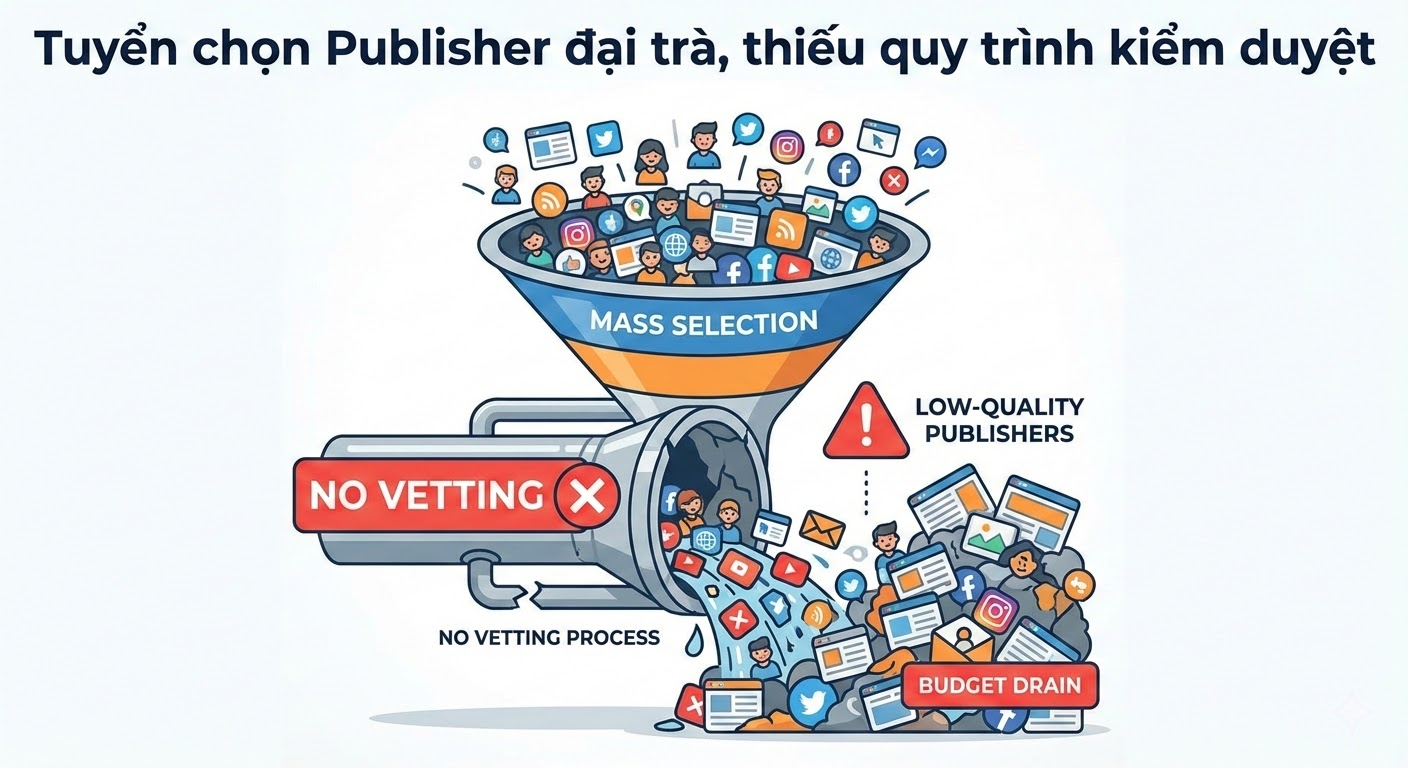
In Affiliate Marketing, the quality of Publishers is many times more important than the quantity. A classic mistake of 90% of Vietnamese businesses is the “the more the merrier” mentality. They automatically approve every participation request without reviewing the partner's traffic source.
This leads to an enormous risk regarding brand safety. Imagine your luxury product advertisement banner appearing on dark websites, gambling sites, or blogs with offensive content. This will kill brand reputation faster than any media crisis.
Loose Publisher filtering process
Many businesses do not require Publishers to provide information about promotion channels (Website, Fanpage, Group, Youtube Channel...). They only care about issuing tracking links and waiting. This is an unprofessional way of working and contains many risks of fraud.
A healthy Affiliate Marketing system needs diversity but must be selective. You need to clearly classify who is a Coupon Site, who is a Reviewer, and who are KOLs/Influencers. Each of these target groups needs a separate approach and management.
Consequences of “scraping the bottom of the barrel”
- The brand appears next to toxic content, legal violations, or content against fine traditions and customs.
- Increase in fake order rates due to Publishers using tools or cheats to get commissions.
- Channel Conflict (Cannibalization): Publishers run ads on brand keywords, competing directly with the In-house team.
- Difficulty in communication and support because the number of partners is too large but ineffective.
- Reporting data becomes noisy, making it difficult to analyze the actual effectiveness of the campaign. Affiliate Marketing.
- Loss of reputation with professional Publishers due to an unfair competitive environment.
Realistic example of wrong recruitment
Example 1: An organic cosmetic brand accepted a series of Publishers running Google Ads indiscriminately. These Publishers used titles like “Scam”, “Exposing” to bait views and then inserted the Affiliate Marketing. link. Customers were confused when searching for the brand name, leading to a 30% decrease in the overall conversion rate of the entire company.
Example 2: A tech startup recruited 1,000 collaborators but did not vet them. 900 of those people only registered to get discount codes for themselves (Self-referral) rather than promoting. The business lost commission money on orders that should have been natural (Organic).
Lessons learned: Set up a strict KYC (Know Your Customer/Partner) process. Require Publishers to describe their plan to run Affiliate Marketing before approval. Traffic quality is more valuable than the number of registered users.
3. Poor Tracking system and ignoring Fraud issues

Technology is the backbone of Affiliate Marketing. However, many businesses use poorly built in-house tracking platforms or free plugins that lack accuracy. This leads to “lost orders” (cookie lost) or incorrect source recording.
More dangerous is the issue of Fraud. The underground world of MMO (Make Money Online) has countless tricks to bypass weak tracking systems. If you don't have Fraud detection tools, you are throwing money out the window for fake traffic.
Common forms of fraud in Affiliate Marketing
According to DPS.MEDIA's experience, fraud in Affiliate Marketing is increasingly sophisticated. If businesses are not equipped with knowledge and tools, being “pickpocketed” is certain to happen. Below are common types of fraud:
| Type of Fraud | Mechanism of Action | Danger level | Prevention methods |
|---|---|---|---|
| Cookie Stuffing | Forcibly assign cookies to the user's browser even if they don't click the link | Very high (Appropriating organic commissions) | Use reputable tracking platforms, check time-stamps |
| Click Spamming | Create a series of fake clicks from bots or malware | High (Distorting conversion data) | Monitor unusual CR (Conversion Rate) |
| Brand Bidding | Running ads on banned brand keywords | Medium (Increasing the business's CPC) | Use keyword search monitoring tools |
| Fake Leads | Fill in fake information to receive CPL commissions | High (Wasting telesale resources) | OTP authentication, Call check, E-KYC |
Importance of the Attribution Model
Most businesses only use the Last-click model (recording for the last touchpoint). This is unfair to Publishers who play the role of Introducer or market educator. A modern Affiliate Marketing strategy needs a multi-touch attribution model.
Incorrect tracking not only loses money but also loses the trust of Publishers. When they put effort into running ads and generating orders but the system doesn't record them, they will immediately stop cooperating. This is a technical error but causes serious consequences for partnerships.
Realistic example of technical errors
Example 1: E-commerce website X used a cheap WordPress plugin for tracking. During a big sale, traffic spiked causing the server to crash, and the tracking system stopped working for 2 golden hours. Thousands of Affiliate Marketing orders were not recorded, causing a wave of boycotts from the Publisher community.
Example 2: Business Y was attacked by a competitor using bots to click continuously on affiliate links. Due to the lack of an IP blocking mechanism, the system still recorded the clicks. Although no commission money was lost (since there were no orders), the conversion index plummeted, causing the Platform's algorithms to undervalue the campaign.
DPS.MEDIA experts recommend: Invest in professional Affiliate Marketing platforms (Affiliate Network) or paid tracking software (SaaS) with Anti-Fraud features. Technology costs are always cheaper than the cost of being defrauded.
4. “Leaving children in the middle of the market”: Lack of support and resources for Publishers
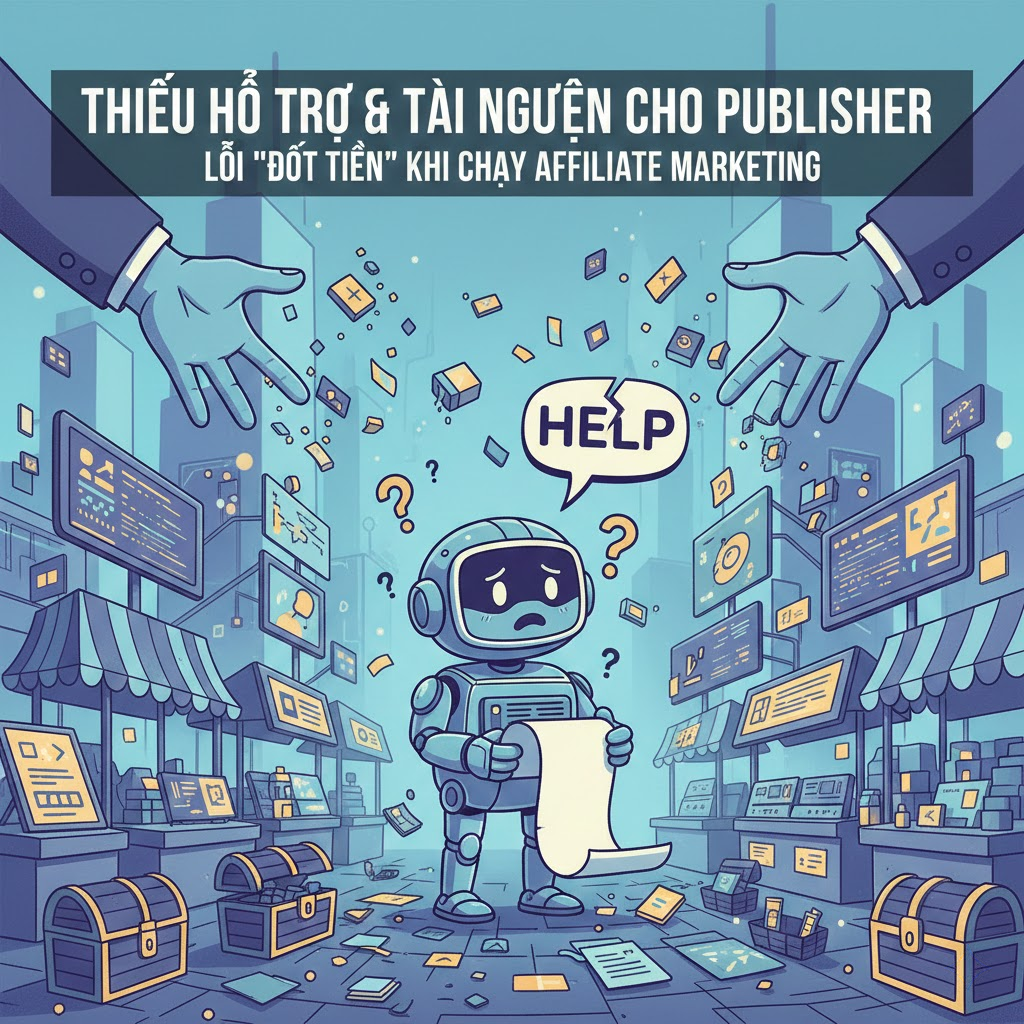
Many businesses consider Publishers as freelance workers who don't need care. They provide a bare link and hope that Publishers will create content themselves, design banners themselves, and think of ways to sell themselves. This is the mindset of an amateur.
In Affiliate Marketing, the Publisher is the extension arm of the sales department. If you don't equip them with “weapons” (marketing resources), how can they fight and bring victory (revenue) back to you?
List of mandatory resources
To optimize Publisher performance, businesses need to prepare a repository of resources (Media Kit). This helps ensure that the communication message is consistent and saves time for partners. Necessary resources include:
- Advertising Banners: Full range of IAB standard sizes (300×250, 728×90, 300×600…) with eye-catching designs.
- Content Samples: Sample articles, review articles, email templates, SEO-standard social media post samples.
- Product Feed: Detailed product data files, real-time inventory and price updates.
- Promotional Programs: Separate discount codes (Coupon codes) for each Publisher or campaign.
- Training Materials: Product usage instructions, USP (Unique Selling Point), target customer audience.
- Fast Support Channels: Zalo/Telegram groups or AM (Affiliate Manager) staff providing 24/7 support.
Consequences of lack of support
When resources are lacking, Publishers will create ugly banners themselves, write incorrect content about product features, or use old images that are no longer suitable. This reduces your brand value in the eyes of the end customer.
Furthermore, good Publishers (Top Publishers) are usually very busy. They will prioritize choosing campaigns that have Affiliate Marketing available resources (“Ready-to-eat”) to save effort. If your campaign is too poor in materials, you will be removed from their priority list.
Realistic example of Publisher support
Example 1: A travel company provided Publishers with a full set of high-quality 4K tour experience videos. Thanks to these materials, TikTokers easily edited and created hundreds of viral videos, helping tour sales increase by 200% during the summer without incurring new video production costs.
Example 2: A mother and baby brand regularly organizes webinars to train nursing mothers on nutritional knowledge to do Affiliate Marketing. Thanks to a deep understanding of the product, the mothers consult very enthusiastically and accurately, the closing rate reaching up to 15% – double the industry average.
5. Misaligned expectations and lack of patience with the Affiliate channel
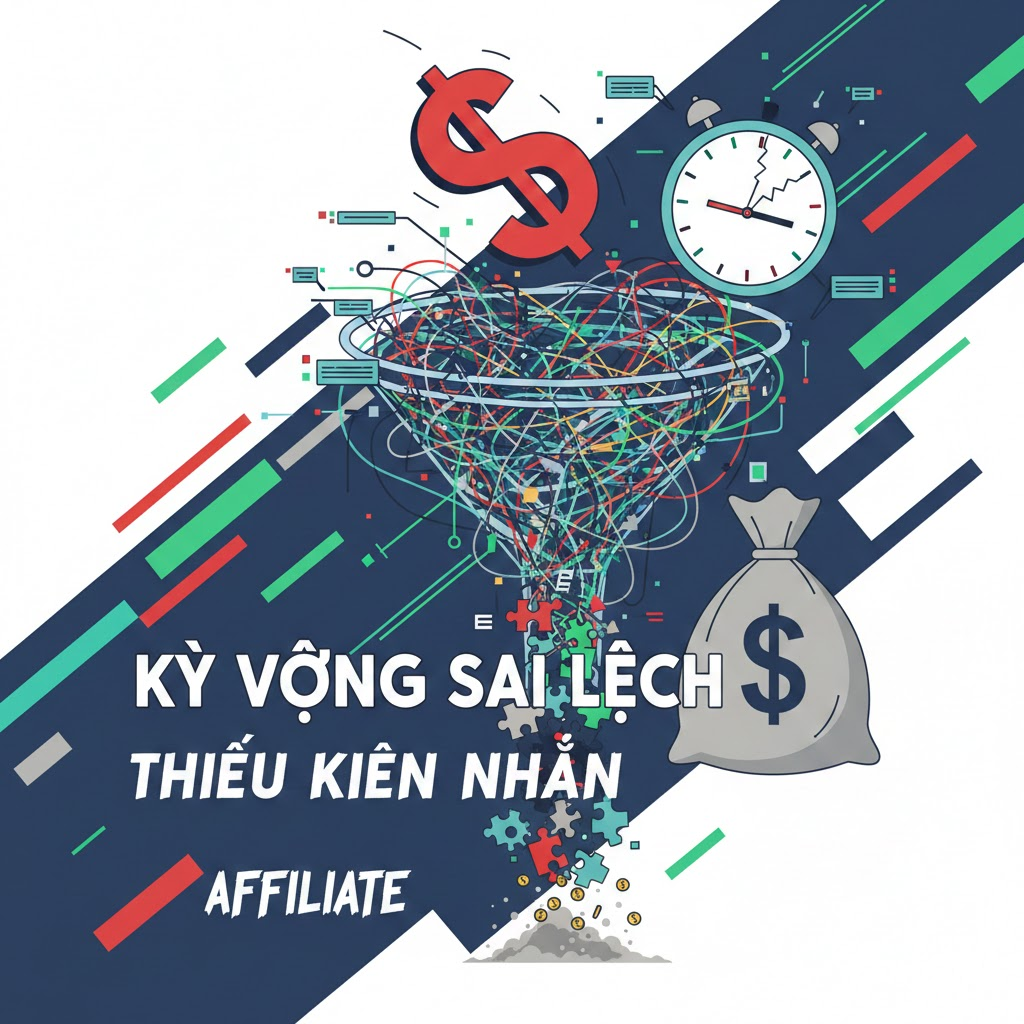
A mistake in mindset is just as dangerous as a technical mistake. Many business owners consider Affiliate Marketing as an “instant magic potion”. They expect sales to explode right in the first week of implementation.
In reality, Affiliate Marketing is a long-distance game (Marathon), not a sprint. It takes time to recruit Publishers, for Publishers to get used to the product, optimize content, and for customers to trust and click the purchase link.
The maturity process of a campaign
A typical Affiliate campaign needs 3-6 months to stabilize (Optimization Phase). The first month is usually a risky “honeymoon” phase or a frighteningly quiet one. If you rush to cut the budget or stop the program because you don't see an immediate profit, you have wasted all the initial setup effort.
It is necessary to establish appropriate KPIs (Measurement Indicators) for each stage. Don't just look at the final revenue, look at leading indicators to evaluate potential.
| Stage | Time | Main goal | Important KPIs to track |
|---|---|---|---|
| Setup & Launch | January | Recruitment & Activation | Number of registered Publishers, Active Publisher Rate |
| Optimize | Months 2-3 | Traffic optimization & Fraud elimination | Click-through Rate (CTR), Conversion Rate (CR), EPC (Earnings Per Click) |
| Scale up | Months 4-6 | Scale expansion & Revenue increase | Total revenue (GMV), ROAS, Customer Lifetime Value (LTV) |
| Mature | Month 6+ | Maintain & Optimize profit | Retention Rate, contribution rate of Top 20% Publishers |
Consequences of haste
- Constantly changing commission policies makes Publishers lose trust and leave.
- Sales pressure causes the Affiliate management department (AM) to accept risky advertising methods.
- Misjudging the effectiveness of the channel compared to Facebook Ads or Google Ads (which have faster results but higher costs).
- Missing the opportunity to build a sustainable passive sales channel in the future.
- Not enough data to optimize the conversion rate on the Landing Page.
Realistic example of expectations
Example 1: Business A stopped the Affiliate Marketing program after 1 month because they only saw setup fees with few orders. Two months later, the Publisher's SEO articles started to reach Top Google, but the links were dead (broken link). The business lost a huge amount of potential customers from SEO.
Example 2: Conversely, Business B patiently supported Publishers in the first 3 months despite slight losses. By the 4th month, when the partner's review campaigns on Youtube went viral, sales increased 5 times and marketing cost per order dropped to a record low.
6. Ignoring Landing Page optimization and user experience

The Publisher's only task is to bring customers to your doorstep (Website/Landing Page). Inviting the guest into the house and closing the sale is your job. A common mistake is that businesses put all their effort into pulling traffic from Affiliate Marketing but then lead customers to a terrible destination page (Landing Page).
If your Website loads slowly, the interface breaks on mobile, the buy button is broken, or the checkout process is too complicated, then the Publisher's efforts go down the drain. This wastes traffic and reduces the Publisher's EPC (Earnings Per Click) index.
Checklist for optimizing Landing Page for Affiliate
To ensure the best conversion rate, the destination page needs to be carefully optimized. According to our experience in implementing overall marketing strategy consulting , improving the Landing Page can increase revenue by 30-50% without increasing more traffic.
- Page loading speed: Must be under 3 seconds. Every second of delay reduces revenue by 7%.
- Mobile-First: 80% of traffic from Affiliate Marketing currently comes from mobile devices.
- Call-to-Action (CTA): The buy button must be prominent, clear, and placed in an easy-to-see position (Sticky button).
- Consistent content: The message on the Publisher's banner and the content on the Landing Page must match (Message Match).
- Social Proof: Need ratings and reviews from old customers to increase trust.
- Tracking Code: Ensure the pixel/tracking code is correctly attached to the Thank-you page.
According to the 2024 market report, the average conversion rate of Vietnamese e-commerce is only about 1.5 – 2%. If your Landing Page is below this level, don't rush to blame Publishers for running poor quality traffic; look at your “house” first.
7. Lack of communication and building relationships
Affiliate Marketing is essentially Relationship Marketing. Technology is just a tool; people are the deciding factor. Many businesses fail because they manage Publishers like soulless bots, communicating via automated emails and never interacting directly.
Publishers, especially KOLs/KOCs, need to be respected and listened to. They understand their audience (Followers) better than you. If you don't build a good relationship, they will not prioritize pushing sales for you during Mega Sale events.
How to build a strong Publisher community
At DPS.MEDIA, we always encourage clients to treat Publishers as Strategic Partners. Organize meetups (Offline), send trial product gifts, or simply wish them a happy birthday.
In addition, on-time commission payment is a vital factor in maintaining the relationship. Late payment is the fastest way to destroy the reputation of the Affiliate Marketing program that you have worked hard to build.
- Pay on time, transparently and clearly in reconciliation.
- Have a mechanism for hot bonuses for Publishers with excellent achievements.
- Listen to Publisher feedback about the product to improve it.
- Share inside information about upcoming marketing plans so they can prepare.
- Create contests to race for top sales to create a vibrant atmosphere.
Conclusion: Optimize Affiliate Marketing to break through revenue
Implementation Affiliate Marketing is a correct strategic move in the digital age, but it is not a path covered in roses. The 7 mistakes mentioned above are the “black holes” swallowing the budget that 90% of Vietnamese businesses are making.
To succeed, you need the right mindset, a smart commission strategy, a solid technical system, and most importantly, respect for Publisher partners. Don't let basic mistakes hinder your business's growth.
Key points to remember:
- Build a Win-Win commission policy, flexible according to each stage.
- Select Publishers carefully, emphasizing quality over quantity.
- Invest in a standard Tracking system and anti-fraud tools.
- Provide full resources (Banner, Content) to support Publishers in selling.
- Patiently nurture the channel, don't expect overnight miracles.
- Optimize Landing Page to not waste traffic.
- Build sustainable relationships with partners based on transparency.
If you are having difficulty operating an Affiliate channel or need an overall Digital Marketing strategy to optimize costs, contact DPS.MEDIA. now. Our team of experts is ready to accompany you in complying with standard affiliate marketing principles and breaking through sustainable revenue.
Ý kiến bạn đọc (8)
Đăng nhập để bình luận
Đăng nhập nhanh 1-chạm bằng Google để chia sẻ ý kiến của bạn về bài viết.
Bằng cách đăng nhập, bạn đồng ý với điều khoản và chính sách cộng đồng.
Chưa có bình luận nào. Hãy là người đầu tiên chia sẻ cảm nghĩ!
Đăng nhập / Tạo tài khoản
Đăng nhập với Google để gửi bình luận và tương tác cùng cộng đồng.
Tiếp tục là đồng ý với điều khoản sử dụng và chính sách bảo mật của DPS Media.