

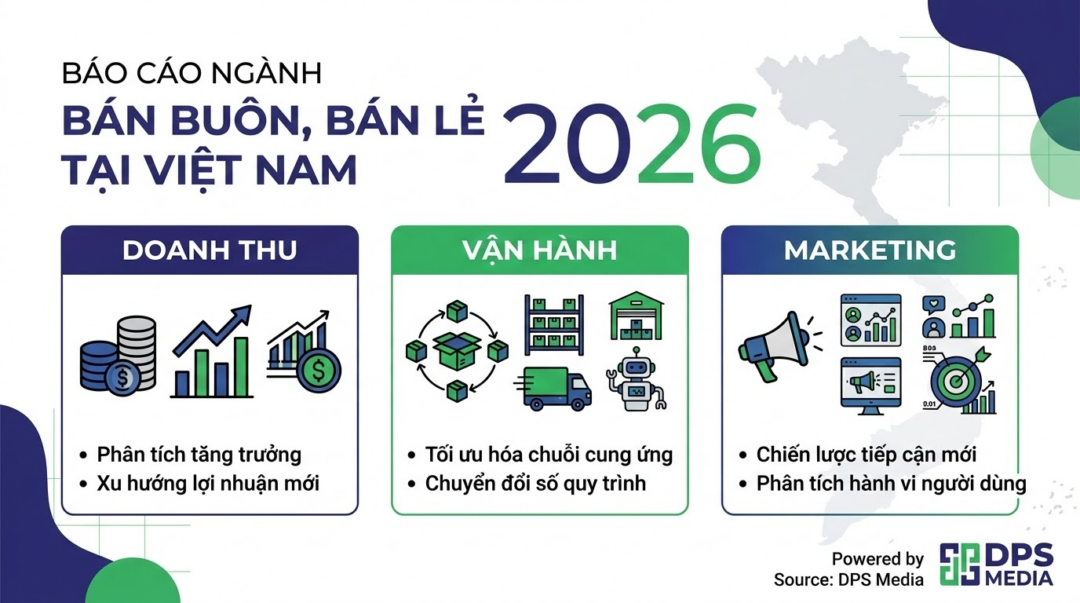

In-depth Analysis Report: Vietnam Wholesale and Retail Industry 2026: Revenue Structure, Operational Innovation, and Strategic Marketing Breakthroughs
Macroeconomic Context and Forces Driving the Domestic Trade Industry in 2026

Entering 2026, Vietnam's economy stands at a historic turning point, transforming from a post-pandemic recovery phase into an expansionary growth cycle with unprecedented strategic ambitions.
The Government has established an extremely decisive governance stance through Resolution 01/NQ-CP, setting a target for nationwide Gross Domestic Product (GDP) growth of 10% or more for 2026, while remaining committed to maintaining double-digit growth throughout the strategic period to 2030.
In this ambitious macro picture, the wholesale and retail sector (Wholesale & Retail) does not merely play the role of a distribution component of the economy but has been positioned to become the core “jet engine,” realizing national growth goals as other sectors—most notably real estate—are forced into a harsh purification cycle to eliminate easy speculative cash flow.
The movement of the retail industry in 2026 is deeply influenced by a strategic shift in focus from monetary policy to fiscal policy.
The State Bank of Vietnam (SBV) is maintaining a relatively cautious management direction, resolutely refusing massive money-pumping races to prioritize absolute macro stability and inflation control.
Notably, starting January 1, 2026, under Circular 26/2022/TT-NHNN, all term deposits from the State Treasury will no longer be included in the total deposit component when commercial banks calculate their loan-to-deposit ratio (LDR).
This technical regulation creates a certain liquidity squeeze on the banking system, thereby indirectly tightening capital for consumer credit and creating short-term pressure on the purchasing power of non-essential goods.
However, this monetary pressure is neutralized and overcome by a series of fiscal stimulus packages and institutional removal efforts from the Government.
Macro demand stimulation measures include adjustments to personal income tax (PIT) policy, expected to help reduce the PIT-to-total-income ratio by approximately 3 to 5 percentage points, depending on the monthly taxable income bracket.
Combined with the continued extension of the Value Added Tax (VAT) reduction policy through the end of 2026 and the cooling of concerns related to international tariff barriers, these policies directly increase the disposable income of the middle class, creating a very firm support for the essential consumer goods market and lifestyle services.
The strong recovery of the industrial production sector, particularly export-oriented production with the Purchasing Managers' Index (PMI) consistently staying above 50 points since July 2025, also contributes directly to improving the income of general laborers, spreading positive effects to the domestic retail market.
In addition, the inflation environment is also being managed systematically.
The Ministry of Finance has proactively developed three inflation scenarios for 2026 with increases of 3.6%, 4.1%, and 4.6% respectively, closely following the target of controlling inflation at around 4.5% set by the National Assembly.
The stability of global inflation, reflected in the cooling of price pressures, along with the shift of international investment capital into safe-haven assets, has contributed to creating a relatively stable domestic price environment.
Although there are still localized fluctuations related to construction material prices (due to demand for key infrastructure projects) or adjustments to state-managed service prices such as healthcare, education, and electricity, the overall consumer price picture still follows annual patterns, providing peace of mind for consumers when making spending decisions.
Another macro driver that cannot be ignored is the perfection of the legal system supporting the private economy and transparentizing transactions.
Decree 20/2026/ND-CP, effective from January 15, 2026, acts as a strategic launchpad for the private economic sector, providing special incentives such as a corporate income tax exemption for the first 3 years for newly registered small and medium enterprises.
For enterprises operating in the field of innovation, this incentive period is extended even longer if taxable income has not arisen in the early years, thereby encouraging the birth of retail business models applying high technology.
Parallel to this, new tax policies for the individual business household sector, combined with requirements for electronic invoice issuance under Decree 70/2025, are step-by-step eliminating the cost gap between the formal and informal economic sectors, promoting a fairer and more transparent competitive playground and strongly supporting the digital transformation process of the entire industry.
Market Size and Comprehensive Retail Revenue Restructuring in 2026

The Vietnam wholesale and retail market enters 2026 with a massive scale foundation and an extremely impressive bounce.
In 2025, Vietnam's total retail sales of goods and consumer service revenue reached 5,391 trillion VND, equivalent to about 203 billion USD for goods alone, accounting for an overwhelming proportion of up to 76% of total national trade and service revenue.
When considering the scale of the entire retail market (including bundled services), the total value has reached the 269 billion USD mark, marking the highest revenue recorded in the last 5 years.
The growth rate in 2025 reached an impressive level of 9.2% to 10%, significantly outperforming the growth rates of many countries in the same Southeast Asian region such as Indonesia, Thailand, or the Philippines.
Based on this firm recovery momentum and positive impacts from the Government's economic stimulus measures, financial institutions and market analysts have provided very optimistic forecasts for the scale of total retail sales of goods and consumer service revenue in 2026.
The target figure is expected to range from 7,200 to 7,500 trillion VND, corresponding to a breakthrough growth rate of 11% to 12.5% compared to 2025.
This forecast is completely consistent with the strategic direction of the Government.
According to the content of the Vietnam Retail Market Development Strategy to 2030 and vision to 2050 (issued under Decision No. 2326/QD-TTg dated October 21, 2025), the growth target for retail sales of goods and services is set at 11 – 11.5% per year.
Although the compound annual growth rate (CAGR) of the retail industry in the 2022-2025 period (reaching 8.7%) or the 2020-2025 period (reaching 7.2%) remains lower than the golden era before the Covid-19 pandemic, retail enterprises, especially those listed on the stock exchange, are still considered bright spots, attracting investment capital thanks to outstanding growth potential.
Looking long-term, according to research by Mordor Intelligence, the Vietnamese retail market is valued at 171.40 billion USD in 2026 and is expected to continue expanding to 217.44 billion USD by 2031, maintaining a CAGR of 4.87% throughout the next decade.
In fact, benchmark data from the first quarter of 2026 has immediately proven these optimistic forecasts.
In the first month of 2026 alone, the total retail sales of goods and consumer service revenue at current prices reached a massive 632.4 trillion VND, an increase of 2.6% compared to December 2025 and a sharp increase of 9.3% compared to the same period last year.
What makes this 9.3% growth rate special is that it was achieved despite January 2026 not coinciding with the Lunar New Year, while the same period last year was the peak month for Tet shopping.
This phenomenon strongly confirms that the positive consumption trend is being maintained based on substantive shopping demand and increased disposable income, rather than just a short-term seasonal effect.
Delving into the revenue structure of January 2026, retail revenue from physical goods reached 487.4 trillion VND, up 9.3%.
The demand for upgrading quality of life is clearly shown through the strong growth of household appliances and equipment (up 9.4%), transport vehicles excluding cars (up 9.3%), while essential goods such as food and foodstuffs increased by 7.7%, and apparel increased by 7.6%.
Revenue from accommodation and catering services also recorded parallel growth, reaching 75.4 trillion VND (up 9.4%), with travel tourism revenue breaking out with a growth of 14% thanks to the strong recovery of international visitor flows and the bustle of domestic tourism.
Geographically, the market is witnessing a very positive diversification of purchasing power, as the growth momentum is no longer limited to traditional megacities but has spread strongly to satellite provinces and cities.
Regarding retail sales of goods, localities such as Can Tho and Quang Ninh led the breakthrough with an increase of 10.7%, closely followed by Hai Phong (10.5%), Thua Thien Hue (10.1%), Tay Ninh (8.8%), and Nghe An (8.3%).
Regarding revenue from accommodation and catering services, Lam Dong recorded an explosion with an increase of 21.3%, followed by Quang Ninh (19.8%), Thanh Hoa (19.6%), and Khanh Hoa (12.3%).
However, in Ho Chi Minh City, the country's largest service and commercial center, growth momentum is still maintained with an extremely large absolute scale.
Accumulated in the first 2 months of 2026, the city's total retail sales and service revenue reached 316,459 billion VND, recording a high growth of 13.1% compared to the same period.
Although in February 2026, revenue decreased slightly due to seasonal factors after the Tet holiday, estimated at 152,425 billion VND, it still maintained a growth of 10.6% compared to the same period last year.
The People's Committee of Ho Chi Minh City clearly identified the first quarter as a vital “momentum-building step.”.
To achieve the goal of double-digit economic growth (about 10%) in 2026, the city is concentrating efforts on stimulating domestic consumption, accelerating public investment disbursement, and requiring management levels from wards to closely monitor and report periodically on even the smallest economic activities such as residential construction and repairs to fully calculate total social investment capital, creating a solid foundation for economic management decision-making.
Shifting Distribution Structures: A Major Overhaul Between Traditional Channels and Modern Retail

The year 2026 witnesses the Vietnamese retail market undergoing a comprehensive major surgery in terms of distribution structure.
The shift from traditional trade models to modern retail ecosystems (Modern Trade – MT) is occurring at an acceleration unseen in the last decade.
Although traditional trade channels, including traditional market systems and family-owned grocery stores, continue to maintain their presence and hold a significant share of sales, estimated to account for 59.35% of total market retail sales by the end of 2025, the structural decline of this group has become an irreversible trend.
Long-term statistical analysis data indicates that the number of traditional markets nationwide has continuously decreased, from 8,660 markets in 2015 to only 8,274 markets in 2024, equivalent to a negative compound annual growth rate (CAGR) of 0.51% over the past decade.
Conversely, 2026 marks a turning point when the coverage rate of modern retail channels (including hypermarkets, supermarkets, shopping centers, convenience stores, and specialized chains) is expected to officially reach 30% of total national retail revenue.
This figure represents a strong breakthrough compared to the maintained level of about 25% for many previous years, clearly demonstrating the large-scale shift in consumer behavior.
This change stems from the evolution in buyer expectations; they no longer value the mere geographic convenience of a grocery store, but prioritize product quality, food hygiene and safety, absolute transparency regarding origin, and a shopping experience in a modern space with climate control and lighting.
The compound annual growth rate (CAGR) of the number of supermarkets nationwide reached 5% in the period from 2015 to 2024, and is expected to continue accelerating from 2026 onwards.
The competitive landscape in the supermarket and hypermarket segment is extremely fierce, shaped by a two-horse race between domestic retail giants and multinational corporations with powerful financial resources.
A breakthrough strategic trend led by domestic enterprises, typically Masan Group with the WinMart chain, is the “rural area attack” strategy.
Instead of continuing to get bogged down in the war for market share in Tier 1 megacities that have already shown signs of saturation and expensive rental costs, these enterprises choose to expand their coverage.
In 2025 alone, Masan opened approximately 800 new retail stores, of which 70% were strategically located in rural areas and Tier 3 cities, places where modern retail networks could not previously reach.
This move not only helps businesses quickly capture market share in satellite cities with fast urbanization rates (such as Da Nang, Can Tho, Hai Phong) but also plays a role in creating a massive physical distribution infrastructure network, providing a solid foundation for implementing last-mile delivery to serve e-commerce orders in the near future.
On the supply side strategy, domestic supermarket systems are taking full advantage of their home-field advantage by prioritizing the development of Vietnamese agricultural and food value chains.
In the Saigon Co.op system, one of the oldest retailers, domestic agricultural products and consumer goods currently occupy 85% to 90% of the shelf space area.
This strategy not only helps domestic retailers receive strong support from Government trade promotion programs but also strengthens the emotional bond with the customer segment that has national pride and prefers using Vietnamese goods.
Sector Differentiation, “Value Retail” Trends, and the Gold Effect
When analyzing deeply into each commodity group, it can be seen that Food, Beverage, and Tobacco remain the foundational business segments, accounting for 48.35% of the overall market share in 2025.
At the same time, Personal Care & Household Care emerged as a phenomenon with the fastest projected growth rate in the market, estimated at a CAGR of 14.36% in the cycle from 2026 to 2031.
Most notably in 2026 is the emergence of a unique derivative consumer behavior originating from global macroeconomic fluctuations: the explosion of the luxury goods and jewelry segment through the “Gold Effect.”.
In the context of precious metal prices, especially gold bars and silver, continuously setting new historical peaks since 2025 due to global investment capital fleeing to safe-haven asset channels, the “asset hoarding” psychology of Vietnamese people has spread and penetrated strongly into the jewelry retail sector.
Instead of viewing jewelry merely as a depreciable beauty product, consumers increasingly consider this a second safe investment channel, ranked only after gold bars.
Leading jewelry retailers such as PNJ are predicted by analysts to record breakthrough revenue milestones thanks to their ability to perfectly combine sophisticated artistic design and the intangible asset storage value that the product brings.
The sharp contrast between cutting and tightening spending on non-essential items and being willing to spend heavily on expensive jewelry products reflects the formation of the “Value Retail” trend.
Consumers in 2026 have become wiser and more demanding than ever; they no longer blindly follow cheap, low-quality products, but are willing to pay at a price with a high profit margin for products capable of bringing dual value (serving both aesthetic and experience needs, as well as having asset investment properties), as long as the business provides truly excellent service and shopping experience.
E-commerce Ecosystem and the Historic Comeback of Social Commerce

The retail industry landscape in 2026 will be completely incomplete without a deep analysis of the breakthrough era of E-commerce and especially Social Commerce.
B2C e-commerce market revenue in Vietnam reached approximately 31 billion USD in 2025, maintaining a growth rate of over 25% per year.
Moving into 2026, this field is expected to continue maintaining its rapid growth momentum from 20% to 25%, thereby expanding its contribution share to about 12% of total national retail revenue.
This achievement firmly consolidates Vietnam's position in the group of 3 largest e-commerce markets in the ASEAN region, behind only the billion-people market of Indonesia and the populous nation of the Philippines.
The growth driver of e-commerce is resonated by the global digitalization trend.
Comparative data from the U.S. Census Bureau shows that, even in developed markets, the share of e-commerce is continuously encroaching on physical retail.
The ability to provide maximum convenience, break geographic barriers, optimize store operating costs, along with the flexible application of cashless payment methods and integration of AI-powered conversational shopping platforms has helped E-commerce floors radically reshape the core consumption habits of Vietnamese people.
The Shoppertainment Era and the Spectacular Rise of TikTok Shop
A truly tectonic shift in the digital platform market share structure occurred in the early months of 2026.
The event where the entertainment-commerce platform TikTok Shop officially “surpassed” Shopee – the enterprise that had held a monopoly and dominated the Vietnamese market for many years – right in the 2026 Lunar New Year peak shopping season is the sharpest proof of the unparalleled power of Social Commerce.
Data extracted from statistical platforms indicate a very clear change in shopping behavior.
The demand for shopping for cultural, traditional, and entertainment items such as Tet ao dai began to increase from October 2025, maintained its heat throughout December, and exploded to its peak in January 2026.
In January 2026 alone, the TikTok Shop platform recorded a huge figure with about 2 million orders of ao dai successfully transacted, setting an unprecedented record for the consumption volume of a niche product group in an extremely short period.
The Social Commerce market segment in Vietnam is estimated to have reached a scale of 5 billion USD by 2025 and is predicted to grow exponentially thanks to the sky-high conversion rate from live broadcasts (livestreaming).
TikTok Shop's rise is not just a change in ranking position, but it reflects the emergence of a new principle in consumer psychology: the collapse of the traditional linear purchasing funnel model.
Modern customers no longer have the patience to go through each step sequentially from Awareness to Consideration, Search, and then Purchase on a specialized platform interface.
Instead, the “Shoppertainment” model directly triggers the “Impulse Purchase” touchpoint in an instant when users are consuming entertainment content.
High-algorithm short-form videos and interactive livestreams possess the ability for demand generation many times stronger than passively waiting for customers to type search keywords into the toolbar of traditional E-commerce.
Regulatory Refinement and the Era of Transparent Cross-border E-commerce
Accompanied by the explosion, risks of counterfeit goods, tax evasion, and violations of consumer rights in the digital environment also increase proportionally.
Therefore, a major turning point for the legal environment of the e-commerce retail industry in 2026 is the appearance of the amended Law on E-commerce, expected to officially take effect from July 1, 2026.
This revolutionary legal framework not only aims to tighten existing management loopholes but is also expected to create a transparent, sustainable development springboard for the entire digital ecosystem in the 2026–2030 period.
The core and toughest point of the new law is maximizing the legal liability of cross-border platforms operating in Vietnam.
Trading floors are mandatory to perform API technical connections and report periodic transaction data through a centralized system called the National E-commerce Activity Management System.
More specifically, the law has taken strong measures to add strict management regulations targeting emerging but complex business models such as livestream sales and affiliate marketing, applied to both domestic e-commerce activities and cross-border networks.
Accordingly, all subjects participating in selling and promoting products via livestream must perform strict electronic Know Your Customer (eKYC) verification.
Furthermore, content hosting platforms are required to store all image, video, and audio data of sales broadcasts for a minimum period of one year for post-inspection purposes.
Upon detecting any signs of violation, state management agencies have now been granted supreme authority to request the platform to stop broadcasting immediately, remove content, block transaction money flows, and provide seller information.
Viewed through the lens of macroeconomics, this regulation in the short term will create a fierce market consolidation wave for hundreds of thousands of informal sellers, small individual content creators selling floating goods, and enterprises lacking compliance capacity.
Although compliance costs may increase, in return, it brings a level playing field for brands distributing genuine goods, large consumer manufacturing corporations, and professional retail chains.
E-commerce experts are recommending that large enterprises should proactively upgrade systems, apply artificial intelligence technologies to automatically identify and review product copyright violations, and at the same time optimize warehousing networks and last-mile fulfillment to meet new operating standards, turning compliance into a long-term competitive advantage.
The Operational Revolution and Reconstructing Retail Supply Chain Architecture 2026
Besides the impressive increase in revenue scale, the wholesale and retail industry in Vietnam in 2026 is undergoing the most profound operational architecture overhaul in history, led by two main transformative forces: the deep penetration of Artificial Intelligence (AI) technology into the core of the supply chain, and the mandatory rise of environmental, social, and governance (ESG) standards along with green logistics networks.
The Era of “Hyper-personalization” and AI in Supply Chain Management
The year 2026 officially marks the end of inventory forecasting methods based on subjective experience or traditional linear time-series algorithms.
The retail industry has strongly entered the “AI-integrated Retail” era, a phase where artificial intelligence is no longer just superficial demonstration tools at the customer service interface (such as advisory chatbots), but has taken deep root in the operational core of complex supply chain systems.
Breathless pressure from rising commercial space rental costs, along with expensive warehouse management costs, has forced industry giants like Masan (with the WinCommerce chain) or Mobile World (with the Bach Hoa Xanh chain) to comprehensively apply AI systems to optimize thin profit margins.
The new generation AI system has the ability to digest and analyze tens of millions of data points in real-time — from barcode scanning transaction history, micro-demographic data in each residential area, weather fluctuations, to keyword discussion trends on social networks and macroeconomic disruption risks.
As a result, they create absolutely accurate inventory forecasting models down to the level of each stock-keeping unit (SKU) at each small-scale retail point.
This capability allows businesses operating distribution chains to get closer than ever to the Just-In-Time (JIT) lean inventory model, minimizing working capital stagnation in the warehouse system, limiting costs of discarding goods due to expiration, and increasing the speed of cash flow turnover.
Moreover, AI serves as the engine core for a superior retail strategy called “Hyper-personalization.”.
Based on synthetic data profiles of behavior and shopping habits, machine learning algorithms automatically design, implement dynamic pricing, and distribute exclusive promotion packages, targeting each individual customer via mobile app notifications.
This sophisticated strategy not only stimulates shopping demand by creating a sense of “being understood” for customers, but more importantly, it perfectly protects the business's profit margin.
This is because retailers no longer have to sacrifice profits by applying mass discount programs across the entire system for customers who were already willing to buy the product at the original price.
Green Retail, ESG Standards, and Shaping Sustainable Logistics Systems
The retail operating environment in 2026 witnesses a revolutionary shift in awareness of all three actors: State legislative agencies, the manufacturing and distribution business community, and tens of millions of consumers regarding sustainable development.
The Government's issuance of the National Green Growth Strategy for the 2021-2030 period, with a vision extending to 2050, has officially created massive regulatory lobby pressure, turning compliance with green commitments from a greenwashing activity into a mandatory vital problem for the operation of the entire supply chain.
The strict internalization of commitments to reduce greenhouse gas emissions and move towards Net Zero forces wholesale and retail enterprises to conduct a review and re-evaluation of the entire product life cycle, stretching from raw material procurement, production processes, packaging technology, to the redesign of distribution logistics networks.
On the demand side, new generation consumers, especially Gen Z and Gen Alpha, are increasingly showing very decisive consumption attitudes.
They resolutely prioritize and vote with their money for brands that provide transparent certificates of origin, use bio-recycled packaging materials, and disclose carbon emission levels in transport.
Green and sustainable factors are no longer an added advantage, but officially a prerequisite “passport” for a business to penetrate and retain the high-potential young customer group.
Sensing this shift in the value axis, leading supermarket chains are actively expanding display space for organic product ranges and eco-friendly goods.
Similarly, large e-commerce floors have begun to add and prioritize displaying search filters specifically for sustainable products to direct user traffic.
In terms of infrastructure construction, massive foreign direct investment (FDI), especially from high-quality capital flows focused on technology and innovation, is pouring into green logistics, renewable energy development, and smart warehouse management systems in Vietnam.
The development of a Smart Fulfillment Centers network using advanced automation not only helps reduce domestic production and transport costs but also elevates the connectivity and flexibility of the Vietnamese supply chain into the global trade network system.
This continues to maintain Vietnam's firm position as a leading FDI destination in Asia in the field of retail distribution and high-tech manufacturing amidst the radical restructuring of global supply chains.
Regarding the long-term vision, the sustainability strategy is also a sharp tool to help wholesalers permanently optimize the energy consumption costs of the point-of-sale system, while effectively avoiding legal risks from international carbon tax barriers.
Strategic Marketing Breakthroughs 2026: Omnichannel Integration, AI Applications, and Unlocking the Creator Economy
The evolution of consumer behavior and the collapse of borders between physical shopping spaces and digital experiences are demanding a comprehensive, profound transformation in the Marketing mindset of the wholesale and retail industry.
The 2026 marketing plan no longer has room for single fragmented campaigns, but is tightly shaped by core pillars: absolute unified Omnichannel operations, Search strategy transformation, depth exploration of Synthetic Data, and optimization of the Creator Economy based on return on investment.
Omnichannel Retail Platforms Become a Mandatory Operational Standard
After the makeshift testing phase during the pandemic and entering the current life-or-death competitive context, implementing an omnichannel retail strategy is no longer a trending concept but has been shaped to become the vital operating infrastructure of every retailer eager to maintain market share.
According to analysis from the in-depth report “Vietnam Retail Industry: Omnichannel Model Takes Off” released by Deloitte Vietnam, multi-platform consumption habits have taken deep root in the daily shopping patterns of consumers, especially in urban areas.
The journey of a typical customer in 2026 is extremely complex and intertwined.
They may start by discovering and being attracted to a product via a video on TikTok, then conduct search for in-depth reviews on Facebook communities, continue to compare specifications and prices on the brand's website or first-party app, browse a physical store to directly touch and test the product, but finally choose to close the order through an intermediary food delivery platform to take full advantage of free shipping promotion codes.
To serve this non-linear journey, a comprehensive Omnichannel Marketing model is required, capable of ensuring a uniform and consistent presence of the brand image across all touchpoints.
Market surveys indicate that up to 74% of businesses in the industry rank customer behavior and preference research as an absolute priority foundation for every Omnichannel strategy.
Retail brands are pouring massive investment capital into restructuring central Customer Data Platforms (CDP), with the goal of synchronizing inventory data, transaction history, and loyalty point accumulation in real-time across all channels.
Flexible delivery models such as “Buy Online, Pick Up In Store” (BOPIS) or integrated checkout features directly within livestream broadcasts are gradually becoming minimum standards.
Centralized management technology platforms like Sapo Hub are being widely applied to help brands establish retention marketing campaigns, turning raw data into automated customer nurturing processes throughout the lifecycle.
This shift also marks the superior competitive advantage of convenience store chains and supermarkets with foreign capital (currently accounting for 4 out of the top 5 brands in Vietnam), as they are the entities capable of deploying methodical Omnichannel systems from parent corporations and possessing strong financial potential to integrate deeply with third-party technology applications.
Constructive Shift from SEO to GEO and the Power of Synthetic Data
According to the 2026 global Marketing trends projection report from the research organization Kantar, the explosion of Large Language Models (LLM) and Generative AI is completely restructuring humanity's mechanism for searching and processing information.
Consumers are increasingly relying on Artificial Intelligence Agents (AI Agents) to delegate and automate search, comparison, and shopping decision-making.
Current data in Vietnam shows that about 24% of AI users have begun viewing and using artificial intelligence tools as personal shopping assistants, and about 3/4 of AI users seek recommendations from AI on a weekly basis.
A direct consequence of this change is that traditional Search Engine Optimization (SEO) strategies based on keywords are gradually losing their power to manipulate.
To continue capturing the "top-of-mind" in the era of complex algorithms, retail marketing experts in Vietnam are pioneering a strategic shift to Generative Engine Optimisation (GEO).
The ultimate goal of GEO is no longer trying to stuff keywords to top the list of millions of Google search results, but to optimize data structure and content authority so that Large Language Models (LLM) cite their information and directly recommend their brand as the perfect, unique, and best answer to a user's query.
The marketing game now requires brands to create a predisposition not only toward human emotions but also to “convince” the logic of AI algorithms.
In parallel, the exploitation of Synthetic Data technology is truly opening a new horizon for retail market research.
Instead of struggling with privacy limits, 2026 Marketers use the computing power of AI to create simulated datasets and Digital Twins of target audience segments.
These models are capable of simulating consumer behavior and price response habits with an astonishing accuracy of up to 94-95% compared to the original dataset.
This technological breakthrough helps brands boldly experiment with high-risk advertising messages, new pricing policies, or product packaging changes without spending millions of dollars on field survey campaigns, while being absolutely immune to legal risks related to leaking or violating data privacy compliance.
Retail Media Networks (RMNs) and the Era of Generative Intelligence
A new “gold mine” reshaping the advertising budget flow of the wholesale and retail industry is the rise of Retail Media Networks (RMNs).
Facing a future where third-party cookies are gradually being phased out by operating systems and browsers, hypermarkets, omnichannel convenience store chains, and large e-commerce platforms are transforming themselves into powerful advertising companies.
By leveraging invaluable and highly accurate first-party data from their own customers, these retailers provide advertising space for Fast-Moving Consumer Goods (FMCG) brands right at the digital point of sale.
Measurement results show that RMNs deliver order conversion efficiency 1.8 times higher than conventional digital advertising platforms.
This effectiveness is so attractive that up to 35% of global Marketers intend to aggressively shift budgets from traditional channels to direct investment in RMNs throughout 2026.
Furthermore, the creative process for advertising is also entering a new phase called “creative intelligence.”.
Instead of mass-producing versions and conducting manual optimization through time-consuming A/B testing, 75% of global Marketers are now applying AI systems to analyze facial expressions, evaluate, and accurately predict whether an advertisement image or video is capable of evoking emotions, attracting attention, and impacting real-time purchase intent prediction before officially spending money on a campaign.
The Creator Economy and Micro-Community Strategies
The role of Influencers and Creators in the 2026 retail ecosystem has moved to a completely different chapter characterized by high pragmatism.
The era of spending billions on vanity metrics such as likes, views, or fake follower counts has officially ended.
Field surveys indicate that up to 61% of Marketers decide to invest budgets in Creator content based on the core measure of actual Return on Investment (ROI), the number of orders closed, and the ability to contribute to building long-term brand value.
To succeed, large retail brands are learning to give up one-way and authoritarian control over messages, moving toward a “co-creation” mindset with Creators.
This method ensures that marketing messages are delivered authentically, naturally, and with deep cultural integration for each distinct follower segment.
Additionally, penetrating and exploiting the power of Micro-communities is becoming a secret weapon with high lethality.
Today's consumers are falling into a state of exhaustion and fatigue with mass advertising messages bombarded from mass media.
They tend to retreat and seek trust from small groups and closed forums where members share a common niche hobby or a specific concern.
Sociological analysis data indicates that nearly 40% of consumers trust recommendations and shopping suggestions from members within micro-communities to a degree comparable to advice from family and close friends.
Sophisticated brands that know how to integrate products and sponsor spaces for these community groups can drive ROI up by an additional 25%, mainly by building organic engagement, reducing churn rates, and establishing superior brand loyalty.
Socio-Economic Consumption Drivers and the Retail Demographic Restructuring Phenomenon
Behind the growth charts and revenue figures of tens of billions of dollars are profound shifts in consumer sociology.
With a golden population structure of over 100 million people, characterized by an absolute dominance of the working-age population and the younger generation, combined with an extremely rapid urbanization process, Vietnam continues to maintain and consolidate its position as one of the most attractive domestic consumer and retail markets on the global investment map.
The Core Dominance of Gen Z, Millennials, and the Experiential Retail Trend
Entering 2026, Millennials and Generation Z (Gen Z) are no longer the potential consumer force of the future, but have officially taken over the role as the main spending force shaping the entire market.
Foot traffic statistics show that this demographic group currently accounts for 60% to 70% of the total flow of people to large shopping malls in urban areas.
This intergenerational transfer of consumption power is bringing about a radical change in the concept and definition of what a retail space is.
For these young consumers, shopping malls or physical store chains are no longer simply viewed as “transactional spaces”—where they go just to pick up items and pay.
They demand that retailers redesign stores into “experiential retail” centers.
It must be a complex architectural space that is a crossroads of culture, installation art, interactive technology, diverse culinary experiences, education, entertainment, and community activities.
Responding to this pressure, commercial real estate developers and brands (both local and international) are aggressively pouring money into repositioning their physical spaces.
The ultimate goal is to create “Instagrammable” touchpoints (unique, highly aesthetic architectural corners that urge users to take photos and share them for free on social media platforms) to attract attention, entice, and keep young customers in the retail space for as long as possible.
The “Treatonomics” Phenomenon and Psychologically-Driven Revenge Spending Behavior
The most important and interesting aspect of behavioral psychology shaping Vietnamese purchasing decisions in 2026 is identified by analysts as the “Treatonomics” phenomenon (Treat Culture or the Economics of Self-Indulgence).
Even though the global macroeconomic context still harbors many unstable variables, and large credits for residential housing or car purchases are being tightened due to the capital market purification cycle, Vietnamese consumers are not responding by cutting spending in an extreme or austere way.
Instead, they seek psychological comfort and stress-relieving joys through small but sophisticated expenditures (inchstones)—the purchase of luxury items on a micro scale.
It could be an expensive cup of specialty coffee, a limited-edition designer lipstick, or the willingness to open their wallet for an intensive spa skincare treatment.
Even more surprisingly, survey results from Kantar indicate a reality showing a major shift in personal financial management perspectives: up to 36% of consumers today are willing to accept the use of short-term consumer credit loans (exemplified by the explosion of Buy Now Pay Later fintech models) just to have immediate funds to finance personal hobbies, desires, and self-reward products to soothe long-term financial pressures.
Deeply understanding this psychological lens, omnichannel retailers are actively promoting partnerships with Fintech organizations to deeply integrate flexible installment payment mechanisms right at the point of sale (both online and offline).
Combined with multi-level loyalty programs with attractive reward mechanisms, these strategies act like a powerful magnet stimulating consumer cash flow to continue pouring into products that bring high emotional and spiritual value.
Alongside product strategy, marketing messages carrying the spirit of Inclusive Marketing—advertising campaigns celebrating diversity in appearance, gender, and breaking social prejudices to honor individual differences—are also prioritized for broadcast by brands.
Up to 65% of consumers expressed strong support and priority for choosing to buy from companies with a mission to promote these authentic and diverse cultural values.
Brands that skillfully integrate Inclusive Marketing into their positioning strategy not only score points ethically but also significantly expand their potential market boundaries.
Medium-term Outlook, Systemic Challenges, and Strategic Conclusions
The overall picture of Vietnam's wholesale and retail industry in 2026 is a complex but promising intersection between core structural explosion opportunities and systemic macroeconomic challenges that cannot be underestimated.
On the positive side, the medium- and long-term outlook for the industry is backed by very solid pillars.
The strong recovery of the export-oriented industrial production chain will continue to lead to a steady increase in the income of workers and general laborers, thereby creating a solid, unshakable foundation for maintaining the growth rate of the essential Fast-Moving Consumer Goods (FMCG) market.
The Government's continuous promotion of the implementation and utilization of advantages from new-generation free trade agreements (FTAs), combined with mega-infrastructure projects improving road transport connectivity and upgrading deep-water seaports, not only solves the problem of directly reducing domestic logistics costs but also successfully attracts high-quality foreign direct investment (FDI) into the wholesale, warehousing, and distribution software technology sectors.
Furthermore, far-reaching changes in the legal institutional environment, including Decree 70/2025 on the mandatory wide-scale application of electronic invoices, are transparentizing the business environment day by day and becoming a catalyst forcing traditional wholesalers to enter a comprehensive digitalization journey if they do not want to be eliminated from the game.
Along with the birth of Decree 20/2026/ND-CP (officially effective from January 15, 2026), tens of thousands of small and medium enterprises, especially companies in the field of innovative startups, will enjoy a corporate income tax exemption policy for the first 3 years.
This wave of new businesses is expected to create an ecosystem of dynamic and creative suppliers, constantly injecting novel product lines into the domestic retail value chain and diversifying sources of goods.
Even capital and knowledge from Vietnamese retail companies are no longer clustered domestically but have begun the journey of Outbound Investment to neighboring countries like Laos (reaching 191.2 million USD) and Indonesia, showing the deep global integration of domestic enterprises.
However, to reap the sweet fruits, businesses must face and overcome evident systemic challenges.
First, although household consumption spending is forecast to grow at a positive 7.2% in 2026, risks of cost-push inflation and pressure from global raw material prices could significantly erode people's real purchasing power.
Second, destructive competitive pressure from cross-border e-commerce platforms is requiring domestic retail businesses to constantly “burn capital” for investment to upgrade core technology infrastructure and optimize last-mile logistics systems to maintain market share.
Third, the tightening of state management regulations for the e-commerce sector, especially the new law taking effect in July 2026 with strict requirements for eKYC account identification and data storage time limits, will unintentionally create a much higher barrier to market entry.
Retail businesses will face the problem of expensive compliance costs and the cost of operating massive data storage server systems.
Conclusion
The year 2026 serves not only as a pivotal year for macroeconomic recovery but truly as a historical creative cycle, completely reshaping the “rules of the game” for Vietnam's wholesale and retail ecosystem in the coming decade.
The core focus of competition in the marketplace has permanently shifted away from bloody price wars that deplete profit margins, to enter a multi-dimensional intellectual race on Customer Experience quality, Technology Application Capacity, and Commitment to Sustainable Development (ESG).
Retail corporations and businesses wanting to win, capture, and firmly protect market share in this market approaching the hundreds of billions of USD mark must successfully solve the difficult equation with three strategic variables: (1) Radical and comprehensive digitalization of the supply chain with the power of Artificial Intelligence (AI) to accurately manage inventory, while establishing a green logistics network to meet Net Zero standards; (2) Re-establishment and smooth operation of a seamless Omnichannel architecture, capable of covering every user touchpoint from physical store spaces to the furthest corners of the Social Commerce ecosystem and (3) Applying “Creative Intelligence” thinking along with Synthetic Data technology to understand to the point of “hyper-personalization” the micro-fractures and latent desires in the consumer psychology of the younger generation.
In the context of an economy receiving effective support from the Government's expansionary fiscal policy axis, combined with a domestic consumer market size that is at the peak maturity of the young population period, any distribution institution or retailer that converges a sharp strategic vision, instantaneous technology adaptation capability, and the courage to integrate sustainable social values into the core of their business, will surely be the leaders, creating the brilliant face of the Vietnamese commercial economy on the journey toward the great vision of 2030.
References:
- 2026: Ambitious growth, cautious credit, and real estate entering a new cycle
- Vietnam's retail industry aims for double-digit growth from 2026
- Summary of forecast data and in-depth analysis of the retail market...
- Consumption recovering slowly, 3 retail stocks remain bright spots in 2026...
- 2026 Outlook | Consumer & Retail Sector – Prioritizing Essentials – MBS
- Vietnam retail stepping into 2026: Domestic consumption continues to play a role...
- The Ministry of Finance develops 3 inflation scenarios for 2026
- Vietnam 2026 Outlook – A Defining Moment for Growth – KPMG agentic corporate services
- Vietnam Supermarket market: Main players and market trends – B...
- Vietnam's retail market reaches 269 billion USD mark, highest in 5 years...
- January 2026: Total retail sales of goods and consumer service revenue increased by 9.3%
- Retail Industry in Vietnam – Size, Share & Analysis – Mordor Intelligence
- Retail sales of goods and consumer service revenue in the first month of 2026 estimated at over 632 trillion VND | Vietstock
- Infographics: Retail sales of goods and consumer service revenue in January 2026 increased by 9.3%
- The first quarter is an important momentum builder for the goal of double-digit growth...
- Vietnam E-commerce 2026: Strengthening accountability of cross-border platforms – VnEconomy
- Retail and Wholesale Market Report 2026
- TikTok Shop just “surpassed” Shopee – CafeF
- TikTok Shop sales ‘slightly higher’ than Shopee in the 2026 Lunar New Year season
- Personalization, sustainability, omnichannel: 3 pillars for the retail industry in 2026 – Vietpress.vn
- Vietnam promotes green logistics to participate in the global supply chain
- Vietnam tops promising destinations for FDI in Asia in 2026
- Marketing Trends in 2026, according to Kantar | by Clever Group...
- Vietnam's retail industry omnichannel model is attracting consumers
- What is omnichannel marketing? Definition and strategy – Amazon Ads
- What is Omnichannel Marketing? Things to know about omnichannel marketing – Sapo
- HANDBOOK Overall Marketing Strategy – Vinalink
- Top 9+ Marketing Trends that will strongly dominate 2026
- Retail 2026 – Personalization leads the consumer experience race – Thuong Truong
- Market dominance strategy for Mother & Baby E-commerce in Vietnam in 2026