



Vietnam Fashion Industry Restructuring Report 2026: In-depth Analysis of Revenue Capacity, Operational Models, and Marketing Shifts
Positioning Macro Status and Textile Industry Standing on the Global Map
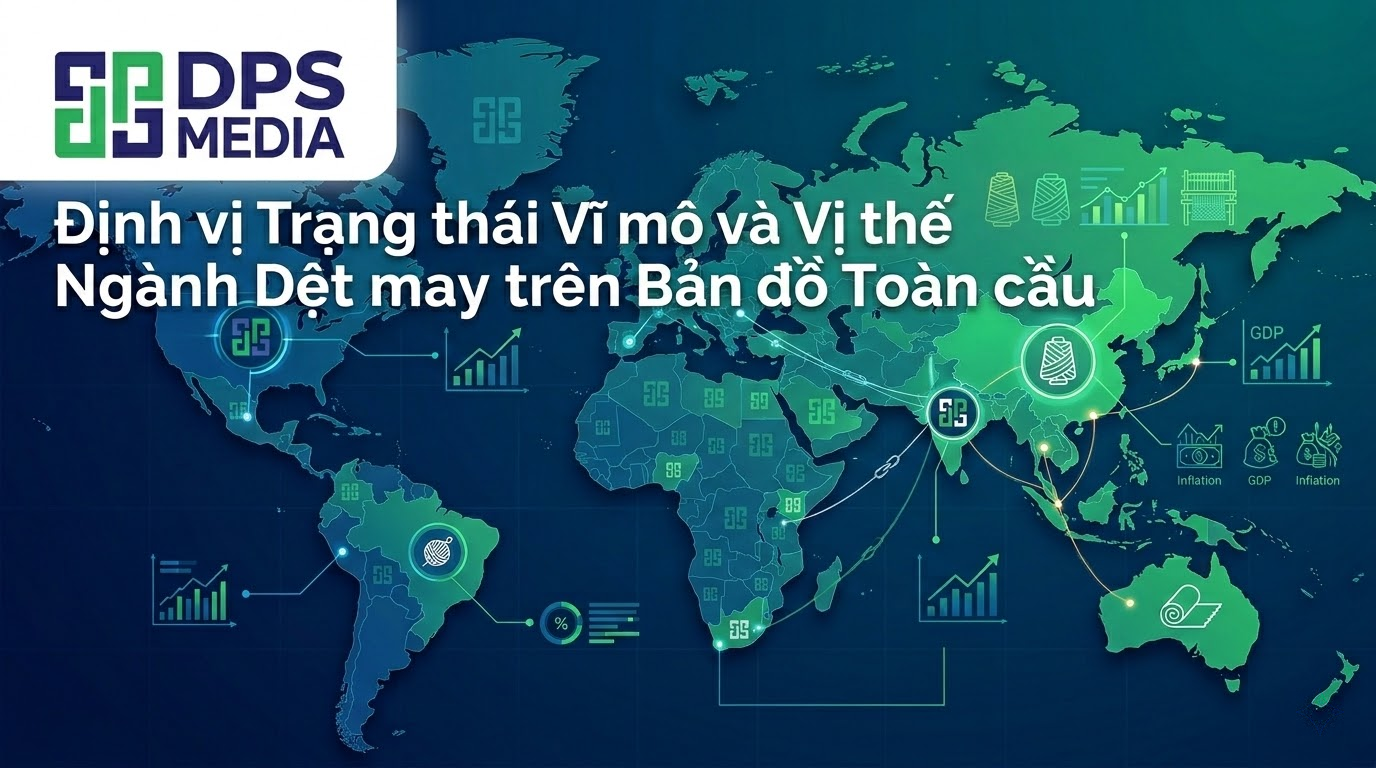
Entering 2026, Vietnam's fashion and textile industry stands at a historic crossroads, where traditional growth drivers based on labor intensity are gradually giving way to a complex ecosystem requiring high levels of technology, data, and sustainability.
The macroeconomic context shows that after the country's total export turnover reached a record $475 billion in 2025 (equivalent to a 17% year-on-year increase), the macro goal set by the Government for 2026 is to continue adding approximately $38 billion to total export value, aiming to set a new record.
To realize the ambitious goal of $550 billion for total import-export turnover in 2026, the economy needs to maintain an average monthly export revenue of $45 to $46 billion.
In this overview, the textile industry plays a role as one of the irreplaceable nuclear pillars.
After a long period of negative impacts from global supply chain disruptions and an 18.1% decline in the global apparel and footwear market (down to $1.45 trillion) in 2020, Vietnam's textile industry has demonstrated extraordinary resilience.
By the end of 2025, the industry's export value had recovered strongly, reaching approximately $46 billion, marking a compound annual growth rate (CAGR) of about 5.6% from 2021 to 2025.
Based on this recovery momentum, independent industrial surveys predict textile exports will approach $48 billion by the end of 2026, while the industry's official strategy has set an ambitious export target of $50 billion.
This recovery and growth are not merely a mechanical increase in quantity but also confirm Vietnam's solid position as the world's third-largest garment exporter, trailing only the manufacturing superpowers China and Bangladesh.
Notably, Vietnam currently holds a 6.4% market share of global apparel exports, a figure reflecting core competitiveness forged over decades.
The above analysis illustrates visually the strategic crossroads Vietnam's fashion industry faces in the new economic cycle.
With the average wage of textile workers at approximately $300/month, labor costs in Vietnam are now three times higher than Bangladesh's $95/month and double India's $145/month.
This factor indicates that Vietnam no longer can, and should not, maintain an absolute competitive advantage based on low-cost labor.
As manufacturing margins are severely squeezed by escalating input costs and rigid tariff barriers from the US market (where tariffs of 20% to 40% apply to apparel imported from Vietnam), the growth engine must undergo a radical shift.
The production system is being restructured from a “volume-based growth” model to “higher value-added growth.”.
Market data reality shows that this structural shift has begun to yield positive results.
Despite bearing higher labor costs, labor productivity in Vietnam's garment sector maintains an average annual increase of 3.5%, reflecting improvements in management skills and technology application on the factory floor.
More importantly, on the international stage, Vietnam has officially surpassed Bangladesh in the production and export of high-end specialized apparel lines, while establishing the number one position in speed-to-market among all Asian countries exporting to the core US market.
Financial Structure, Investment Capital, and Macroeconomic Spillover Effects
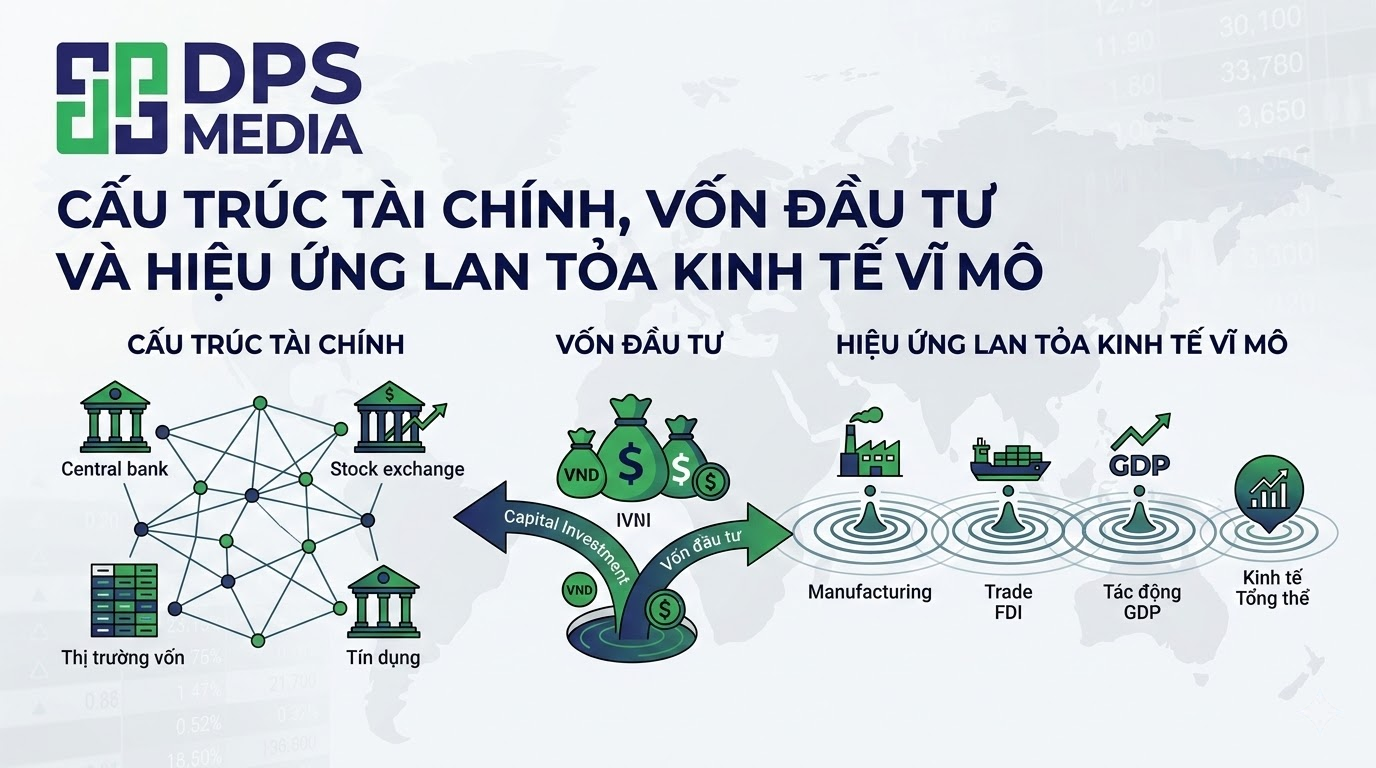
The importance of the textile and fashion industry is not limited to export turnover but also lies in its deep roots within the nation's macroeconomic structure.
Quantitative economic models indicate that the garment industry currently contributes directly about 15% to Vietnam's total Gross Domestic Product (GDP), while accounting for 16% of the total national industrial production value.
In a volatile global economic context, the industry maintains its role as a shield protecting the national balance of payments by generating a massive trade surplus of up to $20 billion annually.
This intrinsic strength is reinforced and sustained by a steady flow of Foreign Direct Investment (FDI).
Each year, the textile industry attracts about $2 billion in new FDI, with the foreign sector currently dominating up to 60% of the country's total textile export value.
However, this industry does not operate as an isolated island but creates a vast network of multiplier effects on the domestic economic structure.
Macro-analytical data indicates that the garment industry's multiplier for domestic services reaches 1.8x, meaning every billion dollars created in the textile ecosystem stimulates the generation of an additional $1.8 billion in supporting sectors, trade, and services.
This chain reaction is most evident through the lens of logistics and transport.
Secondary logistics activities serving the movement of textile materials and finished products alone generate a revenue segment of up to $5 billion.
This massive volume of goods makes garment transport account for 12% of total national road freight volume, sustaining the livelihoods of tens of thousands of small and medium-sized transport enterprises.
In terms of social welfare, the industry's labor absorption capacity remains extremely impressive: for every additional $1 billion in export value, the industry directly creates 150,000 to 200,000 new jobs, playing a key role in poverty reduction and maintaining social welfare stability in urbanizing areas.
Regarding corporate finance, the health of textile companies is assessed as relatively solid.
The average debt-to-equity ratio of enterprises in the industry remains at a safe level of 1.2 for listed public companies.
This moderate financial leverage allows businesses enough room to access long-term loan sources to invest in deep technology.
The textile industry's capitalization also accounts for up to 18% of the total market capitalization on the Ho Chi Minh City Stock Exchange (HSX), reflecting firm confidence from institutional investors in the industry's long-term profitability, despite short-term economic cycle fluctuations.
The national budget also benefits directly from the industry's prosperity, with revenue from garment export taxes contributing about 4% to total budget revenue.
To maintain growth momentum and attract high-quality capital flows, the Government continues to maintain a flexible Corporate Income Tax (CIT) incentive policy, ranging from 10% to 20% depending on the factory's location in economic zones, industrial parks, or remote areas.
This incentive level is a sharp competitive tool helping Vietnam gain an advantage over rival nations in attracting Research and Development (R&D) centers of global fashion brands.
Analysis of Domestic Revenue Scale and Segment Dynamic Shifts

While exports act as the money-printing machine shaping industrial scale, the domestic fashion retail market is fertile ground reflecting the maturity of the consumer economy.
The vibrant cycle of the Vietnamese retail market officially established a new level in 2025, with total retail market size reaching $269 billion – the highest in the past 5 years.
This trajectory is reinforced by a steady growth rate of consumer service revenue at 9% to 10% year-on-year, led by the young consumer class (Gen Z and Millennials) who currently occupy 60% to 70% of total foot traffic at shopping malls nationwide.
Within this macro retail space, measuring the scale of the domestic fashion market alone fluctuates depending on the methodology.
Aggregated statistics indicate that total domestic retail revenue for clothing and apparel is estimated at $6 billion.
However, considering only the branded fashion market with modern retail standards, the market value is priced at $3.5 billion.
Despite measurement differences, the domestic market is predicted to continue growing according to the Law of Long-term Value Added.
Historical analysis shows the domestic textile market reached a scale of $18.0 billion (including the value of circulating materials) in the 2020-2025 period, and is expected to maintain a compound annual growth rate (CAGR) of 4.38% in the 2026-2034 period, aiming for a massive valuation of $26.5 billion by 2034.
The fragmentation of this $3.5 billion market is witnessing a fierce battle for market share between international fast fashion giants and the incredible rise of Vietnamese brands.
Multinational corporations like Zara and H&M continue to maintain an absolute leading position in terms of revenue per square meter of store space and retail efficiency, setting rigorous standards for inventory turnover speed.
At the same time, brands like Uniqlo are constantly expanding their coverage, moving beyond megacities like Hanoi and Ho Chi Minh City to penetrate deep into the Central market, with plans to open new large-scale retail centers in Hue.
Counterbalancing this foreign pressure, the ecosystem of local brands is proving its resilient vitality.
The retail value of the local brand segment is growing at a CAGR of up to 15%, far outpacing the overall growth rate of the entire industry.
Major merger and acquisition (M&A) deals involving office fashion chains like Elise or NEM have created “boosts” in terms of capital flow and governance, professionalizing the operational machinery of Vietnamese fashion.
Parallel to that, designer-centric business models, exemplified by designer Do Manh Cuong's SixDo brand, have publicly declared ambitions to dominate the domestic market share and build an operational model capable of directly rivaling Zara right on home turf.
Core Product Segment Performance and Structural Transformation
The fashion revenue picture is not distributed evenly but shows a concentration of cash flow into highly specific product niches.
Changes in post-pandemic lifestyles, combined with micro-trends regarding health and comfort, have created a sudden surge in several core segments:
Analyzing the above data structure further, the sportswear segment leads with a growth rate of 18%, strongly driven by the “athleisure” trend—where the boundary between workout wear and office wear is increasingly blurred.
Meanwhile, the children's wear segment has proven to be an excellent defensive sector in the context of inflation, bringing in $2.5 billion, as parents often prioritize cutting personal spending before reducing costs for young children.
The lingerie and underwear segment, with its delicate technical processing barriers, brought in $1.8 billion in turnover, consolidating Vietnam's advantage in accepting orders requiring high sophistication.
The 9% growth of the Denim industry and 15% growth of winter wear exported to Northern Europe continue to demonstrate the flexibility of machinery and equipment systems in Vietnamese industrial zones in meeting diverse weather conditions and materials.
Inflation Dynamics, Price Elasticity of Demand, and Strategic Pricing
Revenue dynamics for 2026 are heavily governed by macro variables regarding inflation and cost-of-living pressures.
Empirical data from the General Statistics Office as early as January 2026 in key localities (typically Nghe An) shows that booming purchasing power during the Lunar New Year holiday created a massive demand-pull force, pushing the Consumer Price Index (CPI) up by 2.26% compared to the same period last year.
Delving into the basket of goods for CPI calculation, the “Garments, hats, and footwear” group recorded a price increase of 1.61% in just one month, and a 2.36% increase compared to the same period in 2025.
The rise of CPI in the fashion group reflects a double pressure: on one hand, high raw material and logistics costs force manufacturers to shift part of the burden onto retail prices; on the other hand, consumers are facing shrinking disposable budgets.
Consumer behavior research from international organizations like Euromonitor indicates that fashion buyers in Vietnam in 2026 are adopting a “price-conscious but quality-demanding” spending mindset.
Despite signs of an economic slowdown, the apparel and footwear market still demonstrates incredible resilience, but the revenue structure has been distorted by pricing strategies.
To maintain cash flow and clear inventory, brands have been forced to increase promotional intensity through continuous mega discount sales campaigns throughout the year.
The consequence of overusing promotions is the erosion of brand loyalty, as consumers constantly hunt for value instead of being loyal to a specific label.
To escape the race to the bottom, smart retailers have had to reshape the “value curve” by integrating functional innovations—such as smart temperature-adjusting jackets, UV-resistant fabrics, or the application of high-tech sustainable materials—to justify retail prices in the premium segment.
New Distribution Forms: The Dual Structure of E-commerce
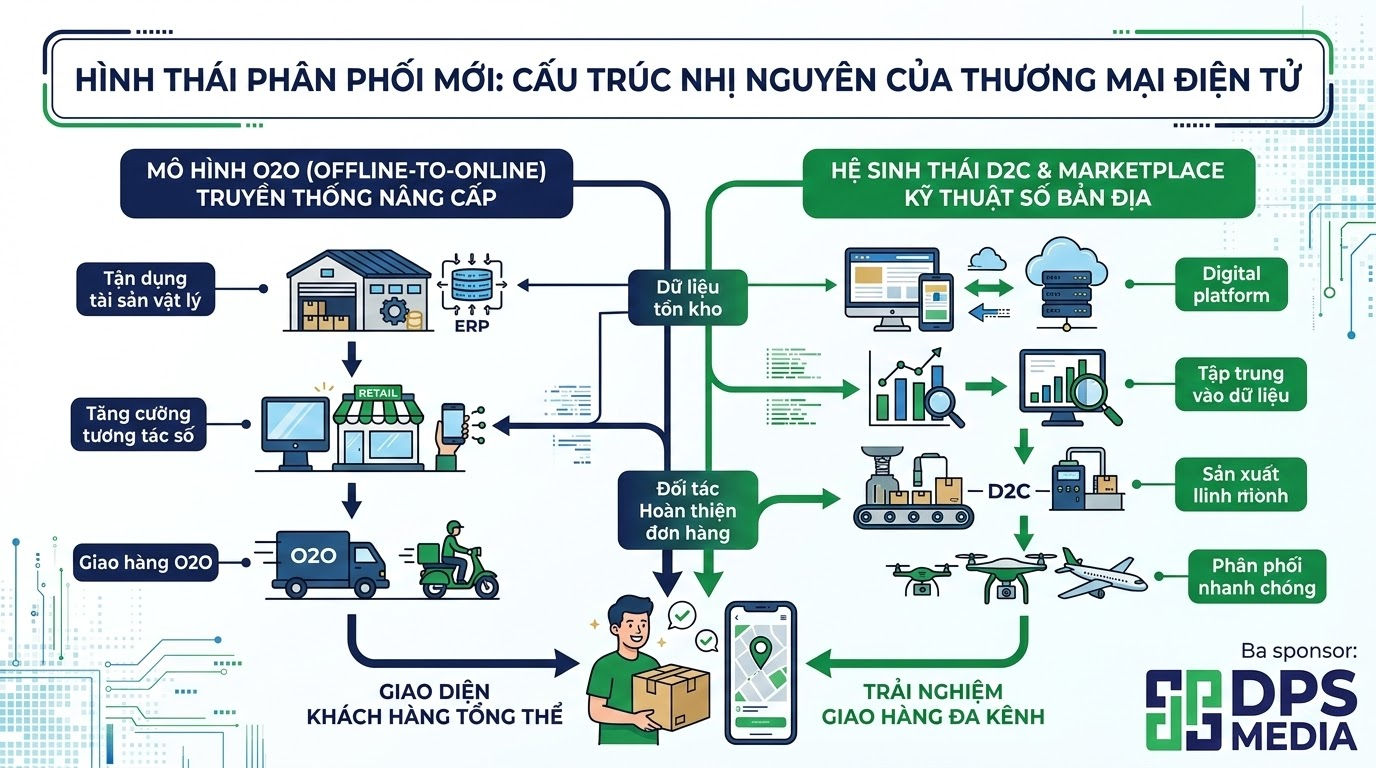
In 2026, the distribution channel structure of the Vietnamese fashion industry has been permanently reshaped by the absolute dominance of the E-commerce ecosystem.
The structural shift from traditional offline-first retail channels to the digital space is no longer an experimental trend but a mandatory operational reality.
The race in cyberspace has now converged into a fierce duopoly between two tech giants: Shopee and TikTok Shop, pushing other veteran platforms to the sidelines.
Market Share Analysis and Algorithmic Pricing Strategies
As of early 2026, analytical data points to a landmark shift in market share.
Shopee, the long-standing e-commerce platform, still maintains its leading position but is under severe erosion pressure, with its overall revenue market share dropping from 58% early last year to only about 52%.
This massive market share gap was rapidly seized by TikTok Shop, with its “Shoppertainment” model.
The short-video-based platform has risen to capture 46% market share (soaring from 39%).
The 6% gap between the two platforms is narrowing by the day, while former powerhouses like Lazada and Tiki now struggle with a mere 2% combined market share.
The competition lies not only in the total market share figures but also in the characteristics of the fashion category on each platform.
Fashion is the spearhead of TikTok Shop's offensive; it is one of the few areas where TikTok Shop's revenue contribution is overwhelmingly weighted, even surpassing Shopee in some young customer segments.
In contrast, Shopee's revenue basket has a safer level of fragmentation, spread across Home and Living, Beauty, Fashion, and Technology categories.
The core difference constituting the profit margins of these two platforms lies in the content distribution algorithm and pricing strategy.
TikTok Shop absolutely dominates the low price range, fully exploiting users' Fear of Missing Out (FOMO) through continuous livestream sessions.
Behavioral data indicates that the majority of fashion orders on this platform are concentrated at prices below 350,000 VND.
Shopping behavior here is highly situational and impulsive, leading to short customer lifecycles on the platform and volatile return rates.
The Average Selling Price (ASP) on TikTok Shop fluctuates from 118,000 to 123,000 VND, an optimal price level for users to make payment decisions without much financial hesitation.
On the other hand, Shopee defines itself as a true digital shopping mall.
Although Shopee's ASP is somewhat lower (from 97,000 to 114,000 VND) due to the dilution of millions of ultra-cheap accessory products, this platform possesses absolute control over high-value transactions.
Transaction data in the segment from over 3.5 million VND to 10 million VND almost entirely belongs to Shopee.
Customers are willing to pay large sums on Shopee thanks to low “trust costs”: transparent dispute resolution systems, clear after-sales policies, the ability to keep money safely in e-wallets, and the prestige of official flagship stores.
This trust is quantified through the Shopee Mall store rate reaching 39%, maintaining a safe distance from TikTok Shop Mall's 34%.
Directly operating Mall stores helps fashion brands eliminate distribution intermediaries, optimize net profit margins, and establish an invaluable direct feedback loop with the end consumer.
The “Dual Strategy” Model: A Theoretical Framework for Multi-channel Resource Allocation
Against the backdrop of digital market fragmentation, marketing strategists have established a new operational theoretical framework for 2026, identified as the “Dual Strategy.”.
Hard-learned lessons from corporations in the Beauty & Personal Care industry in 2025 proved a brutal truth: unipolar dependence on any single platform leads to catastrophic revenue cannibalization risks.
Major brands like ANESSA, La Roche-Posay, or L’Oréal Paris lost significant market share in the first half of 2025 due to a strategic error: they put all their efforts into chasing the red-hot growth of TikTok Shop (which at one point contributed up to 50.6% of the entire beauty care industry's revenue) while neglecting to protect their traditional battlefront on Shopee.
Conversely, brands that excellently applied a parallel allocation strategy, such as d’Alba (maintaining 77% of revenue from Shopee and 23% from TikTok) or Beplain (57% from TikTok and 43% from Shopee), achieved sustainable market share growth.
Applying this principle to the fashion industry in 2026, the Dual Strategy is defined by specialized functional roles for each ecosystem:
TikTok Shop in the role of “The Launchpad”: This platform is not designed to build loyalty but serves as a funnel creator machine.
It is the most powerful Zero Moment of Truth for the Gen Z customer base.
By using creative content and campaigns combined with Key Opinion Consumers (KOCs), TikTok's distribution algorithm creates “assumed demand” in users.
Revenue here is less dependent on seasonality or major sales campaigns but is continuously driven by the virality of short videos.
Shopee in the role of “The Pillar Platform”: If TikTok is where customers are discovered, Shopee is the cache memory that solves the Customer Lifetime Value (CLV) problem.
Shopee acts as a “stable destination,” where customers return for re-purchase transactions.
The clear category hierarchy, integrated loyalty programs, and solid logistics network turn Shopee into a channel that ensures stable cash flow, especially during peak consumption cycles.
Optimizing resource allocation for 2026 requires brands to use creative budgets to fuel TikTok Shop, and use customer care/periodic promotion budgets to consolidate market share on Shopee.
Consumer Behavior Psychology and Contemporary Marketing Pillars
Within the framework of in-depth analysis from the World Global Style Network (WGSN) presented at the Aquafina Vietnam International Fashion Week Fall/Winter, the structure of consumer behavioral psychology in 2026 has witnessed a profound reversal.
The era of marketing gimmicks that capture instant attention is closing.
Consumers are becoming increasingly selective and defensive against the noise of cyberspace.
Shopping motivation is shifting from “attention-maximization” to the need for “cultural sustainability” and emotional depth.
Successful brands do not just sell clothes; they sell authentic values and the ability to decode personal identity.
This micro-understanding has led to the abandonment of traditional customer classification models based on demographics.
Instead, WGSN proposes a market fragmentation method based on “psychographics,” breaking consumers down into specific profiles regarding lifestyle, value systems, and ways of receiving information.
Based on this psychoanalytical foundation, a framework of 5 strategic marketing “guidelines” has been established for 2026, adopted thoroughly by leading brands such as Canifa, Ivy Moda, and Eva De Eva:
Personalization through Artificial Intelligence (AI Application): AI is no longer an infrastructure element but has become a direct touchpoint.
Personalization reaches the level of micro-history analysis.
A typical example is fashion apps, like Ralph Lauren's “app styling” or Zara's recommendation system based on purchase history, automatically building digital wardrobes for each individual, reducing consumer “decision fatigue.”.
Measuring Customer Happiness: Fashion products must perform a mental therapy function.
Shopping is redefined as a process of enhancing emotional quality, requiring marketing messages to be associated with confidence and natural comfort instead of imposing toxic beauty standards.
Multi-touchpoint Diversification ecosystem: Brand presence must extend beyond the limits of a 6-inch screen.
Seamless omnichannel experience means customers can see outdoor 3D advertisements (OOH), interact with livestreams on TikTok, order through Shopee, and decide to go to a physical store to pick up and test the product.
Lifecycle Experience: Brand value does not end at the time of payment.
Labels design touchpoints that last throughout the product's usage lifecycle, including customization services, garment repairs, and trade-in programs to extend product life and enhance brand stickiness.
Social Interaction with Intent: Clothing is a non-verbal communication tool.
Marketing campaigns in 2026 focus on building communities, creating space for consumers to express their social selves and connect with individuals sharing the same ideology.
Ethical Consumption and the Era of Sustainable Fashion
Closely intersecting with the need for emotional depth is the explosion of the sustainable consumption trend.
Sustainability in 2026 is no longer an empty keyword in press releases (greenwashing), but has been brutally quantified into actual purchasing decisions with hard cash.
Empirical data is astonishing, recording that exports of garments produced from sustainable/organic cotton from Vietnam soared by 40%.
At the same time, textile product lines using recycled polyester materials also recorded a 25% increase compared to the previous year.
These sudden growth figures sketch a behavioral economics reality: consumers globally, and the middle class in Vietnam, are willing to pay a green premium for products that prove minimized environmental impact.
In the context of inflation and low-price competition, sustainability has transformed into an absolute competitive advantage.
It provides brands with a reasonable excuse for premiumization, protecting profit margins from the erosion of the bloody price war happening in the low-end fast fashion segment.
Operations Management, Digital Supply Chain Revolution, and Green Logistics
Behind the glamorous transactions on e-commerce platforms and personalized advertising films, the industry's vascular system—Supply Chain Management and Logistics—is undergoing a painful but necessary major surgery.
2026 marks a major milestone as the Vietnamese Government officially issued and applied a series of new logistics adjustment policies from January 1, 2026, forcing the entire ecosystem to shift from traditional physical management models to data-driven management and green standards.
The Imperative of Green Logistics and Emission Standard Pressures
“Green Logistics” has officially been stripped of its voluntary Corporate Social Responsibility (CSR) shell to become a legal technical barrier.
This transformation takes place alongside the Government's tightening of emission control regulations for road and sea transport vehicles, closely linked with international environmental agreements.
For textile enterprises, which consume up to 10% of the national energy total, the energy and emissions puzzle is a matter of life and death.
The formation of mega clean energy infrastructure projects, such as the 1.5 GW Quynh Lap Liquefied Natural Gas (LNG) Power Plant worth $2.3 billion in Nghe An or the Masela LNG carbon capture integrated project, serves as a foundation providing a stable and cleaner power source for textile dyeing industrial clusters, helping the supply chain meet global environmental targets.
In addition to macro infrastructure, for corporations exporting to the European Union (EU) and US markets, greening pressure is doubled by strict legal frameworks like Environmental, Social, and Governance (ESG) standards and especially the Carbon Border Adjustment Mechanism (CBAM).
Any garment shipment that cannot trace its carbon emission origin throughout the entire product lifecycle faces the risk of punitive taxes or complete removal from the supply chains of international brands.
Environmental compliance costs are creating a massive barrier to industry entry; for example, investing in and operating standard industrial wastewater treatment systems currently adds an average of 2% to the total basic production costs of enterprises.
In a business industry characterized by high volume and low margins, a 2% cost increase represents a massive amount of frozen cash flow.
However, in the long term, this strictness acts as a natural Darwinian filter, weeding out small-scale workshops with backward technology, leaving the field to corporations with strong financial potential.
Data Nervous System: ERP, WMS, and the RFID Key
According to policy orientations from early 2026, physical warehouses are no longer viewed merely as shelters for goods.
They must evolve into multifunctional logistics centers, seamlessly integrating traditional storage, wholesale distribution, import-export routing, and the ability to process hundreds of thousands of small orders for e-commerce fulfillment every day.
The state requires all operational data to be circulated on digital platforms, allowing customs and tax authorities to perform automatic checks and cross-references.
Digital data and connectivity standards have officially become the new “soft infrastructure” or “nervous system” of Vietnam's logistics industry.
However, the characteristic of the fashion industry is an extremely short product lifecycle, high seasonality, and a massive number of Stock Keeping Units (SKUs) with many variations in size and color.
Manual management is impossible.
The only solution lies in integrating Radio Frequency Identification (RFID) technology as the backbone for the Warehouse Management System (WMS).
Ultra-small RFID tags, attached to each product unit (item-level tagging) right from the packaging stage at the factory, carry a unique identifier containing full information about the product code, production date, and material description.
As packages move through RFID scanning gates at the central warehouse, the WMS system will identify and automatically update the inventory inflow/outflow in the database with an accuracy of approximately 99.9% without any manual box-opening intervention.
This technology not only cuts thousands of labor hours for monthly inventory but also thoroughly solves the problem of goods loss, while creating a clean database for Artificial Intelligence (AI) systems to learn and provide accurate inventory turnover forecasts, contributing to the release of a large amount of working capital currently sitting idle in warehouses.
Despite the clear quantitative benefits, the industry's digital transformation process is still stuck in a profound paradox regarding technology absorption capacity.
Market statistics indicate that while the popularization of payment technology has occurred at a dizzying pace—with 60% of textile workers already proficient in receiving salaries and transacting via e-wallets and digital platforms—at the corporate governance level, the picture is extremely bleak.
Currently, only a mere 5% of enterprises in the garment industry have successfully implemented and smoothly operated an Enterprise Resource Planning (ERP) system with fully integrated modules.
The severe disconnect between the basic technological awareness of workers and the capacity to master the digital governance infrastructure of the executive apparatus is a fatal bottleneck.
The core reason lies not in the lack of hardware infrastructure, but in the crisis gap of high-quality logistics human resources: the labor market is severely lacking teams capable of designing data architecture, operating AI-powered logistics systems, and possessing a deep understanding of new international legal regulations.
If this gap is not urgently closed, Vietnam's competitive advantage in cost and speed will be completely neutralized by regional competitors who have successfully digitalized.
Strategic Implications and Sustainable Ecosystem Vision
2026 is by no means a linear continuation of previous years, but marks a structural inflection point for the entire Vietnamese fashion and textile-garment ecosystem.
Multidimensional pressure from the decline of the low-cost labor advantage, the ghost of global inflation weighing on consumers“ pockets, and the tightening of cross-border environmental barriers have placed the textile and garment industry in a ”transform or perish" position.
To achieve and maintain an export turnover of $50 billion in a volatile world, the textile-garment supply chain must maximize the capacity of $2 billion in annual FDI capital, directing this cash flow into building circular industrial parks, upgrading smart dyeing and textile processing machinery systems, and investing synchronously in AI-integrated ERP and WMS modules.
Transforming a labor-intensive processing procedure into a management model dominated by data streams is no longer an option but a survival imperative.
In the multi-billion dollar domestic retail battlefield, where growth rates and complexity are increasingly approaching developed markets, decoding 2026 consumer psychology requires unprecedented sophistication.
Vietnamese brands are holding a once-in-a-millennium opportunity to use local cultural empathy as a weapon against the expansion of global fast fashion corporations.
This requires marketing managers to be proficient at tightrope walking in a binary E-commerce environment: knowing how to ignite momentary sparks of desire with short-form content on TikTok Shop, while simultaneously building a solid fortress of trust and customer lifetime value on the Shopee platform.
In summary, the future of the Vietnamese fashion industry will no longer be measured purely by millions of tons of cotton or billions of meters of fabric shipped each month.
It will be benchmarked by the production system's ability to harmonize economic performance with the planet's ecological limits, by the speed at which an RFID data stream can travel from the factory through e-customs to the fulfillment warehouse, and by the level of resonance between a brand's ethical value system and consumers' aspirations for a happier life.
Only by perfecting this multi-dimensional model can Vietnam's textile and garment industry truly shed its image as a global sweatshop to rise as a creative hub, shaping the value chain and sustainable consumption trends of the Asian region in the new era.
References:
- Vietnam textile-garment sector targets 50bninexportsin2026–Fibre2Fashion
- vietnam’s textile and garment industry targets us$50 billion in exports in 2026 – HONG KONG BUSINESS ASSOCIATION VIETNAM
- Global Fashion Industry Statistics – FashionUnited
- Vietnam’s Textile and Garment Industry: Growth Outlook 2026 …
- Vietnam Apparel Industry: Data Reports 2026 – WifiTalents
- The vibrant cycle of the Vietnamese retail market begins: Scale …
- Vietnam's fashion market reaches a value of $3.5 billion – baodautu
- Vietnam Textile Market Size, Share, Growth and Report 2034 – IMARC Group
- Apparel and Footwear in Vietnam | Market Research Report – Euromonitor International
- Nghe An: Consumer Price Index (CPI) in January 2026 increased by 2.26%
- Shopee and TikTok Shop lead in sales revenue scale at …
- From TikTok Shop to Shopee: Dual strategy for long-term growth …
- Consumer Portrait 2026: Forecasted habits, trends, and impacts on brand strategy | Advertising Vietnam
- 2026 consumer trends revealed at the fashion seminar …
- 6 marketing strategies for Vietnamese fashion brands 2026 …
- Sustainable fashion: When Green Logistics is not just a trend but …
- Updating 2026 logistics trends and policies for enterprises
- LNG Bunkering Market Growth (2026): Masela Project, Vietnam Power Plant & GTT Carrier and Asia’s 2026 Market
- AI and automation in supply chain management
- Solutions for applying RFID technology in warehouse management – A.I Tech
- Vietnam promotes green logistics to participate in the global supply chain
- Vietnam – Explore reports – Euromonitor.com
- Womenswear in Vietnam | Market Research Report | Euromonitor