



Types of market research are becoming vital tools for Vietnamese SMEs as advertising costs continue to rise. Many businesses pour budgets into digital marketing but still do not clearly understand what customers really want.
According to We Are Social 2026, Vietnam has more than 72.7 million users on social media and over 78 million internet users. This makes purchasing behavior change much faster than before. Simultaneously, Meltwater's Digital 2026 report shows that digital advertising costs in Vietnam continue to increase sharply in 2026.
This article will help businesses clearly understand each market research method, knowing when to use desk research, when qualitative/quantitative research or in-depth interviews are needed to optimize marketing budgets.
What are the types of market research and why should Vietnamese businesses care?

How has market research changed in the 2026–2026 period?
In the past, many SMEs relied only on intuition or personal experience to decide on products and marketing campaigns. However, the digital environment causes user behavior to fluctuate constantly. According to DataReportal 2026, Vietnamese users spend an average of more than 6 hours per day on the internet.
This creates a huge amount of behavioral data for businesses to exploit.
Market research is no longer an activity reserved for large corporations. Small businesses can also use social listening, online surveys, or desk research to understand customers faster. DPS.
MEDIA recommends SMEs should start with simple data before expanding advertising budgets to avoid spending money on the wrong customer segment.
- Analyze search trends before launching new products
- Measure demand by specific geographical area
- Monitor customer behavior on social media
- Evaluate direct competitors
- Check negative feedback before scaling ads
- Identify marketing channels that bring high conversion
A cosmetics brand in District 3 once ran TikTok Ads continuously for three months but the conversion rate only reached 0.7%. After market research, the business discovered that the target customers prioritized reviews from dermatologists instead of entertainment KOLs. After changing the message, the cost per order decreased by 38%.
A healthy food startup in Hanoi also encountered a similar situation. They focused on running Meta Ads for the 18–22 age group, but survey data showed that actual customers were in the 28–35 office worker group. After adjusting the campaign, online revenue increased by 64% in two months.
When should businesses invest in research instead of running ads immediately?
Many SMEs tend to run ads as soon as the product is finished. This is a common mistake because the business does not yet know what customers care about most. If insight is not understood, the advertising budget is often scattered.
Businesses should research before launching new products, expanding markets, or changing brand positioning. With a budget under 100 million VND per quarter, investing 10–15% in research often helps significantly reduce the cost of targeting the wrong segment.
| Scenario | Should research? | Suitable method | Priority level |
|---|---|---|---|
| Launching a new product | Yes | In-depth interview | High |
| Expanding to other provinces | Yes | Desk research | High |
| Optimize advertising | Yes | Quantitative | Average |
| Changing brand identity | Yes | Qualitative | High |
Common mistakes when SMEs ignore market data
The first mistake is taking internal opinions instead of customer feedback. This makes the product suitable for the founding team but not for market needs.
The second mistake is using data that is too old. Online consumer behavior changes very quickly. According to We Are Social 2026, TikTok in Vietnam has exceeded 67 million adult users.
If businesses still only focus on Facebook, reach will decrease sharply.
A furniture business in Binh Thanh once lost nearly 400 million VND because they imported products according to international Pinterest trends. After a field survey, they found that buyers in Vietnam prioritized minimalist but easy-to-clean products over aesthetic factors. Adjusting the product portfolio helped the inventory rate decrease by 31% after six months.
The most popular types of market research today

Desk research is suitable when needing a quick market assessment
Desk research is a method using available data from industry reports, Google Trends data, social media statistics, or competitor reports. This is a suitable choice for SMEs needing a quick market assessment with a low budget.
Businesses should use desk research when needing to determine market size, industry trends, or basic consumer behavior. If the budget is under 20 million VND, this is often a reasonable starting step before deploying larger surveys.
According to DPS. MEDIA's experience, SMEs should combine data from Google Trends, Meta Audience Insights, and the Digital 2026 report to check market demand before scaling ads.
- Check search volume by season
- Analyze what content competitors are running
- Assess the level of industry competition
- Identify areas with high demand
- Compare behavior by age group
- Measure brand interest
Qualitative research helps understand deep customer insights
Qualitative research focuses on motives, emotions, and the reasons behind purchasing behavior. This method often uses small group interviews or observation of user behavior.
Qualitative is suitable when businesses need to understand why customers haven't bought, don't trust, or haven't returned. A group of 8–15 participants is usually enough to identify common behavioral patterns.
A coffee brand in Thu Duc once thought customers cared about low prices. However, qualitative research showed that buyers actually prioritized a quiet workspace. After changing the store design and promotional content, the return rate increased by 43%.
Quantitative research for measurement and forecasting
Quantitative research uses large-scale surveys to measure trends and forecast behavior. This is a way to help businesses make decisions based on data instead of intuition.
Typically, a survey of 100–300 samples is enough for local SMEs. For national brands, businesses should expand the sample size by region.
Qualitative and quantitative methods are often combined to both understand insight and have confirming data. For example, a business can conduct deep interviews first and then deploy a wide-scale survey to verify hypotheses.
| Method | Targets | Cost | Insight depth |
|---|---|---|---|
| Desk research | Quick assessment | Low | Average |
| Qualitative | Understand motives | Average | High |
| Quantitative | Measure trends | Average | Average |
| In-depth interview | In-depth analysis | High | Very high |
| Social listening | Monitor feedback | Low | High |
In-depth interview for B2B problems or new products
In-depth interview is a form of deep interviewing of each individual over a long period. This method is suitable for B2B, finance, education, or new products with a long purchase cycle.
Each interview usually lasts from 45–90 minutes. Businesses should conduct at least 10 interviews to find reliable common points.
An HR management software company in HCM City once deployed LinkedIn ads but failed to generate quality leads. After conducting in-depth interviews with HR directors, they discovered that customers cared more about data integration capabilities than AI features.
After changing the landing page, the demo rate increased by 52%.
Multi-channel customer behavior survey
Customers no longer buy on a single platform. They might watch TikTok, search Google, and then buy on Shopee or a website. Therefore, multi-channel behavior research is increasingly important.
Businesses should combine Google Analytics, social listening, and CRM to track the customer journey. This helps identify awareness-generating channels and conversion-generating channels.
- Track pre-purchase behavior
- Measure decision-making time
- Identify the most influential platform
- Check website return rate
- Evaluate user retention content
- Analyze behavior by device
Compare pros and cons of 5 methods
| Type of research | Advantages | Disadvantages | Suitable business |
|---|---|---|---|
| Desk research | Fast, economical | Lack of deep insight | Startup |
| Qualitative | Understand customer emotions | Difficult to scale | New brand |
| Quantitative | Easy to measure | Time-consuming survey | Ecommerce |
| In-depth interview | In-depth insight | High cost | B2B |
| Social listening | Real-time tracking | Easy data noise | Online SMEs |
Which business should use each type of market research?

Which method should new startup SMEs prioritize?
Startups often have limited budgets so they need to prioritize speed and efficiency. Desk research combined with social listening is a suitable choice in the early stages.
Businesses should focus on identifying three factors: market demand, main customer group, and competition level. If these three factors are not clearly identified, scaling ads will be very risky.
A local fashion brand in District 1 once imported a large number of oversized shirts following a TikTok trend. However, social listening data showed that female office workers cared more about basic office products. After adjusting products, ROAS increased from 1.
9 to 4. 3.
What data do retail and ecommerce businesses need?
Retail businesses need to clearly understand purchasing behavior by season, region, and platform. Quantitative research is often more suitable because it can measure the scale of demand.
Ecommerce SMEs should monitor conversion rates by traffic source, cost per order, and purchasing decision time. This is important data to optimize advertising.
- Add-to-cart rate
- Re-purchase rate after 30 days
- Cost per new customer
- Conversion rate by device
- Effectiveness of short video content
- Peak shopping hours
How should B2B businesses use in-depth interviews?
B2B has a long sales cycle and many people involved in decisions. Therefore, in-depth interviews often bring deeper insight than quick surveys.
Businesses should interview both end-users and budget decision-makers. These two groups often have completely different criteria.
A logistics company in Binh Duong once focused on promoting delivery speed. However, in-depth interviews showed that business customers cared more about tracking and data reporting capabilities. After changing the sales message, the contract closing rate increased by 28%.
How should growing brands combine qualitative and quantitative?
When a business starts to scale marketing, using only one research method will not be enough. This stage needs a combination of qualitative and quantitative to both understand emotions and measure the scale of behavior.
For example, a brand can use qualitative research to find TikTok content insights and then deploy quantitative surveys to confirm the most potential customer group.
According to DPS. MEDIA's experience, fast-growing businesses should review market data every quarter instead of every year. This is especially important for the ecommerce and online education industries.
Effective market research deployment process for SMEs

Identify research objectives before choosing a method
Many businesses deploy research but do not clearly identify the question to be solved. This results in much data collected but not usable.
SMEs should start with a specific goal such as increasing leads, reducing cost per lead, or identifying new customer groups. When the goal is clear, the business will choose the right research method.
Choose survey sample and reasonable research time
A sample size that is too small will make the data unreliable. However, a sample that is too large causes unnecessary costs.
For local SMEs, a survey of 100–200 samples is often enough to identify main trends. The research period should last at least 2–4 weeks to avoid seasonal data bias.
| Business scale | Suitable sample size | Time | Targets |
|---|---|---|---|
| Startup | 50–100 | 2 weeks | Test demand |
| Local SMEs | 100–200 | 3 weeks | Optimize marketing |
| National Ecommerce | 300–500 | 4 weeks | Scale advertising |
| B2B | 20–50 interviews | 4–6 weeks | Understand buying behavior |
How to read data to make marketing decisions
Data is only valuable when converted into specific actions. SMEs should focus on metrics directly related to revenue instead of vanity metrics.
For example, high video views but low conversion rates may show the message is not meeting the need. Conversely, low traffic but high-quality leads is a positive signal.
KPIs to track after research
- Conversion rate by channel
- Cost per potential customer
- ROAS by campaign
- Website return rate
- Purchase decision time
- Brand awareness level
An English center in Phu Nhuan once ran ads based on intuition for nearly a year. After researching search data and surveying parents, they shifted the budget to Google Search. Quality leads increased by 41% in the next quarter.
Market research trends in Vietnam in 2026
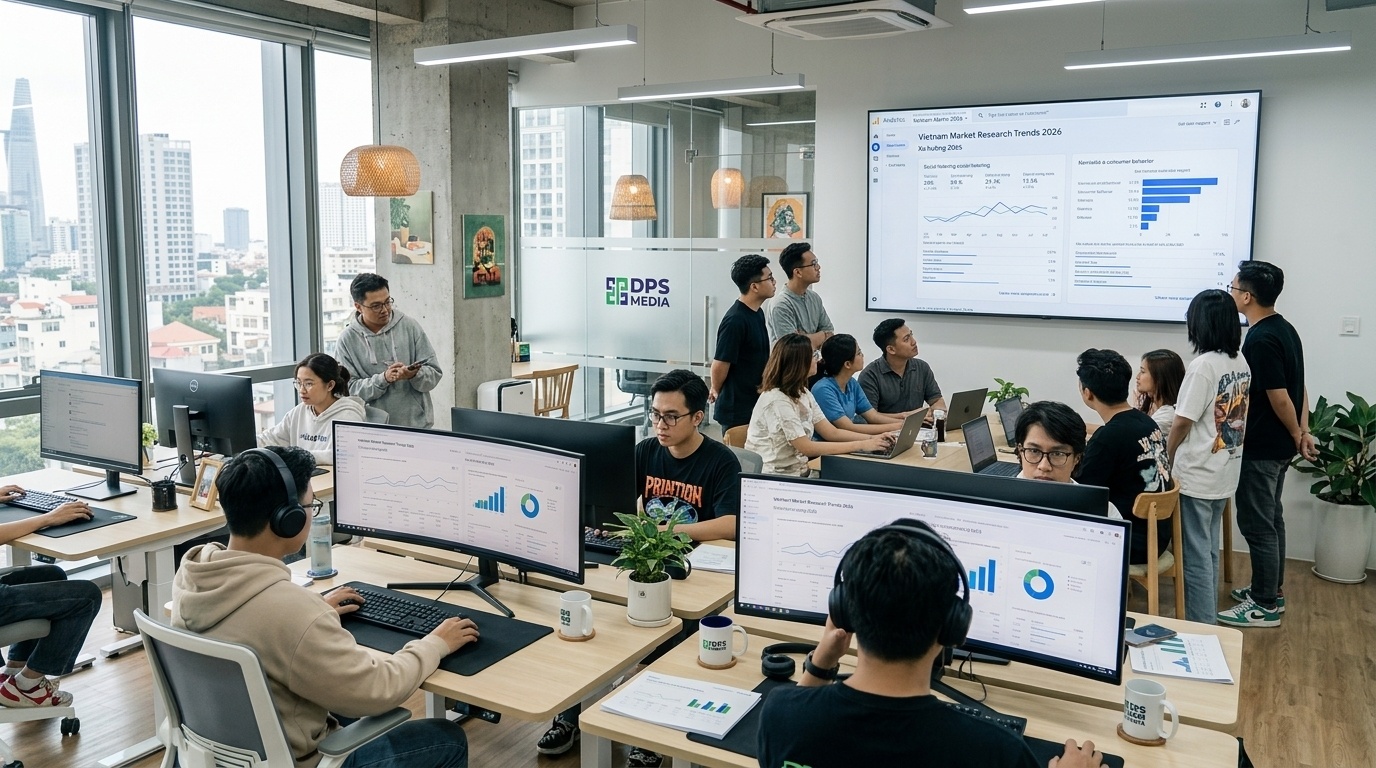
AI and social listening are changing how data is collected
AI helps businesses analyze thousands of comments and customer feedback in a short time. This is especially useful for SMEs without deep research teams.
Social listening also helps brands detect crises earlier. Businesses can monitor customer sentiment in real-time instead of waiting for end-of-quarter reports.
Vietnamese users prioritize multi-platform experiences
According to We Are Social 2026, Vietnamese users often research brands on multiple platforms before buying. This forces businesses to research omnichannel behavior instead of just tracking one channel.
SMEs should combine website, social media, and e-commerce platform data for a more comprehensive view of customers.
What do SMEs need to prepare to better utilize data?
Businesses need to build a data collection process from the start instead of waiting for a large scale to deploy. Standardizing data early will help marketing be more effective in the long run.
Types of market research will continue to play an important role as digital competition increases. SMEs need to choose the right method instead of trying to deploy every form at once.
- Start with free data first
- Clearly identify research objectives
- Combine qualitative and quantitative
- Monitor data every quarter
- Prioritize revenue-related insights
- Synchronize data across platforms
If businesses need to build market-research-strategy and a more professional digital marketing strategy, DPS. MEDIA can accompany as an execution partner for Vietnamese SMEs in the digital growth phase.