





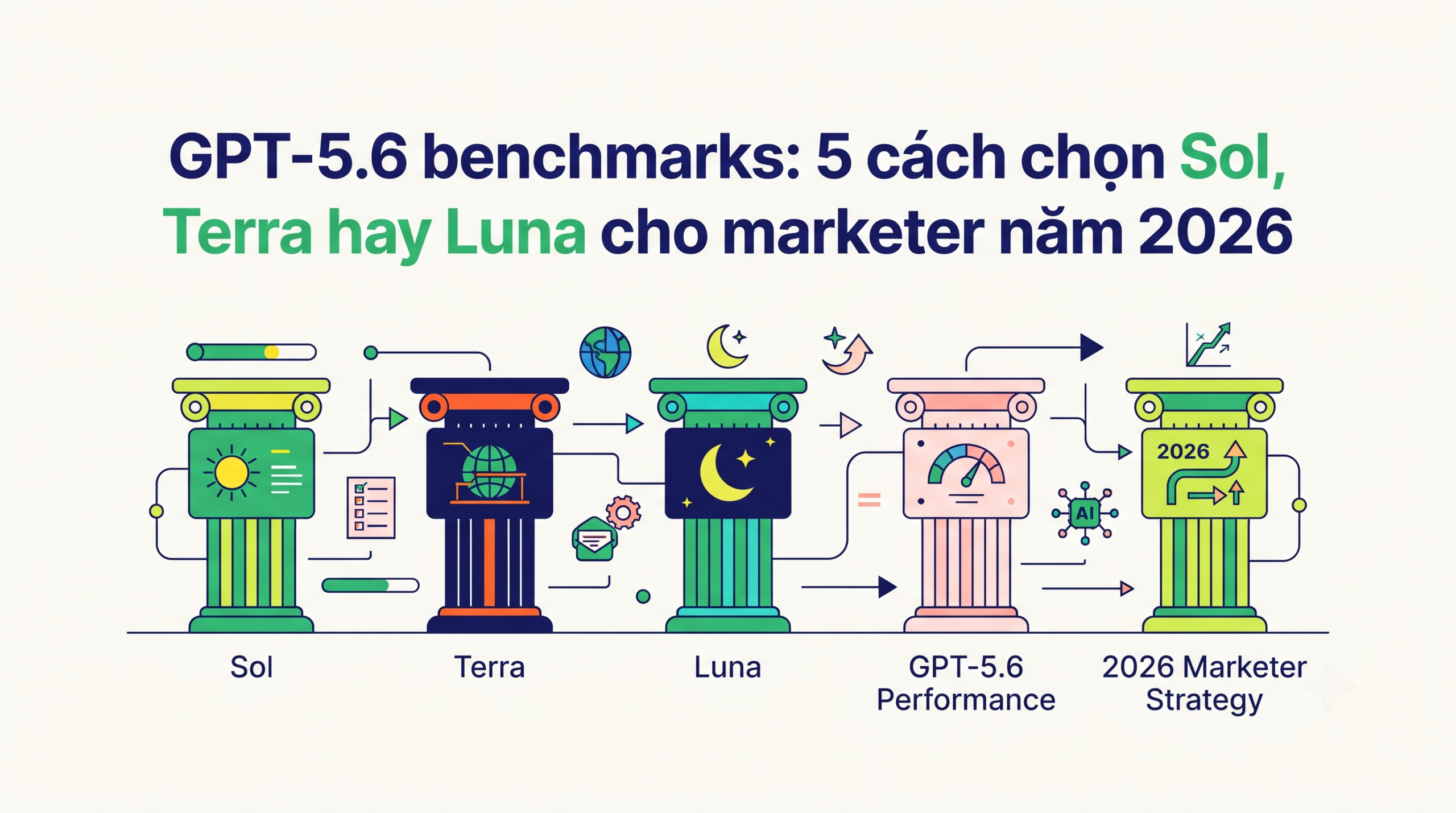
GPT-5.6 benchmarks are being widely discussed not only because the new models are faster or smarter. What matters to marketers is that OpenAI has divided the model lineup into three tiers: Sol, Terra, and Luna, each offering different trade-offs among quality, speed, and cost.
Vellum's analysis of GPT-5.6 benchmarks raises a practical question: is it necessary to use the most expensive model for every campaign? The brief answer is no. Marketing teams should choose models based on the type of work, workflow length, and the risk involved when AI produces an incorrect answer.

OpenAI announced GPT-5.6 Sol, Terra, and Luna for ChatGPT, Codex, and the API starting in July 2026. In OpenAI's official announcement, Sol is the flagship tier, Terra is the balanced choice for everyday work, while Luna is designed for speed and cost efficiency.
What do GPT-5.6 benchmarks say—and not say?
A benchmark is a snapshot under specific testing conditions, not a promise that a model will always win across every advertising account, brief, or market. Marketers should treat benchmarks as data for forming hypotheses, then validate them using the company's real task set.
- Sol: prioritizes quality for complex, multi-step tasks that require tools or self-verification of results.
- Terra: provides a balanced option for most everyday work, such as writing, analysis, planning, and content variation.
- Luna: is suitable for high-volume pipelines where the cost per processing run matters more than the final few points of quality.
Vellum also notes that comparison tables are not always fully equivalent: some benchmarks are self-reported by labs, others are evaluated by third parties, and reasoning configurations may differ. Therefore, do not use a single number to declare that one model is the absolute winner.
1. Multi-step marketing work requires evaluating agent capabilities
A chatbot answering one question and an AI agent completing an entire workflow are two different types of work. In agentic marketing, the model must read the brief, find data, compare sources, create a draft, check for errors, call tools, and only then deliver the result.
This is why benchmarks such as Agents’ Last Exam, Terminal-Bench, BrowseComp, and OSWorld matter. They are closer to how a marketing team runs a campaign than a standalone question-and-answer test.
For example, when AI must review dozens of competitor pages, build a messaging matrix, identify content gaps, and propose a publishing calendar, Sol may be worth the cost. When the task is simply turning one message into 20 headline variations, Terra or Luna is usually a more reasonable starting point.
2. Higher quality does not necessarily mean greater business efficiency
OpenAI announced GPT-5.6 API pricing per one million tokens: Sol costs USD 5 for input and USD 30 for output; Terra costs USD 2.5 for input and USD 15 for output; Luna costs USD 1 for input and USD 6 for output. The output price difference between Sol and Luna is fivefold, not including how many tokens each model consumes during a long workflow.
| Model | Positioning | Suitable marketing use case |
|---|---|---|
| Sol | High quality, difficult tasks | Strategy, multi-source research, complex agents, final review |
| Terra | Balanced | Content plans, SEO briefs, campaign analysis, emails, and landing pages |
| Luna | Fast and cost-efficient | Lead classification, summarization, variation generation, labeling, and batch processing |
Do not only ask which model has the highest score. Ask how much one completed task costs, how long it takes, and how much human revision it requires. A cheaper model that constantly needs corrections may not actually be cheaper; a more expensive model that significantly reduces review rounds may have a lower total cost.
3. Long context should not be assigned mechanically to the cheapest model
Marketers often work simultaneously with brand guidelines, advertising reports, customer research, product tables, and campaign histories. With long context, the issue is not only whether the model can read the documents; it must also correctly remember details from the beginning when drawing conclusions at the end.
Vellum's analysis highlights a notable gap among the tiers in long-context recall, especially for Luna. This signals that the cheapest model should not be used for work requiring comparisons across multiple documents, verification of brand requirements, or synthesis of decision-critical insights.
A safer approach is to divide the workflow into two layers: Luna or Terra handles structured collection and summarization; Sol or Terra handles synthesis, cross-checking, and final recommendations.
4. Computer use and browsing enable a new form of marketing automation
GPT-5.6 is designed for workflows involving browsers, tools, and multiple actions. For marketers, this can transform AI from a content writer into an operational layer that checks landing pages, reads campaign data, compares landing pages against briefs, and identifies inconsistencies.
However, computer interaction capabilities also increase control requirements. Tasks that can send emails, change budgets, or edit public-facing assets must include approval steps, permission limits, and action logs.
- Use Luna for steps where an error would not cause serious consequences, such as grouping or standardizing data.
- Use Terra for operations with clearly defined procedures that require speed.
- Use Sol for steps requiring judgment, cross-checking, or high-impact decisions.
5. Benchmarks must be connected to the team's own test set
No public benchmark fully understands your business. A retail team needs to test whether models preserve accurate product information; a B2B team needs to test research quality and lead qualification; an agency team needs to test whether models maintain brand voice across multiple clients.
Create a small test set of 30 to 50 real tasks, divided into three groups: high-volume tasks, reasoning-intensive tasks, and tasks involving brand risk. Evaluate not only accuracy but also time, token usage, revision count, and the percentage requiring human intervention.
GPT-5.6 routing for marketing teams: where should you start?
- Set Terra as the default: use it for most briefs, content plans, and standard marketing analysis.
- Route high-volume tasks to Luna: classification, summarization, variation generation, and data preprocessing.
- Only escalate to Sol when there is a reason: difficult research, multi-step workflows, final evaluation, or tasks where mistakes are costly.
- Set budget thresholds: track costs by campaign, client, and task type instead of looking only at a general total AI cost.
- Keep human review at sensitive points: legal content, product claims, pricing, advertising budgets, and customer data should not be published entirely automatically.
A simple routing rule could be: Luna produces high-volume drafts, Terra refines structure and tone, and Sol reviews critical sections. Not every task needs to pass through all three tiers, but the team should know when a model upgrade is necessary.
Do not read a benchmark table as the final ranking
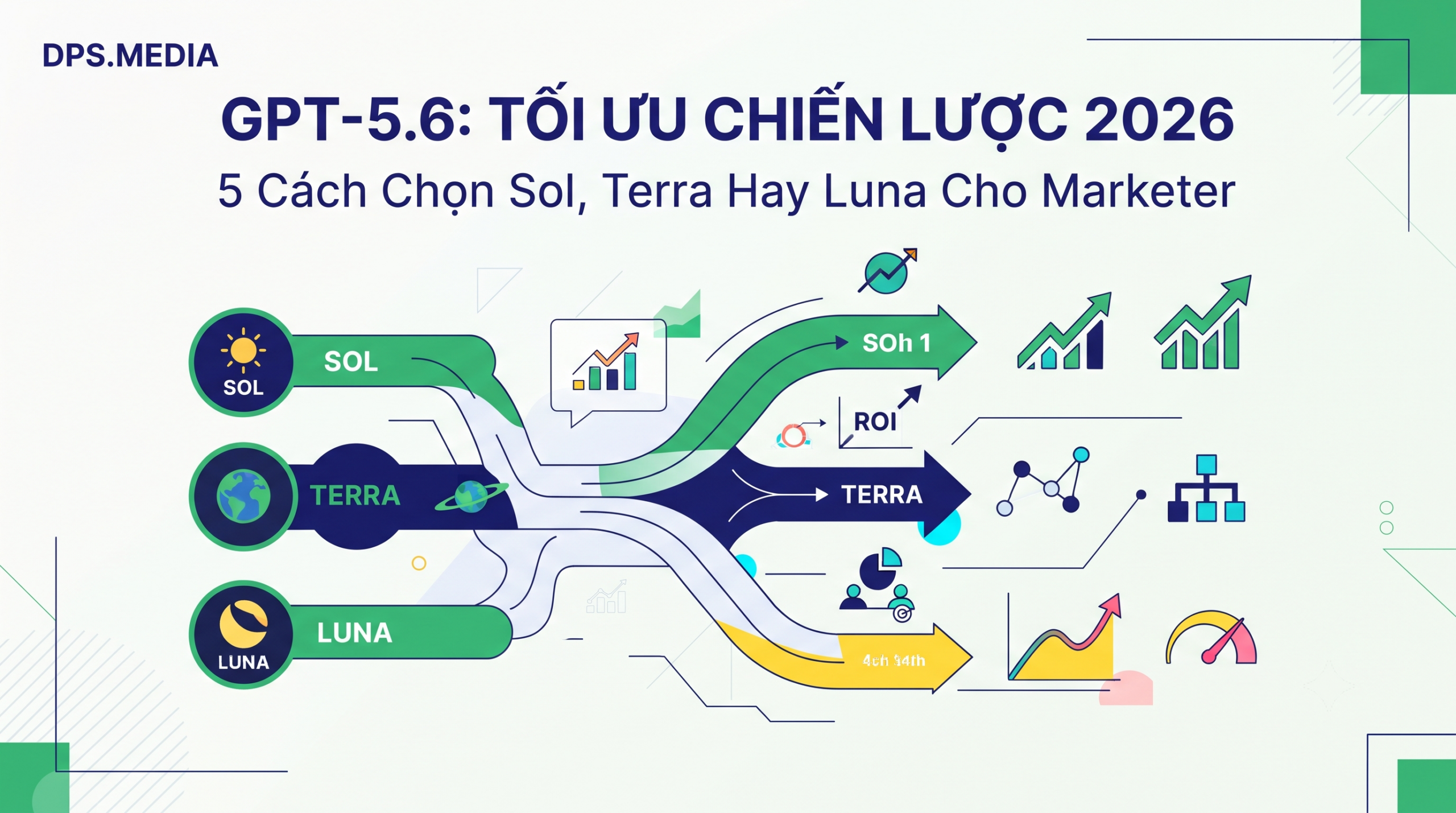
The strongest point about GPT-5.6 in Vellum's analysis is not the claim that one model wins every test. More notable is the tier separation: Sol for difficult work, Terra for balanced work, and Luna for volume and cost efficiency.
That is also how marketers should interpret every new model announcement. Instead of asking which AI is the smartest, ask which AI is best suited to a specific step in the funnel, given the current risk level and budget.
To save this guide for later, you can also read GPT-5.6 benchmarks and how marketers can choose an AI model as an internal routing checklist.
Conclusion
GPT-5.6 Sol, Terra, and Luna show that the future of AI marketing will not be about choosing one model and using it for everything. More effective teams will know how to route tasks, measure quality using real data, and balance speed and cost with the appropriate level of control.
When your business needs to turn AI, data, and content into a measurable growth system, refer to high-quality Digital Marketing services of DPS.MEDIA. Benchmarks start the discussion; workflows and business results are the ultimate test.
Ý kiến bạn đọc (9)
Đăng nhập để bình luận
Đăng nhập nhanh 1-chạm bằng Google để chia sẻ ý kiến của bạn về bài viết.
Bằng cách đăng nhập, bạn đồng ý với điều khoản và chính sách cộng đồng.
Chưa có bình luận nào. Hãy là người đầu tiên chia sẻ cảm nghĩ!
Đăng nhập / Tạo tài khoản
Đăng nhập với Google để gửi bình luận và tương tác cùng cộng đồng.
Tiếp tục là đồng ý với điều khoản sử dụng và chính sách bảo mật của DPS Media.