


Competitor analysis frameworks are becoming an essential tool for Vietnamese SMEs as advertising costs rise and digital competition becomes increasingly fierce. According to We Are Social 2026, Vietnam has more than 72.7 million users social networks and digital usage levels are continuously increasing, making public data a valuable source of insight for businesses.
According to Statista 2026, the digital advertising market in Vietnam continues to grow strongly, and search advertising still accounts for a high proportion of online advertising budgets. This makes understanding competitor strategies a practical competitive advantage, no longer just an optional extra.
This article helps SMEs understand how to implement competitive intelligence, build a competitor SWOT, and transform public data into actionable marketing decisions. Based on DPS. MEDIA's experience, many small businesses fail not because of a lack of budget but due to a lack of a systematic competitor analysis system.
What is a competitor analysis framework and why should SMEs care?
A competitor analysis framework is a system that helps businesses collect, standardize, and interpret market data. This framework usually combines SEO, advertising, social media, and customer feedback data to create a comprehensive view.
SMEs often compete in markets with limited budgets. Therefore, understanding where competitors are investing will help reduce trial-and-error costs. This is also the foundation of modern competitive intelligence.
Why public data is becoming a competitive advantage
Most businesses now leave behind a very large digital footprint. Websites, Meta ads, TikTok, Google Search, or customer reviews are all public data that can be analyzed.
According to We Are Social 2026, the number of social media users in Vietnam increased by nearly 9.8% in just one year. This creates a huge amount of behavioral data that SMEs can leverage to understand competitors and customers.
A cosmetics brand in District 3 once monitored a competitor's TikTok content for three months. They discovered that real review videos generated higher engagement rates than studio videos. After changing the format, the landing page conversion rate increased by 34%.
An office furniture business in Binh Thanh made a mistake by only looking at fanpage followers. They ignored advertising and SEO data. As a result, they spent over 120 million VND on a campaign for the wrong customer segment before readjusting their funnel.
- Observing ad frequency helps predict competitor budgets.
- Analyzing SEO keywords reveals a business's commercial priorities.
- Customer reviews reflect actual service weaknesses.
- Social media content demonstrates brand positioning strategy.
- Landing pages help evaluate the sales funnel structure.
- Traffic data helps measure market growth levels.
| Data source | Insight obtained | Utility level | Monitoring frequency |
|---|---|---|---|
| Google Search | Strategic Keyword | High | Weekly |
| Meta Ad Library | Advertising message | High | Weekly |
| TikTok | Content trends | Average | Daily |
| Customer reviews | User pain points | High | Monthly |
Common mistakes when SMEs do competitive intelligence
Many SMEs understand competitive intelligence as copying competitors. This is a common mistake. The real goal is to find market gaps and optimize marketing decisions.
Another error is collecting too much data without clear KPIs. SMEs should prioritize metrics directly related to leads, conversions, and advertising costs.
An education business in Thu Duc once tracked more than 15 competitors simultaneously. The data was too scattered, causing the marketing team to spend nearly two months without drawing actionable insights. After reducing to 4 main competitors, CPL decreased by 22%.
- Not distinguishing between direct and indirect competitors.
- Only focusing on social media.
- Ignoring SEO and paid search data.
- Not standardizing measurement KPIs.
- Analyzing data but not turning it into action.
- Tracking too many competitors at once.
When businesses should implement a competitor SWOT
A competitor SWOT is suitable when a business is preparing to launch a new product, increase advertising budgets, or enter a highly competitive market. This is a method to systematize a competitor's strengths, weaknesses, opportunities, and threats.
Businesses should implement a competitor SWOT when they see unusual increases in advertising costs or continuously decreasing conversion rates. This is often a sign of new competitors in the market or that old strategies have lost effectiveness.
DPS. MEDIA recommends that SMEs update their competitor SWOT every quarter instead of every year. Digital marketing cycles now change much faster than in the pre-2026 period.
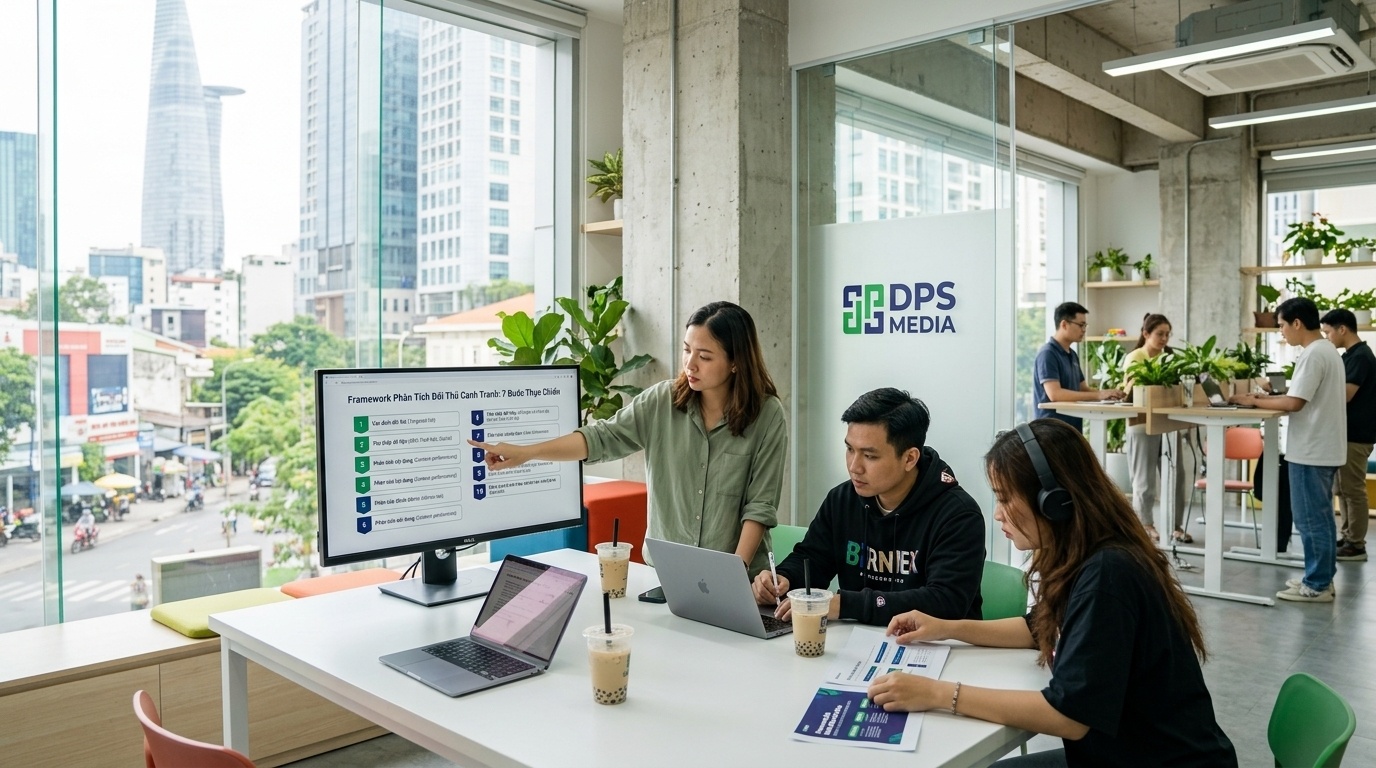
A competitor analysis framework consisting of 7 practical steps
Identify groups of direct and indirect competitors
The first step is to correctly identify competitor groups. Direct competitors compete for the same products and the same customer segment. Indirect competitors may have different products but solve the same need.
SMEs should limit themselves to 3 to 5 focus competitors. This is a suitable threshold to monitor data without becoming overwhelmed.
A milk tea brand in Go Vap once viewed every beverage shop as a competitor. After reclassifying, they discovered the real competitors were strong delivery brands on delivery apps. Online revenue increased by 27% after three months of optimizing the menu based on this insight.
- Identify target customer groups before choosing competitors.
- Distinguish between brand competitors and advertising competitors.
- Prioritize businesses with the same price point.
- Track emerging competitors as well.
- Evaluate the digital coverage level of each unit.
- Eliminate businesses outside the segment.
- Standardize the list by industry.
Collect data from websites, social media, and advertising
This is the most important step in the competitor analysis framework. SMEs need to build a periodic data collection process instead of acting on intuition.
Websites help evaluate SEO structure and sales funnels. Social media reflects content strategy. Meanwhile, ad libraries show which messages and offers are being prioritized.
According to Statista 2026, mobile ads continue to increase in proportion in Vietnam. This shows that SMEs need to prioritize monitoring the competitor's mobile experience instead of just looking at desktop.
| Channel | Data to track | Targets | Tool |
|---|---|---|---|
| Website | Keywords and CTA | SEO | Ahrefs |
| Advertising content | Paid social | Meta Ad Library | |
| TikTok | Viral video | Content trend | TikTok Creative Center |
| Google Ads | Search intent | Lead generation | Google Ads Transparency |
Analyze content and SEO strategy
SEO reflects a business's long-term growth direction. SMEs should look at which keywords competitors are investing in, what content generates traffic, and which landing pages have many backlinks.
According to Statista 2026, search advertising is still the group with the highest spending in digital advertising in Vietnam. This shows that search intent continues to be an important source of leads.
A logistics company in District 7 used to focus on running ads but ignored SEO. After analyzing the competitor analysis framework, they discovered the leader succeeded thanks to a cluster of import-export keywords. Six months later, organic leads increased by 41%.
- Measure top traffic keywords.
- Analyze high-conversion content.
- Track quality backlinks.
- Evaluate website speed.
- Check internal link structure.
- Compare CTAs on landing pages.
Evaluate advertising effectiveness and sales funnels
SMEs cannot directly view a competitor's ROAS. However, advertising effectiveness can be inferred through ad duration, creative change frequency, and funnel structure.
If an ad runs continuously for more than 30 days, there is a high probability the campaign is bringing good results. Conversely, ads that change too quickly often reflect poor performance.
A dental clinic in Phu Nhuan once copied a competitor's landing page without understanding the funnel behind it. They lost nearly 80 million VND on advertising, but the booking rate only reached 1.2%. After adding a chatbot and remarketing, conversion increased to 3.8%.
Build a competitor SWOT into actionable insights
A competitor SWOT is only useful when it is translated into specific decisions. SMEs should link each insight with a clear marketing or sales action.
For example, if a competitor is strong in SEO but weak in social commerce, the business could prioritize TikTok Shop. If a competitor has many negative reviews about customer service, that is an opportunity to improve the customer experience.
| SWOT Factor | Observed signs | insight | Actions |
|---|---|---|---|
| Strength | Strong SEO | Long-term content investment | Increase SEO budget |
| Weakness | Bad reviews | Weak customer service | Focus on retention |
| Opportunity | New Keyword | Increased demand | Launch new landing page |
| Threat | Ads increasing strongly | High competition | Optimize CPL |
How does competitive intelligence help SMEs optimize marketing?
Optimize advertising budgets according to market gaps
Competitive intelligence helps SMEs avoid burning budgets in saturated markets. Instead of direct competition, businesses can choose long-tail keywords or niche customer groups.
An English center in Tan Bình once competed for general IELTS keywords with many large brands. After analyzing competitors, they switched to IELTS keywords for working professionals. CPL decreased by 31% after just two months.
- Prioritize long-tail keywords with high intent.
- Reduce direct competition.
- Optimize remarketing budget.
- Measure CPL by industry group.
- Allocate budget seasonally.
- Track weekly CPC fluctuations.
Discover customer insights from public feedback
Public reviews are a very valuable data warehouse. SMEs can understand where customers are satisfied or frustrated when using a competitor's product.
A spa chain in District 1 discovered many customers complaining about long wait times at a competitor. They implemented an online booking system and increased the return customer rate by 18%.
Track industry fluctuations and new trends
The competitor analysis framework does not only serve marketing. It also helps businesses track market trends and changes in user behavior.
According to the We Are Social 2026 report, Vietnamese users spend more time on short videos and social commerce. This causes many industries to adjust their content strategy towards being more concise and visual.
DPS. MEDIA recommends that SMEs build a monthly competitive intelligence dashboard to track traffic, advertising, and content fluctuations. Continuous updates will help businesses react faster to market changes.
Tools supporting the competitor analysis framework
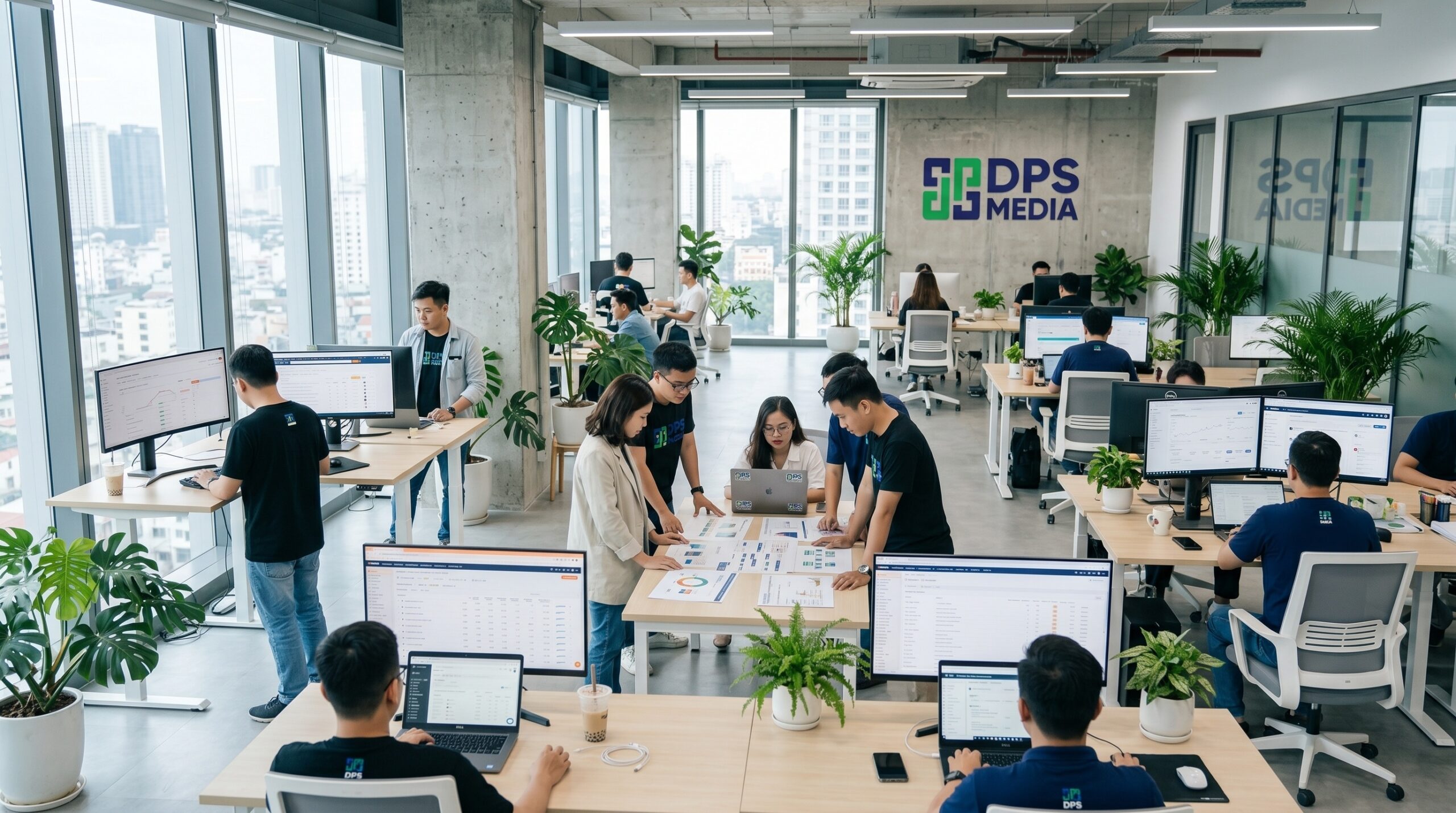
SEO and traffic intelligence tools
Ahrefs, SEMrush, and Similarweb are three popular tools that help SMEs track competitor keywords, backlinks, and traffic. SMEs do not need to buy all of them at once.
With a limited budget, businesses should prioritize tools that serve current goals. If focusing on organic leads, SEO tools will be more important than social listening.
- Ahrefs is suitable for backlink analysis.
- SEMrush is strong for keyword gaps.
- Similarweb supports traffic estimation.
- Google Trends helps view trends.
- Looker Studio supports KPI dashboards.
Social listening tools and ad libraries
Meta Ad Library helps SMEs see a competitor's active ads. TikTok Creative Center helps discover trending videos and popular hashtags.
Additionally, social listening helps detect brand crises early. This is a major advantage in the F&B, education, and retail industries.
KPI Dashboard for SMEs Vietnam
SMEs should create simple dashboards instead of overly complex systems. An effective dashboard needs to focus on actionable metrics.
Important KPIs include organic traffic, top 10 keywords, CPL, ad CTR, and landing page conversion rates. Based on DPS. MEDIA's experience, Vietnamese SMEs often fail because they measure too many metrics unrelated to revenue.
How to apply the competitor analysis framework for Vietnamese SMEs
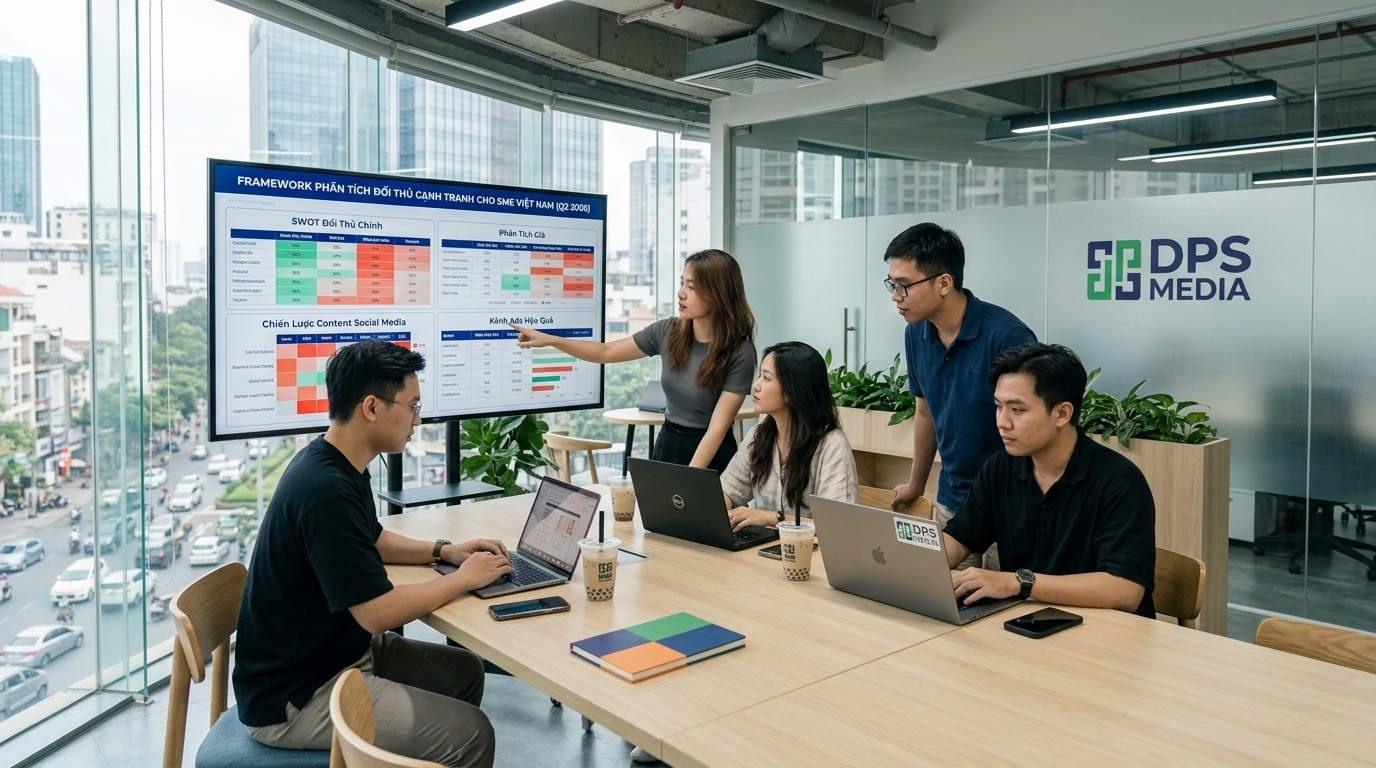
F&B industry case in Ho Chi Minh City
A bakery brand in District 10 used to depend entirely on Facebook Ads. After implementing the competitor analysis framework, they discovered the competitor grew strongly thanks to Google Maps SEO.
The business shifted budget to local SEO and optimized customer reviews. After four months, the number of orders from Google Maps increased by 46% and advertising costs decreased significantly.
B2B service business case
A warehouse management software company in Ho Chi Minh City once ran very broad ads. The qualified lead rate only reached 12%.
After analyzing competitive intelligence, they discovered the competitor focused on in-depth content for the logistics industry. The marketing team started building a series of industry-specific landing pages and increased the SQL rate to 28% in the next quarter.
90-day implementation checklist
- Weeks 1-2: identify 3-5 focus competitors.
- Weeks 3-4: collect SEO and social data.
- Month 2: build competitor SWOT.
- Month 2: standardize KPI dashboard.
- Month 3: implement new ad tests.
- Month 3: measure conversion and optimize funnel.
- End of quarter: update strategic insights.
The competitor analysis framework is not a one-time activity. It is a continuous process that helps SMEs reduce trial-and-error costs and accelerate digital marketing growth.
Businesses need to remember that data is only valuable when transformed into specific actions. Effective competitive intelligence must lead to clear decisions regarding budget, content, SEO, or advertising.
- Analyze the right competitor group before collecting data.
- Combine SEO, social, and paid media for a comprehensive view.
- Prioritize insights that can be acted upon immediately.
- Update competitor SWOT periodically every quarter.
- Track CPC fluctuations and search trends regularly.
- Standardize KPI dashboards according to revenue goals.
In the context of increasingly strong digital competition in Vietnam, SMEs need a practical market analysis system rather than making decisions based on intuition. DPS. MEDIA is the right partner for businesses wanting to build a systematic competitor analysis framework and optimize long-term marketing effectiveness.