






Digital marketing is becoming a vital priority for Vietnamese SMEs as advertising costs rise and customer behavior changes rapidly. According to We Are Social 2026, Vietnam has 79.8 million users internet and over 76.2 million active social media accounts. This article helps businesses understand how to build an effective digital marketing strategy and optimize growth budgets.
According to the Digital 2026 report by We Are Social and Meltwater, Vietnamese people spend an average of over 6 hours per day on the internet. Mobile currently accounts for 83% website traffic in Vietnam. This makes online advertising and the digital content ecosystem the most important touchpoint with SME customers.
According to the experience of DPS. MEDIA, many small and medium enterprises fail not because of a lack of budget but because of choosing the wrong digital marketing channels. Measuring the wrong KPIs or implementing with a lack of data causes advertising costs to rise quickly without generating real customers.
How is digital marketing for SMEs in Vietnam changing?
Digital user behavior in 2026
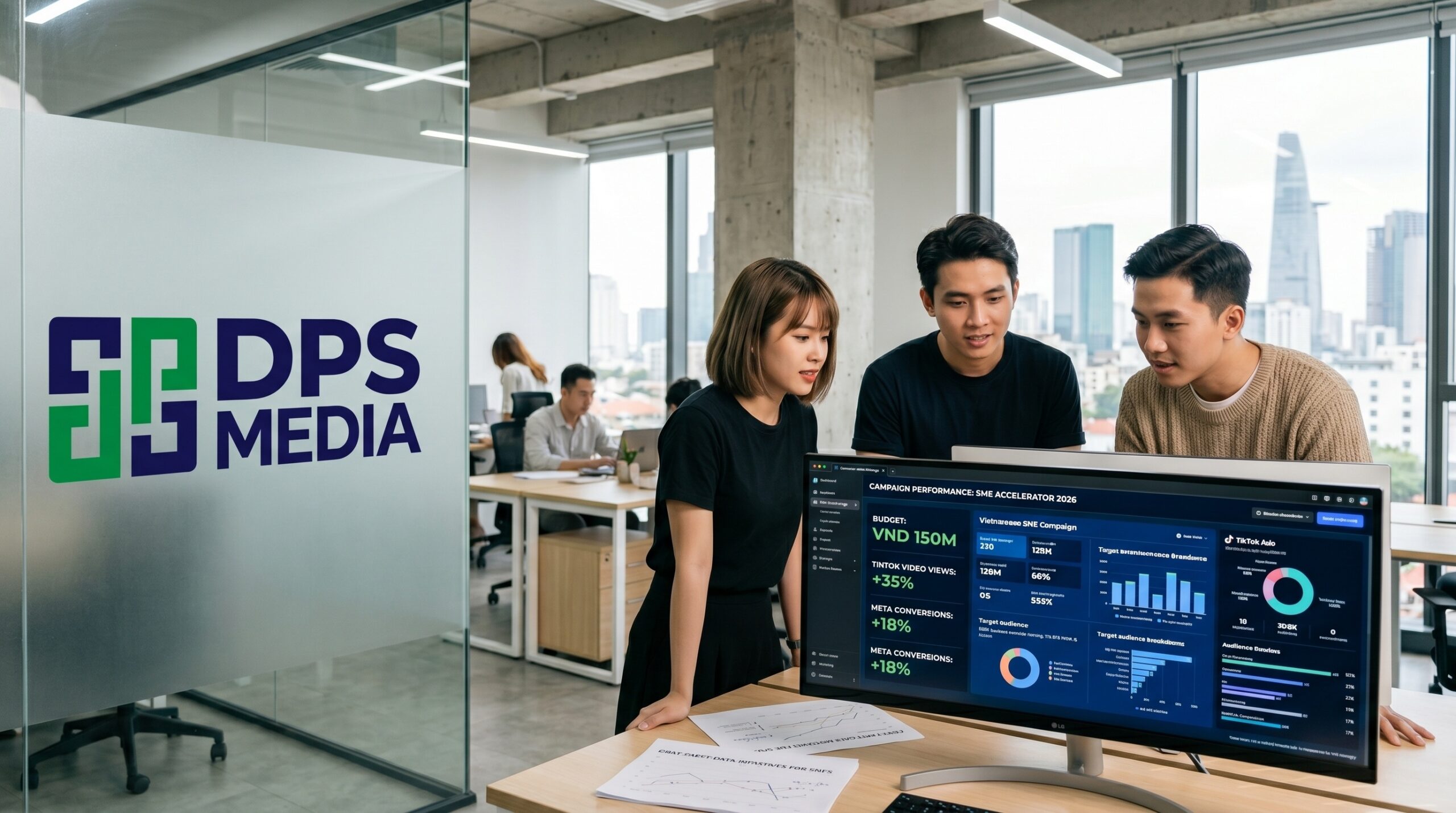
According to Digital Insight 2026 Vietnam, up to 95.4% of Vietnamese internet users use at least one social media platform. Facebook, TikTok, and YouTube continue to lead in terms of usage time. This changes how SMEs approach customers in digital marketing.
Many businesses that previously only invested in websites have now shifted to multi-platform strategies. Customers often watch TikTok before searching on Google or reading reviews on Facebook. The buying journey has become much more complex compared to the period before 2026.
- Users prioritize short videos under 60 seconds.
- Mobile devices account for the majority of traffic.
- Brand searches via social media are increasing strongly.
- Customers believe in UGC and real reviews.
- Purchase decision time is shorter than before.
- Social commerce is growing rapidly in Vietnam.
Ms. Hanh, owner of a spa in District 3, used to only run traditional Facebook Ads. After implementing short TikTok videos combined with landing pages, the number of leads increased by 42% in three months. The cost per potential customer decreased to 68.
000 VND.
A furniture business in Binh Thanh faced a different problem. They invested over 120 million VND in online advertising but did not optimize for mobile. The bounce rate exceeded 78%.
After improving website speed and business SEO content, the conversion rate doubled.
| Indicators | 2026 | 2026 | Source |
|---|---|---|---|
| Internet users | 79.5 million | 79.8 million | We Are Social 2026 |
| Social media accounts | 72.7 million | 76.2 million | DataReportal 2026 |
| Mobile traffic | 79% | 83% | We Are Social 2026 |
| Daily online time | 5h48 | 6h05 | Meltwater 2026 |
Why SMEs shift budgets to digital marketing
Digital marketing allows SMEs to measure effectiveness almost in real-time. Businesses can know which ads generate leads, which keywords generate revenue, and which content has high conversion rates.
Meanwhile, offline channels are increasingly difficult to measure ROI accurately. A billboard or flyer campaign may create awareness but is very difficult to determine actual revenue. This makes SMEs prioritize budgets for digital marketing.
Outstanding digital marketing trends
AI marketing is changing how businesses produce content and optimize ads. According to AnyMind Group 2026, brands in Vietnam are strongly increasing investment in first-party data and marketing automation to reduce platform dependence.
Short video and social commerce continue to be the two strongest growth trends. According to Research and Markets 2026, the Vietnam social commerce market is expected to reach 5 billion USD in 2026.
Effective digital marketing channels for SME businesses
SEO and content marketing
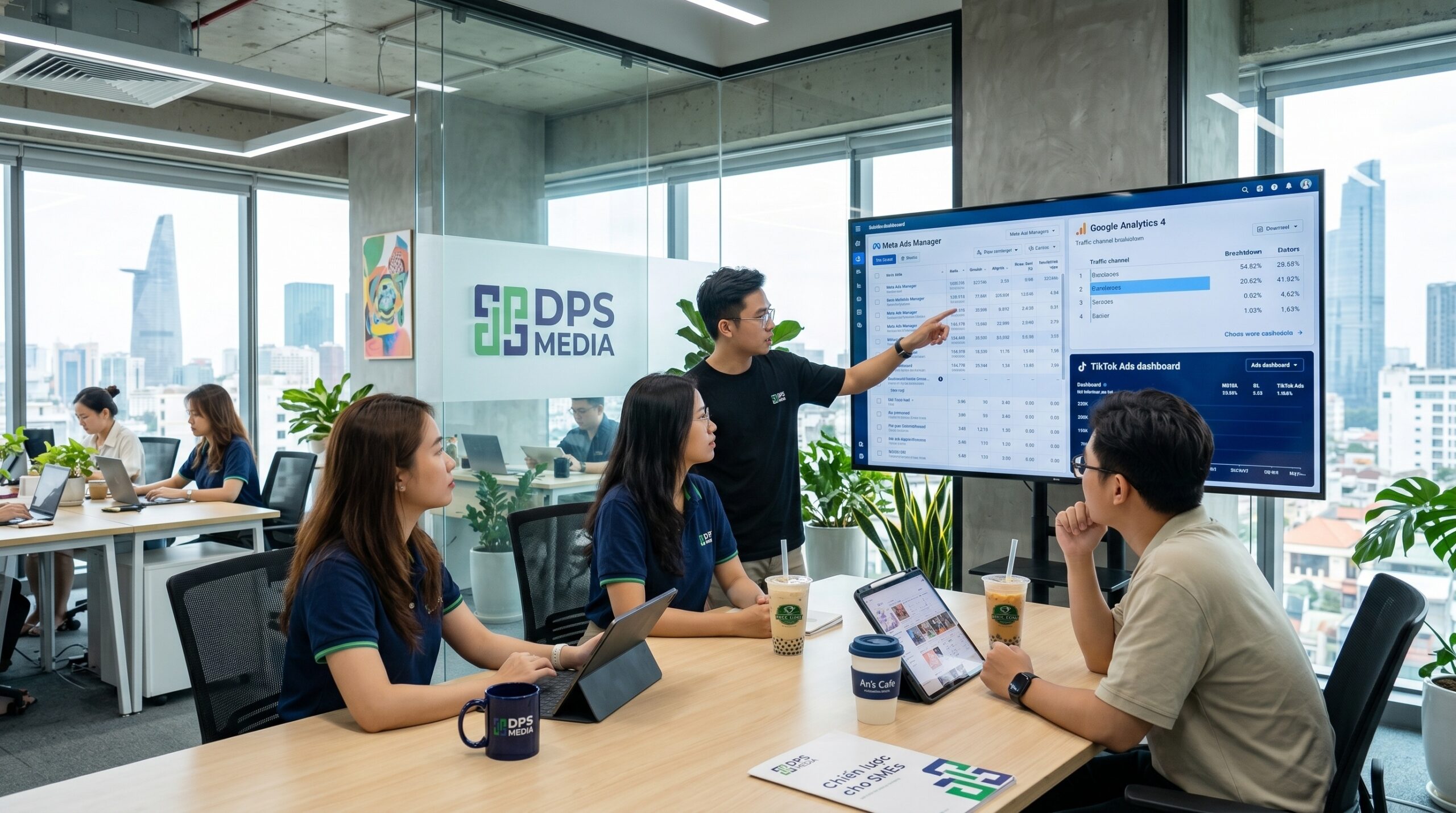
Business SEO helps SMEs build sustainable traffic instead of depending entirely on paid advertising. An effective SEO strategy usually needs 4 to 8 months to create stable growth.
Businesses should prioritize groups of keywords with high purchase intent. For example, the keyword “small business accounting services” often has better conversion rates than generic keywords like “accounting”.
DPS. MEDIA recommends SMEs build content clusters based on each customer need instead of writing separate posts. This helps the website increase topical authority and improve long-term search rankings.
- Focus on keywords with purchase intent.
- Optimize loading speed on mobile.
- Build in-depth blogs following topic clusters.
- Invest in high-conversion landing pages.
- Combine SEO with social content.
- Measure monthly traffic and leads.
Mr. Nam, owner of an office furniture company in Thu Duc, implemented a SEO content strategy in 9 months. Organic traffic increased by 210% and brought in an average of 120 leads per month.
An education business in Tan Binh once bought cheap backlinks to increase rankings quickly. The website's traffic dropped by more than 60% after a Google algorithm update. After six months of re-optimizing content and technical SEO, traffic recovered by about 75%.
| Channel | Initial cost | Effectiveness period | Sustainability level |
|---|---|---|---|
| SEO | Average | 4-8 months | High |
| Google Ads | High | Immediate | Average |
| Facebook Ads | Average | 1-2 weeks | Average |
| Email marketing | Low | 2-4 weeks | High |
Facebook Ads and TikTok Ads
Facebook Ads are suitable for broad customer groups and remarketing needs. Meanwhile, TikTok Ads are more effective for products needing visual videos and viral potential.
SME businesses should set CPL benchmarks before running online ads. If CPL exceeds the target by 20% for 7 consecutive days, creative or targeting needs to be optimized.
Google Ads for high conversion needs
Google Ads is suitable for customers who already have clear needs. This is a channel with high conversion rates if businesses properly optimize landing pages and keyword intent.
A kitchen equipment showroom in Phu Nhuan implemented Google Ads according to high-conversion keyword groups. The closing rate increased by 31% after two months despite the budget remaining the same.
Email marketing and automation
Marketing automation helps SMEs save personnel and increase customer care capabilities. Basic workflows like welcome emails or abandoned cart reminders usually have very good ROI.
Businesses should maintain an open rate above 25% and a CTR of 3% or more. If lower, subject lines and customer data segmentation need optimization.
How to build a budget-optimized digital marketing strategy

Determine appropriate KPIs for each stage
Many SMEs set the wrong KPIs from the start. New businesses often focus too much on revenue while ignoring traffic and leads. This makes campaigns prone to failure.
In the early stage, businesses should track traffic, CTR, and cost per lead. When the system is more stable, they can shift to ROAS and lifetime value.
- Measure CPL by each advertising channel.
- Compare landing page conversion rates.
- Track ROAS by campaign.
- Monitor customer retention rate.
- Measure monthly organic traffic.
- Evaluate cost per order.
A natural cosmetics brand in Go Vap once set a ROAS goal in the first month. The campaign failed and lost more than 80 million VND. After switching to lead and remarketing KPIs, the conversion rate increased from 1.2% to 3.8%.
A dental clinic in District 10 was successful thanks to full tracking of lead sources. They discovered Google Ads generated fewer leads than Facebook but the closing rate was three times higher.
Allocate budget by channel
SMEs should not put their entire budget into one platform. Instead, it should be divided by awareness, conversion, and remarketing goals.
| Targets | Priority channel | Proposed proportion | Main KPI |
|---|---|---|---|
| Recognition | TikTok Ads | 30% | Reach |
| Lead | Facebook Ads | 35% | CPL |
| Conversion | Google Ads | 25% | ROAS |
| Retention | Email marketing | 10% | Repeat rate |
Common mistakes SMEs often make
Many businesses run online ads without a dedicated landing page. This reduces conversion rates and significantly increases advertising costs.
Another common mistake is over-reliance on promotions. This leads to many short-term orders but low profits and difficulty in retaining customers.
Effective deployment process
An effective digital marketing campaign needs to follow a clear process from market research, customer persona analysis, content building to data measurement.
According to the experience of DPS. MEDIA, SMEs should review advertising data at least weekly instead of waiting until the end of the month. Continuous optimization helps reduce budget waste significantly.
Criteria for choosing a suitable digital marketing agency

Industry experience and case studies
A digital marketing agency needs practical experience with industries similar to the business. A good case study must clearly show goals, KPIs, and measured results.
Businesses should ask the agency to explain the strategy instead of just providing an advertising quote. This helps evaluate long-term thinking capabilities.
- Check case studies by industry.
- Request transparent KPIs.
- Evaluate data analysis capabilities.
- Check reporting processes.
- Compare creative capabilities.
- View multi-channel optimization capabilities.
Measurement and reporting capabilities
A good agency must have a dashboard or clear tracking system. Businesses need to know where leads come from and which channel generates the highest revenue.
If an agency only reports engagement without conversion data, SMEs should reconsider the partnership.
Strategic thinking instead of just running ads
Many agencies only focus on media buying but ignore brand strategy. This makes businesses dependent on advertising and difficult to grow long-term.
SMEs should prioritize entities capable of building a synchronized ecosystem of content, SEO, and marketing automation.
Cost and service commitments
Low cost does not mean high efficiency. A cheap agency lacking tracking can cause a business to waste a much larger budget.
Businesses should evaluate total ROI instead of just looking at monthly service fees.
What do SMEs need to prepare for digital marketing in the next 3 years?

AI and marketing automation
AI marketing will help SMEs optimize ads faster and personalize content better. However, AI is only effective when businesses have quality customer data.
Automation tools will change marketing workflows in the next three years. SMEs need to prepare personnel capable of reading data and analyzing customer behavior.
Social commerce and short video
Social commerce is growing strongly thanks to TikTok Shop and Facebook Marketplace. Users are increasingly buying directly on platforms instead of visiting websites.
Businesses should invest in short videos with entertainment value and real reviews. Overly promotional content is no longer as effective as before.
First-party data and data privacy
Data privacy regulations are increasingly tightening. Businesses need to build first-party data systems instead of depending entirely on advertising platforms.
Collecting emails, phone numbers, and customer behavior needs to be transparent and with clear consent.
Build sustainable digital assets
Websites, SEO, and in-depth content will continue to be the most important digital assets for SMEs. This is the foundation that helps businesses reduce dependence on increasing advertising costs.
SME businesses wanting long-term growth need to build their own content ecosystem. This includes websites, social media, email marketing, and synchronized customer data.
- Build mobile-optimized websites.
- Invest in long-term SEO.
- Increase ownership of first-party data.
- Develop in-depth short videos.
- Automate customer care.
- Measure data in real-time.
Digital marketing is no longer a supplementary option for Vietnamese SMEs. It has become the core growth foundation in today's digital competitive environment.
Businesses need to prioritize long-term strategies instead of just focusing on short-term advertising. SMEs that invest properly in data, SEO, and content will have a major advantage in the next three years.
- Focus on building long-term digital assets.
- Measure KPIs by each growth stage.
- Combine SEO and paid advertising.
- Optimize mobile and user experience.
- Invest in short video and social commerce.
- Build marketing automation systems.
- Prioritize first-party customer data.
DPS. MEDIA is a suitable partner for Vietnamese SMEs wanting to build sustainable digital marketing strategies, optimize advertising performance, and increase long-term revenue growth in the strong digital transformation period.
Ý kiến bạn đọc (9)
Đăng nhập để bình luận
Đăng nhập nhanh 1-chạm bằng Google để chia sẻ ý kiến của bạn về bài viết.
Bằng cách đăng nhập, bạn đồng ý với điều khoản và chính sách cộng đồng.
Chưa có bình luận nào. Hãy là người đầu tiên chia sẻ cảm nghĩ!
Đăng nhập / Tạo tài khoản
Đăng nhập với Google để gửi bình luận và tương tác cùng cộng đồng.
Tiếp tục là đồng ý với điều khoản sử dụng và chính sách bảo mật của DPS Media.