


International business models are changing rapidly as more and more businesses are operated by just one person. For Vietnamese SMEs, this is no longer a strange trend but has become a practical competitive problem in the era of AI and the digital economy.
According to We Are Social 2026, Vietnam has more than 78 million users internet and the social media usage rate exceeds 73% of the population. The Google Vietnam 2026 report also shows that digital advertising spending continues to increase sharply in the small and medium enterprise group. This creates conditions for freelancers, creators, and micro-businesses to reach customers nationwide without needing a large apparatus.
This article will help Vietnamese businesses understand why the one-person business model is booming in many countries, how freelancer policies are changing, and what lessons are suitable for the Vietnamese market in the 2026–2030 period.
How is the international business model changing the global digital economy?
Why the international business model is shifting to “solo business”
Many countries are witnessing a boom in one-person businesses. The biggest reason comes from AI, digital platforms, and global sales capabilities. An individual can now operate marketing, customer service, accounting, and advertising with just a few SaaS tools.
According to China Daily 2026, China already had more than 16 million one-person businesses by mid-2026. This figure accounts for more than 27% of the total newly registered businesses. This is a sign that the digital economy is shifting from a large company model to a lean model.
DPS. MEDIA recommends that Vietnamese SMEs should look at one-person businesses as an optimal operational cost model instead of just viewing them as independent freelancers. As advertising costs continue to rise, small businesses need lean marketing systems and high automation capabilities.
- AI helps reduce operational personnel costs
- Remote work expands global markets
- Creator economy creates direct revenue
- SaaS platforms reduce technology costs
- Digital advertising helps solo businesses reach customers quickly
- International payments are becoming more convenient
- Automation reduces dependence on internal personnel
Mr. Phuc, owner of a design studio in District 3, used to hire 6 full-time employees. After switching to a remote model and using AI to create proposals, he reduced operational costs by 40% in 8 months. Revenue still increased by 22% thanks to focusing on international customers.
Meanwhile, Ms. Thao sells skill courses on TikTok but depends entirely on this platform. When the algorithm reduced reach, revenue dropped by nearly 60% in three months. Afterward, she switched to building an SEO website and email marketing, helping the return customer rate increase by 34%.
| Factors | Traditional business | One-person business | Impact |
|---|---|---|---|
| Human Resources | 5–50 people | 1–3 people | Reduce fixed costs |
| Marketing | In-house agency | Automation + AI | Accelerate deployment |
| Operations | Many departments | Focused | Fast decision making |
| Market | Domestic | Global | Increase scaling ability |
Countries that are driving the one-person business the strongest
China is emerging as the fastest-growing market for one-person businesses in Asia. According to Chinhphu.vn 2026, Vietnam has also begun researching a pilot of this model in the national innovative startup strategy.
Japan, on the other hand, focuses on protecting freelancers with specific laws. This country views freelancers as an official economic component instead of part-time laborers. That helps increase market stability.
In the US, the contractor economy model is thriving thanks to platforms like Upwork, Fiverr, and the creator ecosystem. AI tools are helping solo founders operate companies like a micro-agency.
- China supports fast OPC registration
- Japan protects freelancer rights
- US promotes the creator economy
- Singapore supports micro-startups
- South Korea encourages remote work
- Indonesia develops digital nomads
An education startup in Hanoi once opened a large office to create a professional image. After 18 months, premises costs exceeded 900 million VND but leads did not increase correspondingly. When switching to a remote-first model, the marketing budget was reallocated to SEO and CPL decreased by 37%.
A logistics consulting expert in Binh Thanh operates with only two collaborators but uses a CRM and AI chatbot. After 6 months, the number of B2B customers increased from 12 to 39 businesses.
AI and automation help freelancers operate like a business
AI is changing the way freelancers compete. According to research on Freelancer.com in 2026, the demand for AI skills and ChatGPT increased sharply in technology job postings.
This shows that AI does not completely replace freelancers but helps them increase productivity.
Currently, a solo founder can use AI to write content, design ads, create landing pages, and handle customer service automatically. This is a major change for the international business model in the next 5 years.
- AI Chatbot handles customers 24/7
- AI content reduces writing time
- Cloud CRM supports lead management
- Email automation increases retention
- AI design reduces creative costs
- Voice AI supports telesales
- Workflow automation reduces operational errors
| Tool | Targets | Benefit | Appropriate |
|---|---|---|---|
| CRM | Lead management | Increase conversion | SMEs |
| AI content | SEO | Time saving | Creator |
| Email automation | Retention | Increase repeat sales | Ecommerce |
| Chatbot | Customer service | Reduce support load | Service |
How do freelancer policies in countries create a competitive advantage?
Japan and the new Freelancer Act
Japan has implemented the Freelancer Act to protect payments and contract transparency. According to the Mynavi 2026 survey, more than 41% of Japanese freelancers feel the working environment improved after the law took effect.
A key point of the Japanese freelancer policy is clearly defining payment terms and contract obligations. This helps freelancers reduce the risk of bad debt and disputes.
Vietnamese businesses can learn how to standardize freelancer contracts. This is an important step if you want to build a sustainable team of collaborators.
- Clear payment term regulations
- Protect negotiation rights
- Transparency in scope of work
- Reduce price squeezing
- Standardize freelance contracts
- Encourage flexible labor
A content agency in Tan Binh used to hire freelancers based on verbal agreements. After three failed projects, the agency lost nearly 120 million VND due to late delivery. When applying contracts with clear KPIs, the on-time deadline rate increased to 92%.
An e-commerce SME in Thu Duc implemented a milestone-based payment system. This helped reduce disputes with designers and increased project handover speed by 28%.
China pilots support for one-person businesses
China is promoting the one-person business model as a national strategy. According to China Daily 2026, many localities support free offices and startup subsidies for solo entrepreneurs.
Notably, the government views AI as an infrastructure that helps individuals create businesses. This is very different from the traditional view of small businesses.
According to the experience of DPS. MEDIA, Vietnamese SMEs should closely monitor support policies for digital transformation and innovative startups. Businesses that leverage AI early often have higher profit margins during periods of fierce competition.
- Faster business registration
- Encourage AI startups
- Workspace support
- Innovation tax incentives
- Digital skills training
- Connect to export platforms
| Country | Prominent policy | Targets | Impact |
|---|---|---|---|
| Japan | Freelancer Act | Labor protection | Increase stability |
| China | OPC support | Increase digital startups | Solo business boom |
| USA | Creator economy | Increase innovation | Expand contractor |
| Singapore | Digital SME | Digital Transformation | Increase productivity |
Tax and insurance policies for international freelancers
Vietnam is beginning to tighten regulations for freelancers and independent workers. From 2026, many discussions related to social insurance and freelancer income management have appeared.
This is both a challenge and an opportunity. When the market is more transparent, businesses and freelancers will find it easier to cooperate long-term.
Vietnamese SMEs need to standardize invoices, contracts, and tax management if they want to work with international clients. This is especially important in the context of rapidly increasing cross-border remote work.
- Standardize contractor contracts
- Transparent tax declaration
- Periodic cash flow management
- Separate personal and business accounts
- Use cloud accounting software
- Set up standard invoice processes
What barriers are one-person businesses in Vietnam facing?
The legal framework has not kept up with the freelance economy
Many Vietnamese freelancers currently operate on the boundary between individual and business. This creates difficulties when signing international contracts or scaling up.
Decree 168/2026/ND-CP has updated many contents related to business registration. However, the market still lacks a separate legal framework for solo businesses.
This makes it difficult for many freelancers to access capital, insurance, or enterprise customers. This is a point Vietnam needs to improve if it wants to promote the digital economy.
An advertising expert in Go Vap once lost a 40,000 USD contract because he did not have a suitable legal entity to sign with a US partner. After switching to a single-member limited liability company model, he began to reach larger customers.
Conversely, a web design freelancer accepted personal payments without transparency for two years. After a tax audit, back tax costs and fines amounted to more than 180 million VND.
Vietnamese SMEs lack marketing and digital operation capacity
Many small businesses still rely on personal relationships instead of building a sustainable marketing system. This causes the cost of finding customers to increase rapidly as the market competes.
According to Statista 2026, digital advertising spending in Southeast Asia continues to increase strongly among SMEs. That means businesses that do not invest in digital marketing will lose their competitive advantage.
- Lack of a long-term SEO strategy
- No measurement of CPL and CAC
- Relying too much on ads
- Lack of CRM for customer management
- No marketing automation
- Digital team lacks expertise
- No landing page optimization
A furniture company in Binh Duong spent more than 250 million VND per month on Meta Ads but did not track leads correctly. After implementing a CRM and new landing page, CPL decreased by 31%.
An organic cosmetics brand in District 7 invested in SEO for 10 months. Organic traffic increased by 180% and revenue from search accounted for 42% of total orders.
Common mistakes when building a one-person business
The biggest mistake of many solo founders is trying to do everything manually. This causes them to quickly become overwhelmed when revenue increases.
Additionally, many people depend entirely on TikTok, Facebook, or marketplaces. When the algorithm changes, revenue is seriously affected.
- Not building a personal brand
- Not saving customer data
- Lack of a sales process
- Not investing in website SEO
- Not measuring marketing ROI
- Too dependent on social platforms
Lessons from international business models for Vietnamese SMEs
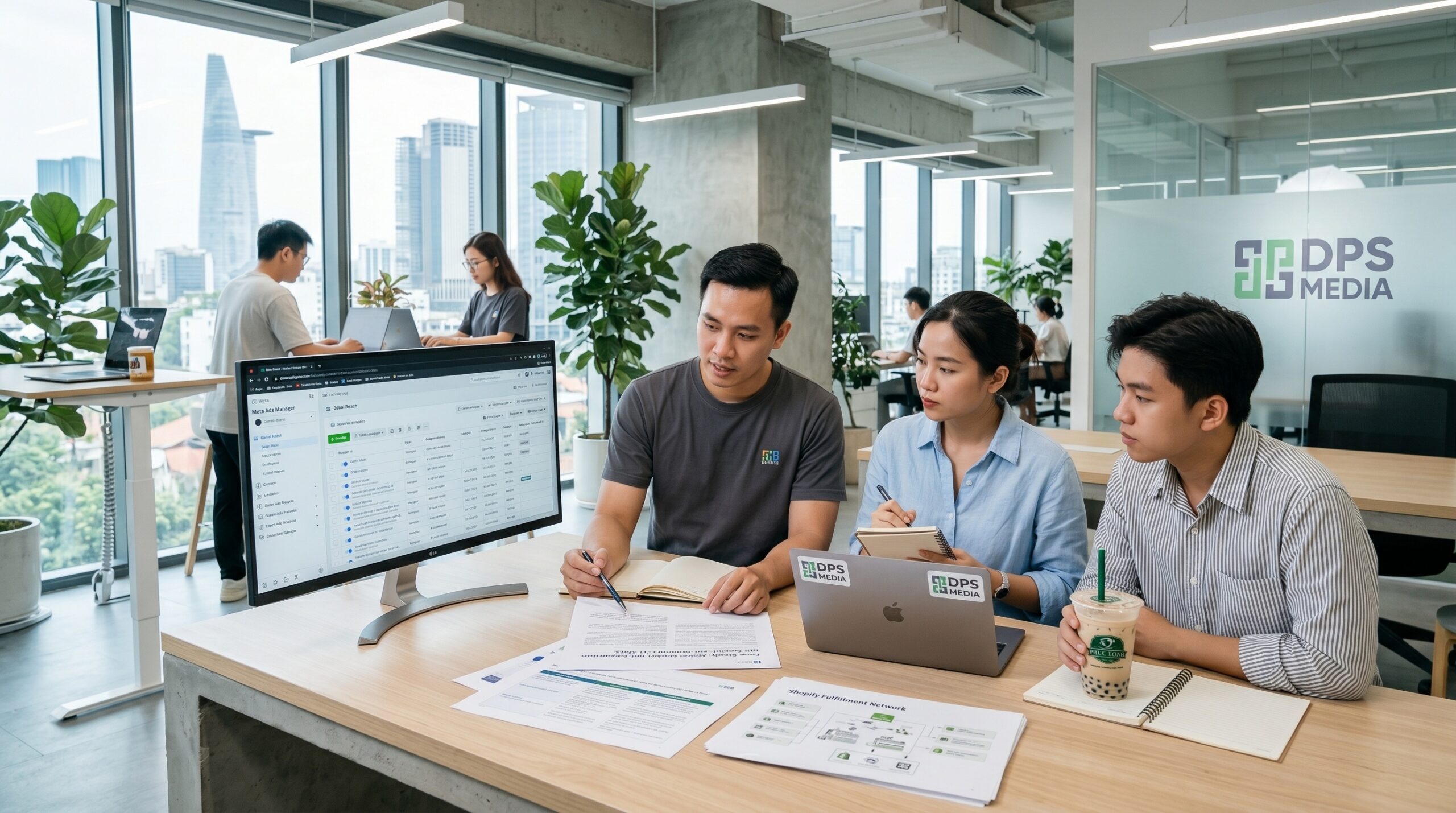
Build systems instead of just selling services
Successful one-person businesses often focus on systems. They automate processes before expanding revenue.
This helps reduce dependence on personal time. When the workflow is stable, the business can scale without a sharp increase in costs.
DPS. MEDIA recommends that Vietnamese SMEs invest early in CRM systems, SEO and marketing automation. This is the foundation that helps small businesses compete with larger teams.
- Automate quotes
- Create onboarding processes
- Build a clear sales pipeline
- Use KPI dashboards
- Standardize content marketing
- Create care email workflows
Focus on personal brand and inbound marketing
In the solo business model, personal brand is an important asset. Users often buy from individuals they trust before buying from a business.
SEO, LinkedIn, TikTok, and YouTube are becoming strong inbound channels for freelancers and micro-agencies. This is a prominent trend of the current international business model.
An HR expert in Phu Nhuan built a LinkedIn channel sharing recruitment case studies. After 9 months, the amount of inbound leads tripled without running ads.
A personal financial advisor in Hanoi once depended entirely on paid webinars. When CPM increased sharply, profits dropped deeply. Afterward, he switched to SEO blogs and podcasts, helping to reduce acquisition costs by 45%.
Leverage AI to increase profit margins
AI not only saves time but also increases profit margins. A solo founder can handle a workload that previously required an entire team.
Vietnamese businesses should start with repetitive tasks like content, reporting, chatbots, and marketing data analysis.
| AI application | Targets | Benefit | Impact KPI |
|---|---|---|---|
| AI content | SEO | Accelerate publishing | Traffic |
| Chatbot | Customer service | Reduce response time | Conversion |
| Automation | Increase retention | Repeat sales | |
| AI analytics | Ads analysis | Reduce CPL | ROAS |
What marketing strategies do one-person businesses need for growth?
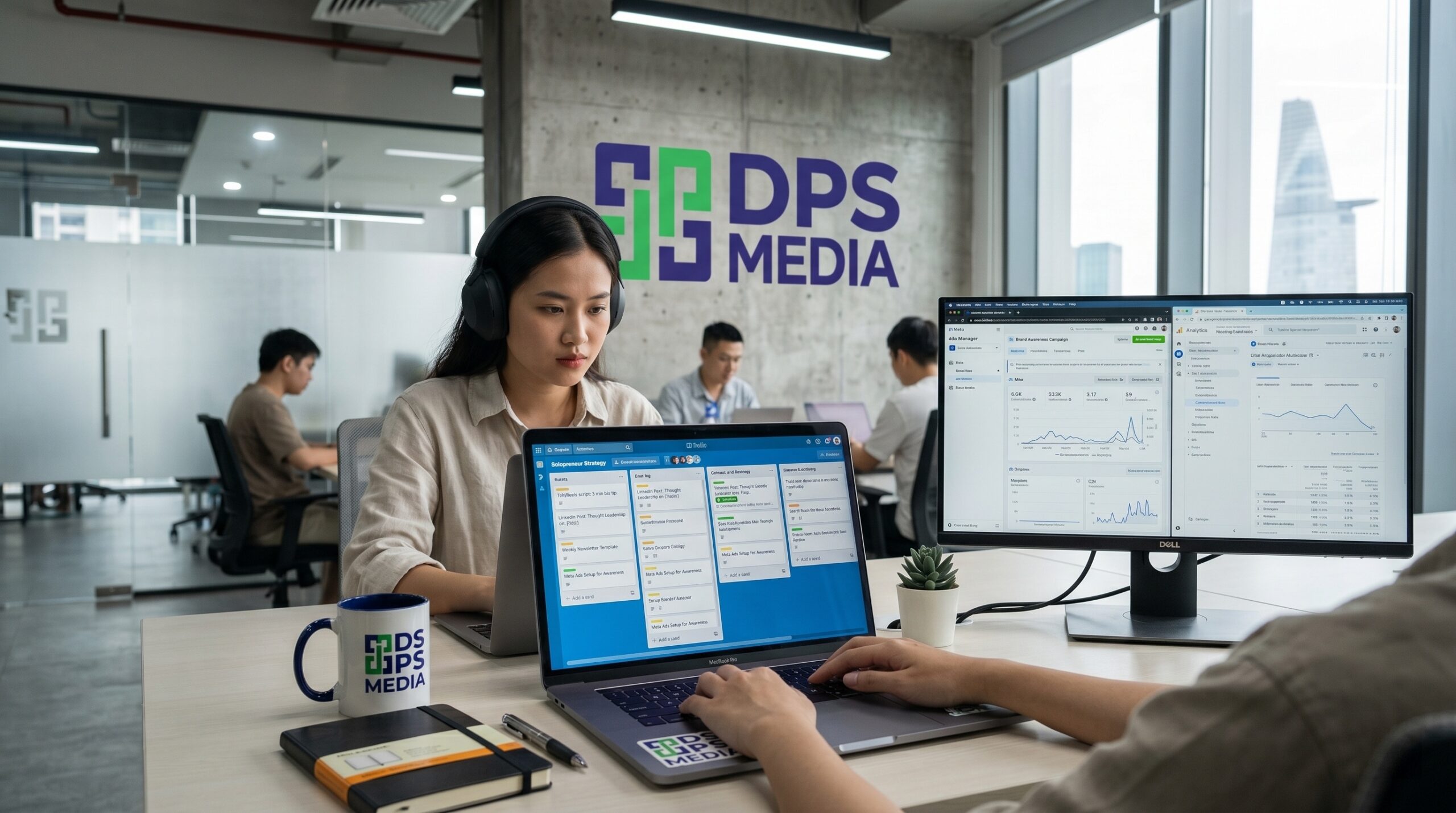
SEO and content are long-term assets
SEO is suitable for one-person businesses because the long-term cost is lower than continuous advertising. When content is properly optimized, organic traffic can generate stable leads for many years.
A B2B SME website in Ho Chi Minh City increased organic traffic by 210% after 11 months thanks to a content cluster strategy. The lead rate from SEO was 28% higher than from social ads.
- Build in-depth topic clusters
- Optimize articles according to search intent
- Invest in EEAT and case studies
- Create high-conversion landing pages
- Measure keyword ranking periodically
- Combine SEO and email capture
Performance advertising for solo business
Solo businesses do not have large budgets, so they need to optimize performance. Meta Ads and Google Ads must be tied to actual CPL, CAC, and conversion.
Many businesses fail because they only look at reach instead of lead quality. This is a common error in Vietnamese SMEs.
An online English center in Thu Duc once ran ads optimizing for messages but did not filter leads. CPL was low but the closing rate was only 2%. After switching to a conversion campaign and a separate landing page, the closing rate increased to 11%.
Email marketing and CRM help keep customers
Email marketing is still an effective retention channel for small businesses. When combining CRM, solo founders can upsell without needing to sharply increase advertising costs.
According to the Nielsen Vietnam 2026 report, returning customers usually have significantly lower conversion costs than new customers. This is especially important for one-person businesses.
- Set up email onboarding
- Segment customers by behavior
- Create automated upsell workflows
- Send periodic newsletters
- Connect CRM with advertising
- Measure monthly retention
The future of one-person businesses in Vietnam to 2030
AI agents will change the labor market
AI agents are gradually becoming “digital personnel” for solo founders. Repetitive tasks will be more strongly automated in the next few years.
This does not mean humans will disappear. Value will shift to strategic thinking, creativity, and the ability to build a brand.
Micro-agency and remote-first trends
Many future businesses will only consist of 2–5 people but serve global customers. This is a micro-agency trend that is increasing sharply in Asia.
Remote-first helps SMEs reduce premises costs and expand the talent pool. However, businesses need clear processes and KPIs to avoid losing control.
What does Vietnam need to prepare for the new wave?
Vietnam needs to improve freelancer policies, support international payments, and train digital skills. If done well, one-person businesses can become a new driver for the digital economy.
This model is particularly suitable for creators, consultants, e-commerce, and B2B services. Vietnamese SMEs should view this as an opportunity rather than a threat.
- Invest in AI and automation skills
- Standardize freelance legalities
- Increase SEO and content capacity
- Measure marketing effectiveness with data
- Build long-term digital assets
- Diversify lead sources
- Focus on customer retention
The international business model is showing that one-person business is no longer a temporary choice. This is becoming a practical business structure in the digital and AI-first economy.
Key lessons Vietnamese SMEs need to remember:
- Build systems instead of depending on personnel
- Invest in SEO and inbound marketing early
- Standardize legalities and freelance contracts
- Leverage AI to increase productivity
- Diversify customer sources and traffic
- Use CRM to keep customers long-term
- Monitor marketing data frequently
In the period of increasingly strong digital competition, small businesses need lean operation capabilities and more effective marketing than before. DPS. MEDIA is the right partner for Vietnamese SMEs that want to build a sustainable digital marketing system, optimize leads, and grow long-term in the era of the one-person business.