



2026 is forecasted to be a pivotal year for Vietnam's economy, not only due to global market fluctuations but also due to the strong transformation in the domestic legal framework. A series of new laws and amending documents will take effect, marking a major step forward in efforts to reform administration, enhance business environment transparency, and integrate more deeply with international standards. For the business community, from multinational corporations to individual business households, timely grasping and thorough preparation for these changes is not only a mandatory compliance requirement but also an opportunity to restructure, optimize operations, and break through in the new development phase. This article will analyze in depth the significant impacts of the new laws to be applied in 2026.
1. Investment Law (Amended): Opening the Market, Minimizing Barriers
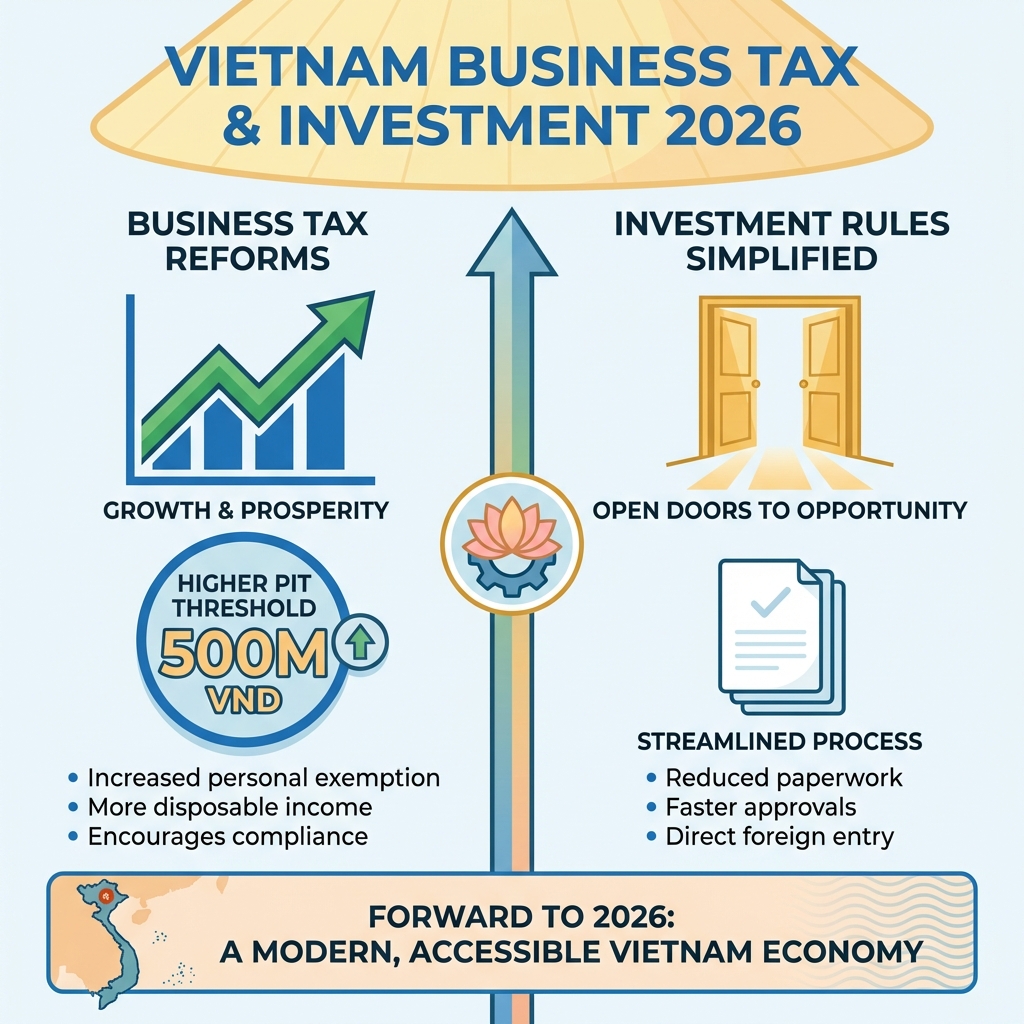
Effective from March 1, 2026, the Investment Law (amended) brings a “breath of fresh air” to the investment and business environment in Vietnam. The most important highlight of this law is the strong reduction of market entry barriers, demonstrating the Government's determination to create the most open and favorable business environment. Specifically, the law has officially abolished the business license requirement for 38 conditional business sectors. This is an impressive number, helping to remove the “heavy” administrative procedure burden that has hindered the development of many businesses for many years.
Furthermore, the state management mindset has also fundamentally changed, shifting from the “pre-check” mechanism (license first, operate later) to “post-check” (register operations and be subject to compliance supervision). This change gives businesses more autonomy, allowing them to seize business opportunities quickly without waiting for lengthy approval procedures. In addition, the new regulations also focus on special incentives for strategic sectors such as high technology, semiconductor industry, clean energy, and innovation, promising to attract a wave of high-quality foreign direct investment (FDI) into Vietnam in 2026.
2. Digital Era and Legal “Shield”: Personal Data Protection Law & Digital Technology Industry Law
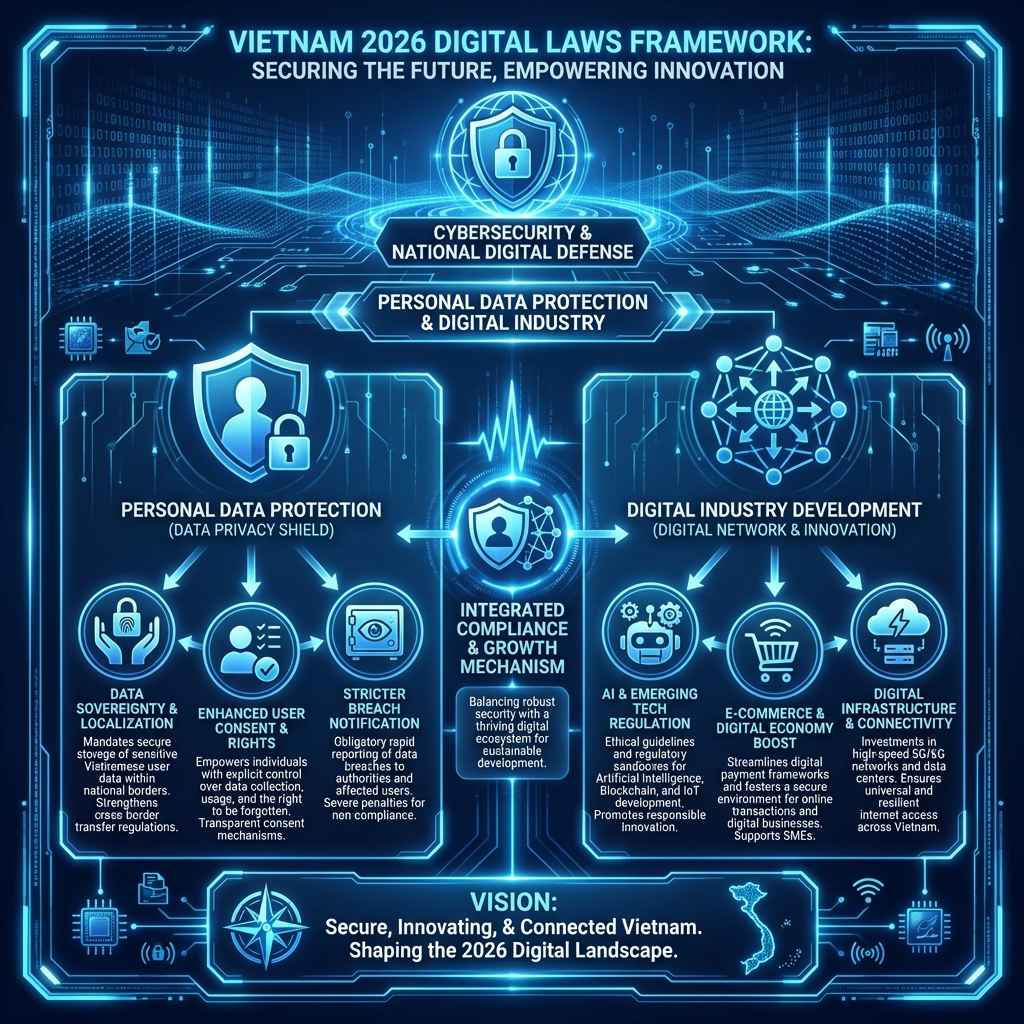
In the context of strong digital transformation, data has become the “new asset” of the economy. Effective from January 1, 2026, and especially the full enforcement of the Personal Data Protection Law (PDP Law) will set new standards on how businesses collect, store, process, and share customer information. No longer general recommendations, the PDP Law establishes mandatory legal obligations with severe penalties for violations, including illegal data trading or user information leakage.
For businesses, this means they must review and upgrade their entire data management processes, invest in cybersecurity infrastructure, and train personnel on privacy compliance. Although initial compliance costs may increase, in the long term, complying with the PDP Law will help businesses build solid trust with customers – a vital factor in the digital economy. Alongside that, the Digital Technology Industry Law also creates an open legal corridor with many tax, land, and credit incentive mechanisms for businesses operating in digital technology, software, and digital content sectors, propelling Vietnam to rise as a regional technology hub.
3. Personal Income Tax Reform: Relieving People's Burden, Promoting Consumption
July 1, 2026, will witness significant changes in personal income tax (PIT) policy, directly impacting workers“ wallets and the business efficiency of individual households. One of the most anticipated amendments is raising the taxable revenue threshold for business households from 100 million VND to **500 million VND/year**. This is truly a ”liberating” policy for millions of small-scale business households, helping them reduce tax pressure, accumulate capital to expand scale, and gradually formalize their business operations.
For salaried employees, the progressive tax bracket is also simplified, reducing from 7 to 5 brackets. Spacing out the tax brackets and adjusting rates not only reduces actual tax obligations for workers, especially the middle class, but also indirectly helps businesses more easily attract and retain talent. As people's disposable income increases, domestic market purchasing power will certainly improve, creating new growth momentum for production and consumer service businesses.
4. Other Adjustments: Value Added Tax (VAT) Law & Advertising Law
In addition to the above “backbone” laws, 2026 also records important adjustments in the Value Added Tax (VAT) Law and Advertising Law. For the VAT Law, new regulations will focus on resolving difficulties for agricultural production by adjusting taxable objects for some agricultural products and fertilizers. At the same time, VAT refund regulations are also made more transparent to avoid capital stagnation for businesses.
In the advertising sector, the Advertising Law (amended) will tighten management of online advertising activities, especially on cross-border platforms like social networks and e-commerce sites. The new regulations require these platforms to strictly comply with content, truthfulness, and tax responsibility provisions in Vietnam. This aims to create a level playing field for domestic advertising businesses and protect consumers' legitimate rights against misleading advertising information.
5. Overall Impact and Advice for Businesses
Overall, the 2026 legal landscape shows a clear trend: the Government is striving to create a more transparent, fair, and favorable business environment, while imposing higher requirements on businesses' social responsibility and legal compliance. These changes are both opportunities and challenges. Opportunities lie in reduced costs, simplified procedures, and new investment incentives. Challenges lie in the pressure to innovate management, upgrade technology, and comply with stricter data and tax standards.
To adapt and develop, businesses need to proactively update guiding documents regularly, consult legal experts, and proactively review their internal processes. Thorough preparation from now will be the “key” to help businesses steadily overcome challenges and fully seize the opportunities brought by the new legal framework in 2026 and beyond.