

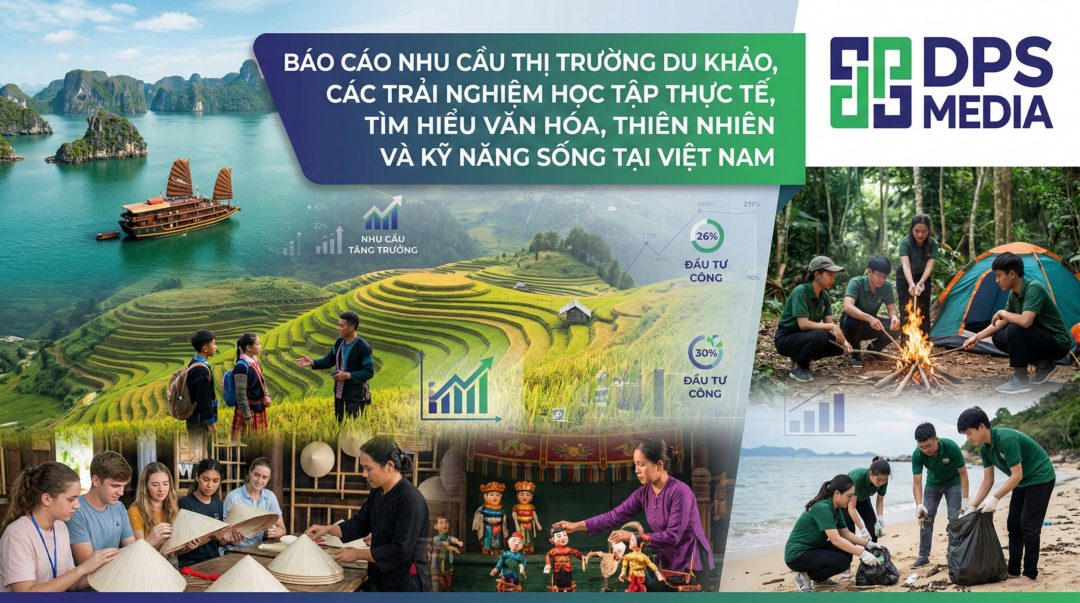

Comprehensive Research Report: Analysis of Market Demand for Educational Tours, Experiential Education, and Life Skills Training in Vietnam
Overview of the Macro Context and Recovery Drivers of Vietnam's Tourism Industry
The 2024-2026 period is witnessing a landmark development cycle for Vietnam's tourism economy.
This development does not merely stop at recovering mechanical growth indicators after the global pandemic but represents a profound shift in product structure and consumer behavior.
Analysis of statistical macro data shows that by 2025, Vietnam's tourism industry has risen to the group of countries with the world's top growth rates, officially welcoming a record number of over 21.5 million international visitors, marking a growth of 22% compared to 2024 and far exceeding the historical peak of 18 million in 2019.
At the same time, the domestic tourism market continues to affirm its role as a massive launchpad with approximately 135.5 million visitors, generating total revenue exceeding the 1 quadrillion VND mark, turning tourism into a brilliant highlight in the socio-economic picture.
Typical destinations across the country recorded operating indices at maximum capacity; for example, Quang Ninh completed its target of welcoming 19 million visitors, Binh Dinh province welcomed 9.2 million visitors bringing in 25.5 trillion VND in revenue, while the alliance of 8 Northwest provinces and Ho Chi Minh City attracted up to 76.5 million visitors in a short period.
The explosion in scale of the traditional tourism market creates an inevitable economic consequence: the saturation of pure sightseeing and entertainment tourism models and the strong increase in demand for high value-added niche markets.
In this context, the educational tourism (Edutourism) market, experiential tours, and nature-culture exploration programs emerge as a strategic growth pillar.
This driver is reinforced and directly guided by Resolution No. 80-NQ/TW of the Politburo on cultural development (issued in early 2026), which clearly defines the orientation of turning heritage into economic assets and building a “heritage-led economic development” model.
In parallel, Vietnam's Cultural Industries Development Strategy has also positioned cultural tourism as one of the 13 key cultural industries, responsible for contributing 15% to 20% of the total expected revenue of about 40 billion USD from tourism activities by 2030.
The convergence of a robust tourism infrastructure foundation and macro orientations for cultural industry development has created a perfect launchpad for the practical learning tourism market to rise strongly in both breadth and depth in the coming decade.
The Nature and Demand-Stimulating Drivers of the Experiential Education and Life Skills Market
The formation and explosion of the educational tour, summer camp, and practical learning experience market in Vietnam did not stem from simple marketing campaigns by the travel industry.
Instead, it originates directly from a structural crisis in the formal education system and the socio-psychological shifts of the contemporary youth generation.
Structural Bottlenecks in the Traditional Life Skills Education System
Quantitative research conducted at large higher education institutions such as Hong Duc University, Vinh University, and Hanoi National University of Education has exposed an alarming reality regarding the quality of young human resources: the practical life skills capacity of Vietnamese students is at a very limited level.
Through closed questionnaire surveys using a 3-level scale (maximum average score of 2.0), students' self-assessment results for essential skills such as social adaptation, career goal identification, problem-solving, and task organization for efficiency only fluctuated at very low levels, from 1.20 to 1.22.
More notably, under the objective evaluation lens of educational experts and managers, the practical capacity of this group was even rated lower, only reaching scores from 0.85 to 1.36.
In particular, survival and social integration skills, such as the ability to self-learn from daily practical experiences, the ability to establish and maintain positive social relationships, as well as the practice of standard cultural behaviors, were all in the alarming score group.
The deep-seated cause of this serious shortage stems from the imbalance and rigidity in the traditional general education curriculum.
The teaching of life skills in schools today is mainly integrated forcedly into academic subjects like Civic Education, Biology, and Geography, or glossed over during flag-raising ceremonies.
At educational institutions like Hoang Duc Primary and Middle School (Thanh Hoa province), although the board of directors has made efforts to allocate time for life skills orientation, the resulting effectiveness remains extremely modest.
Delivery methods heavy on academic theory, the complete absence of practical space, along with the reality of teachers facing huge pressure for academic achievement scores, have made life skills education content hollow, failing to reach the complex psychological structure of modern adolescents.
In addition, objective environmental factors such as the wave of globalization, the explosion of information and communication technology, and personal lifestyle habits have led to a significant portion of young people lacking confidence, lacking independence, and having a tendency to live reclusively and immerse themselves in the “virtual world” of online video games.
This reality has created enormous psychological pressure on parents, especially the urban middle class, driving them to seek extracurricular educational intervention solutions and practical experiences more strongly than ever.
Legal Policy Levers: Impact of Circular 32/2018/TT-BGDĐT
Clearly recognizing the massive gap in students' practical capacity, the Ministry of Education and Training took a historic turning point by issuing Circular No. 32/2018/TT-BGDĐT.
This legal milestone officially turned “Career Orientation Experience Activities” into a mandatory educational component within the 2018 General Education Program, granting it a status equivalent to a core academic subject.
The policy specifies a substantial time allocation of up to 105 periods per school year (averaging 3 periods per week), distributed across four basic organizational formats: flag-raising ceremonies, class meetings, theme-based education, and club activities.
More importantly, this regulation encourages and permits the implementation of flexible learning activities both inside and outside the school campus.
This legalization has transformed extracurricular activities from a voluntary option for pure entertainment into a mandatory academic target that every educational institution must achieve.
However, the sudden application of an advanced educational model to an infrastructure system with many limitations has created an operational “shock.”.
The majority of public schools nationwide are currently facing a severe shortage of land, facilities that fail to meet requirements for simulation games, and particularly a lack of teachers with deep expertise in survival skills training and behavioral psychology.
The deadlock regarding internal resources has forced thousands of schools to seek support solutions from external partners.
The shift from an in-house education model to an educational outsourcing model immediately gave birth to a massive B2B (Business-to-Business) market, where school study tour packages and educational field trips provided by travel companies, life-skill training centers, and ecotourism sites have become essential commodities.
In-depth Analysis of Educational Tour and Practical Experience Product Segments
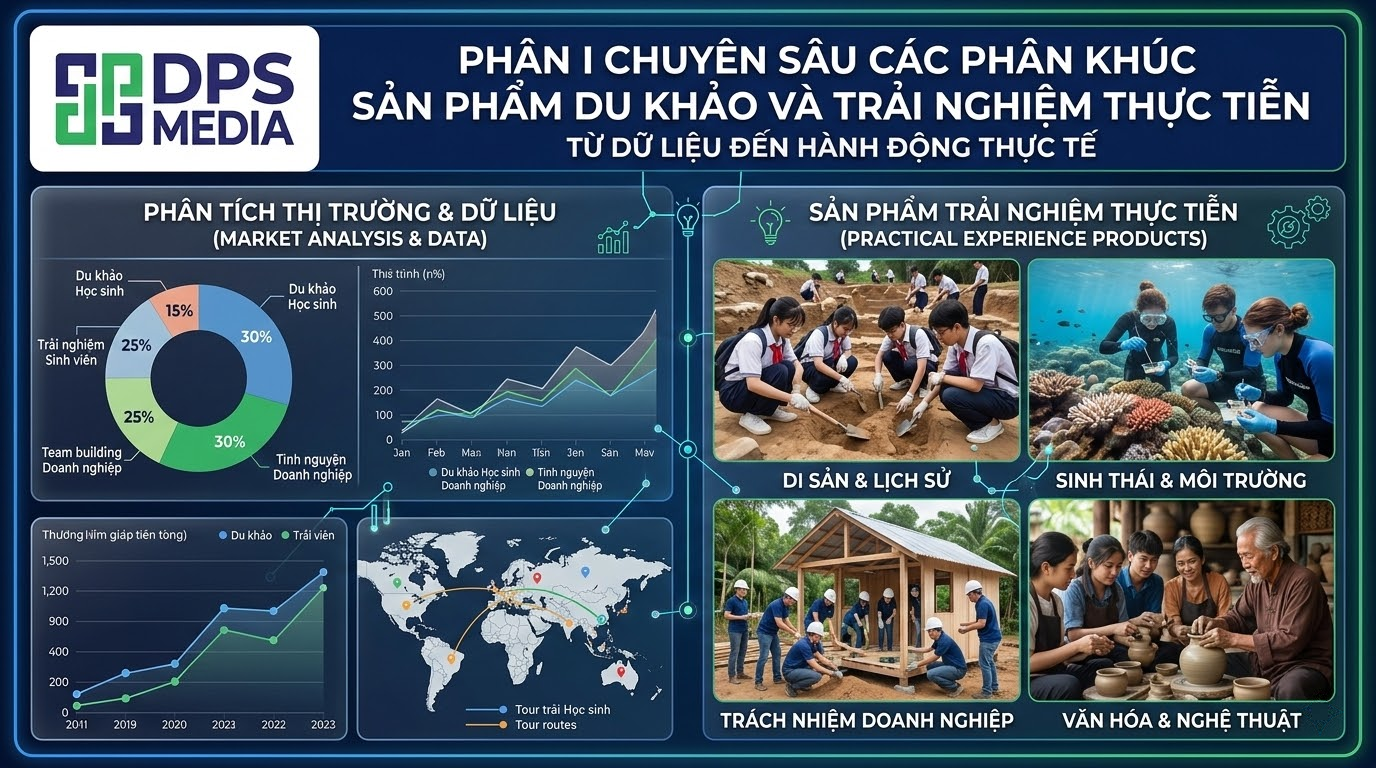
The practical learning experience market in Vietnam is not a monolithic block but has fragmented into many distinct models, sophisticatedly designed to meet various levels of educational expectations, budget affordability, and the complex psychological characteristics of specific age groups.
1. Ecotourism combined with Experimental Education (Edutourism and Farmstay)
This is the most popular and steadily growing segment, taking full advantage of Vietnam's traditional agricultural resources and ecological diversity.
Educational tourism in this model is not merely a change of scenery, but requires visitors to participate in interaction, academic research, scientific observation, and self-validation of their knowledge through practical experience.
A typical success story of this model in the Mekong Delta is the Hai Van Farm (Vam Ho Bird Sanctuary, Vinh Long Province).
Located along the peaceful Ba Lai River, this tourism space has transcended the conventional concept of ecotourism to become a center for fostering environmental awareness and local cultural preservation.
With an annual capacity of over 10,000 visitors (mainly students and researchers), this farm has boldly applied the advanced “Garden STEAM” educational method.
Entirely different from textbook learning, students participating in this program are placed in situations where they must analyze the river ecosystem, simultaneously applying Science, Technology, Engineering, Arts, and Mathematics (STEAM) to specific agricultural practices of the Southern region.
These tourism products are designed as flexible modules, strictly customized according to each age group or the specific curriculum requirements of each school.
Similarly, in areas like Cu Lao Dung, a series of field programs are organized for university students to directly visit, take samples, and study the complex mangrove ecosystem.
In the Northern region and high mountainous areas, the Farmstay model—combining accommodation and survival skills with wild nature—holds absolute dominance.
An analysis of the architectural space and services of typical farmstays shows a strong shift toward sustainable living and technology-free retreats.
In Lao Cai, Chapa Farmstay (located deep in Y Linh Ho village, Sapa) provides a direct lens into wilderness living with views of the majestic Hoang Lien Son range, forcing participants to learn to adapt to mountain living conditions.
In Hai Phong, Hoi Lake Farmstay creates a living space in absolute harmony with the environment by using entirely thatch and bamboo for its accommodation architecture, combined with biological discovery tours at Monkey Island and Cat Dua Island to promote marine ecosystem conservation awareness.
In the Southern region, spaces like Hoang Hac Gia Trang (Dong Nai Province) provide isolated natural lake terrain, serving as ideal training grounds for overnight camps, team-building skills practice, and large-scale outdoor physical training activities.
2. Cultural, Historical, and Heritage Conservation Educational Tours (Cultural Heritage & Historical Tours)
Driven by the urgent need to preserve national identity and the macro-orientation of cultural industry development, historical study tours are undergoing a process of deep specialization, integrating high academic content instead of just perfunctory commentary as before.
| Region/ Destination | Core Educational Experience Activities | Cultural & Academic Values Delivered |
| Lao Cai & Northern Mountainous Provinces | Organizing experiential and career orientation classes directly within traditional stilt house spaces. Students interact directly with local artisans to learn handicrafts like basketry, brocade weaving, and practice traditional Then singing melodies. Participating in the Bac Ha Spring Festival to research the diversity of indigenous culture. | Developing a deep awareness of preserving intangible cultural values; nurturing career ideas related to heritage conservation, community-based tourism, and sustainable economic development. Expanding learning spaces beyond the four classroom walls, helping students absorb the behavioral culture of ethnic minorities. |
| Bac Lieu & Mekong Delta | Field surveys at the Southern Amateur Music (Don Ca Tai Tu) Memorial Site and the musician Cao Van Lau memorial area. Groups of students and experts participate in seminars and practice directly with traditional musical instruments like the zither (dan tranh), monochord (dan bau), moon lute (dan nguyet), and long-necked lute (dan day). | Transforming music history learning from theory to visual and auditory experience; preserving the cultural space of Don Ca Tai Tu (a Representative Intangible Cultural Heritage of Humanity) among the younger generation. |
| Cao Bang & Historical Site Complexes | Performing trekking journeys on complex terrains, conquering the Me Pia Pass (14 levels) famous for its danger, and admiring unique geological phenomena at Nam Tra Waterfall (Angel Eye Mountain). Combining study tours at the Special National Historical Site of Pac Bo and Mount Karl Marx. | Integrating knowledge of geology and physical geography with revolutionary history. Students improve physical fitness through trekking while absorbing heroic historical lessons in a real-world context. |
| Hanoi & Ethnic Culture Village | Students from higher education institutions, such as the University of Languages and International Studies (Vietnam National University, Hanoi), organize tours and large-scale surveys at the Vietnam National Village for Ethnic Culture and Tourism. | Creating an environment for practicing research in anthropology and cultural studies, and developing intercultural communication skills for students majoring in foreign languages and international studies. |
3. Survival Summer Camps, Leadership Skills, and Psychological Intervention Models
As academic pressure increases and parents in major economic hubs realize their children are facing emotional fragility and a severe lack of resilience, the market for premium residential summer camps and intensive skill training courses has boomed, forming a diverse service ecosystem.
Intensive Intervention and Technology-Free Summer Camps: Representing the segment of rigorous training and the highest international safety standards is the Outward Bound Vietnam organization.
This model operates on the philosophy of pushing participants out of their comfort zones to discover hidden potential.
The training environment here requires total isolation from the digital world; participants are stripped of all electronic devices and must learn to camp independently, manage their own food rations, and directly face high-intensity physical challenges such as mountain climbing and hiking to awaken inner strength.
Packing list requirements are extremely strict, including specialized survival gear, water shoes, quick-dry clothing, and protective equipment.
Professionalism is absolutely guaranteed as the entire coaching team is required to hold international certifications in First Aid, CPR, and lifesaving.
This experience is designed not to seek perfection but to foster the will to take risks, resilience, and the ability to support teammates in adversity.
Developing Emotional Intelligence (EQ) and Social Competence: Educational systems like UPO Education, Wedo-Wegood, and CARA approach this from a developmental psychology perspective, providing courses designed across short to long-term timeframes.
Typically at UPO, the course system is finely segmented by age group: Camp UP (3 days 2 nights) focuses on training creative thinking, independence, and team leadership in the absence of parents; while Dream UP & Fly UP (for ages 10-16, lasting up to 21 days of companionship) aim to nurture intrinsic motivation, positive thinking, and gratitude.
MasterKids Academy provides a character-building roadmap based on UNESCO's 15 living value themes, helping teenagers self-direct their personal goals.
In particular, Wedo-Wegood centers implement outdoor social projects to comprehensively develop seven foundational indices: IQ (Intelligence), EQ (Emotional Intelligence), CQ (Creative Intelligence), MQ (Moral Intelligence), AQ (Adversity Quotient), PQ (Passion Quotient), and SQ (Social Intelligence).
The market's willingness to pay for these products is significant; for example, the fee for "Lang Hao Huc" (Excited Village) Summer Camp can reach nearly 10 million VND, reflecting a serious and massive investment from urban middle-class families.
Pre-Elementary and Environment Adaptation Programs: A niche but rapidly growing segment is summer camps acting as a psychological “stepping stone.”.
Parents with children aged 5-6 preparing for Grade 1 often seek integrated pre-elementary summer camp programs to minimize “transition shock.”.
The Western Australian International School System (WASS), PennSchool, and Sydney International School System (SISS) have captured this trend by organizing multi-themed discovery programs, cleverly embedding basic Math and Vietnamese knowledge into practical activities, helping students practice independence in an international education environment before official enrollment.
4. Vocational Internship Experience Models for University Students
At the higher education level, the shortage of life skills and practical work capacity (as analyzed earlier) has driven universities to proactively establish strategic alliances with the private sector to immerse students deeply in the real labor environment.
A typical case is the Vietnam National University of Agriculture.
This institution has expanded its multi-industry linkage network, allowing students (especially those in Economics, Rural Development, and HR Management) to freely choose professional practice locations according to their personal orientation.
This practical experience process does not stop at company tours but requires an immersive experience in the operational chain.
At companies like KHVatec Hanoi (Bac Ninh), ASIA International Human Resources, or Pro Sports, students directly participate in the entire HR management lifecycle: from posting job advertisements and screening resumes to coordinating interviews, managing internal records, and calculating benefits and salaries.
This is the most rigorous environment, requiring students to work in teams, handle real-world situations, find root causes, and propose solutions, thereby radically improving the bottlenecks of “social adaptation” and “work organization” identified in previous surveys.
5. Voluntourism and Corporate Social Responsibility (CSR/ESG) Trends
A trend reshaping the aesthetic and consumption values of young people (especially Gen Z) is “Voluntourism”—the organic combination of travel discovery and community development projects.
Shifting from superficial charity to a sustainable model: Today's youth are no longer satisfied with pure sightseeing; they carry a desire to “go – experience – contribute.”.
This trend is appearing not only among students but also spreading to the corporate sector through the need for team-building programs linked to CSR (Corporate Social Responsibility) strategies and ESG (Environmental, Social, and Governance) standards.
In Southeast Asia, the DESA social enterprise model on Langkawi Island (Malaysia), founded by Ms. Surina Pison (Chik Su), is seen as an inspiring reference point.
Instead of short-term charity activities, DESA focuses on livelihood training, teaching spa skills, healthcare, and traditional wood carving to autistic and disabled children, while inviting tourists to learn and buy products, creating a sustainable economic cycle.
Management Practice in Vietnam: Applying this mindset in Vietnam, organizations like the Fly To Sky Charity network are striving to standardize voluntourism processes.
Instead of large-scale, movement-style trips, they prioritize small, practical projects focused on local actual needs.
Participation in these activities requires a strict risk management process: assigning supervisors, detailed safety briefings, limiting workload according to volunteer capacity, providing full protective gear, and particularly controlling legal and ethical risks when interacting with vulnerable children groups.
Business Ecosystem and Service Supply Chain Structure
The boom in diverse experiential models has led to the formation of a complex supply chain.
The core competencies of each business group shape the market segment they serve.
| Supply Chain Segments | Core Competency Characteristics and Strategic Competitive Advantages | Typical Brands in the Market |
| Comprehensive Travel Groups (Mass Market Operators) | Possessing massive transport capacity, a global network of accommodation partners, wholesale price negotiation power, and professional risk insurance systems. Ability to organize student groups of up to thousands of people simultaneously. Strong focus on operational logistics, day tours, and MICE (Meetings, Incentives, Conferences, Exhibitions) infrastructure. | Saigontourist, Vietravel, Hanoitourist, Fiditour, Ben Thanh Tourist, Vietnamtourism-Hanoi, Saco Travel. |
| Innovative Travel Enterprises (Niche/Boutique Operators) | Specializing in exploring new niche routes (such as the Northeast and Northwest regions). Absolute strength in designing high-interaction team-building scripts, connecting corporate and school culture, and creating emotional “thematic tours” instead of just physical sightseeing. | PYS Travel, Vietnam Booking, VietSense Travel, BestPrice. |
| Educational Institutes & Life-Skill Centers (Life-skill Academies) | Do not own transport infrastructure but hold exclusive rights to psychological-pedagogical curricula and competency assessment certification systems. Personnel are psychological experts, soft-skill lecturers, and survival trainers. Directly intervening in perception, changing behavior, and training intelligence indices (EQ, AQ, SQ). | UPO Education, Wedo-Wegood, CARA System, MasterKids, Vietskill, iGEM LEARNING, YDC, Citysmart, GAIA. |
| Specialized Training & International Career Counseling Units | Providing integrated services between international study environment survey tours, support for visa applications for study or settlement, and soft skill training courses preparing for Western education environments. | OHANA Tour, Kiwi Travel. |
Pricing Strategy and Consumer Segmentation: The fragmentation of the supply chain is clearly reflected in the range of service prices.
For traditional school tours involving day trips (e.g., tours exploring Dai The Gioi Water Park or Dam Sen organized by Vietourist), prices are compressed to extremely affordable levels, from only 139,000 VND to under 5,000,000 VND for basic packages.
This is a cost-leadership strategy, using high volume to offset thin profit margins.
In contrast, for long-duration residential survival summer camps, intensive psychological training courses, or Outward Bound programs, fees can range from several million to tens of millions of VND (such as the 10 million VND level of Lang Hao Huc).
This premium pricing is composed of the high costs of psychological consultants, heavy-duty risk insurance fees, high staff-to-student ratios, and international standard training equipment.
Analysis of Barriers, Risks, and Accumulated Challenges
Despite its huge growth potential, the field trip and experiential learning market in Vietnam is revealing systemic gaps that directly threaten the sustainability of this industry.
1. Maximum Risks in Security, Safety, and Logistics Operations
Moving hundreds or even thousands of students at once out of the strictly controlled school environment creates an operational challenge on a massive scale.
The risk of traffic accidents, drowning, mass food poisoning, or students getting lost is always present like a ticking time bomb.
In practice, security and safety incidents have occurred, causing serious public repercussions.
To prevent this, professional travel companies are required to develop sophisticated risk control scenarios.
For example, Saigon Star Travel's set of standards requires detailed classification of each student's medical records (such as preparing separate meals and specific medications for diabetic students to avoid sudden blood sugar spikes); mandatory regulations to bring energy-boosting food (cakes, canned food) after swimming or trekking activities; along with a closed-loop procedure for checking luggage and personal belongings before and after leaving transport vehicles or resorts.
Nonetheless, a significant portion of domestic travel enterprises, primarily accustomed to serving adult tourists, have appeared confused and ill-prepared when facing specific safety standards for children, especially in volunteer and eco-discovery tours.
2. Trust Crisis from Excessive Fees and Educational Commercialization
A painful challenge hindering the healthy development of the market is the distortion of experiential activities.
Taking advantage of the implementation of the 2018 General Education Program, some educational institutions have colluded with low-quality travel units to organize sightseeing, incense offerings, and pure recreational tours under the guise of “experiential learning” for the purpose of collecting unauthorized fees (overcharging) from parents.
This commercialization causes the core goals of educational activities to be completely distorted, causing serious waste of social resources and creating a wave of public indignation.
As a result, state management agencies have been forced to tighten discipline.
The Department of Education and Training in many localities, typically Hai Phong city, has continuously issued urgent rectification documents.
These directives strictly prohibit the spontaneous organization of out-of-school activities; requiring all programs to be included in the annual educational plan and approved by the School Board; at the same time, the scale of organization must be reasonably limited by group, class, or club, instead of mobilizing the entire school en masse, which causes loss of control and disrupts the duration of other academic subjects.
Most importantly, the principle of voluntary participation and 100% consensus from parents and students, based on a public and democratic consultation process, is established as a red line.
This pressure for financial transparency is creating a harsh filter, gradually eliminating travel companies that compete through “commission discounts” instead of core competencies.
3. Pedagogical Gaps and the Crisis of Reality (The “Staged Authenticity” Problem)
A more academic and profound challenge lies in the quality of the academic content of the field trips themselves.
Many current educational tourism models fall into the trap of “staged authenticity.”.
According to field observations by educational experts during experiential thematic lessons at the primary and secondary levels, there is a worrying trend where students and teachers “act out” behavioral situations smoothly and mechanically, according to pre-arranged scripts mainly to serve filming and photography for achievement reports.
Quick, complete answers and perfectly clever conflict resolution, just like in textbooks, constantly appear.
However, authentic experiential education never has a common denominator or a single perfect answer.
In the randomness of real life, social conflicts, natural risks, or survival situations always contain complex emotional levels, panic, psychological nuances, and individual limits.
Designing field trips where every situation is “softened” and every risk is sterilized has completely eliminated the core essence of empirical education: learning through stumbling and the ability to synthesize knowledge from family, school, and subjects to solve unprecedented problems.
At the same time, the capacity to convey knowledge at many ecological and historical destinations remains very weak.
Most monuments or farms only provide physical space, lacking vivid simulated interactive models, storytelling activities, artistic performances, and especially a severe shortage of scientists and local experts capable of answering and interacting deeply with visitors.
This poverty in interaction turns an intellectual field trip into a superficial "riding a horse to look at flowers" session.
4. Inadequacies in Teacher Resource Allocation Mechanisms
The process of integrating experiential activities as a core subject also faces huge administrative barriers from the teacher workload calculation mechanism.
In the spirit of Official Dispatches 3899/BGDĐT-GDTrH and 5636/BGDĐT-GDTrH from the Ministry of Education and Training, assigning teachers to teach 105 periods of experiential activities creates complex overlaps with the work of the current form teacher force.
Regulations only allow teaching hours to be counted for teachers if that work content does not overlap with existing form teacher duties and must strictly follow the professional requirements of each topic.
Although the Ministry encourages flexibility in scheduling, rigidity in labor quotas makes it extremely difficult for schools to assign personnel to manage students during off-campus extracurricular trips.
As a consequence, many schools leave the entire responsibility for disciplinary control and academic content delivery to the travel partner's tour guides—who have plenty of crowd-animation skills but completely lack an in-depth pedagogical and psychological background.
Summary and Future Outlook of the Experience Industry
The ecosystem of field trips, experiential learning, cultural and natural exploration, and life skills training in Vietnam is entering a cyclical purification phase.
The initial explosive growth momentum (based on the effect of mandatory education regulations and parent crisis psychology) will gradually weaken.
Instead, the next development phase for 2026-2030 will be determined by fierce competition in academic quality, transparency, and the degree of authenticity of the experience.
Strategic forecasts show that the market will witness a profound blurring of boundaries between the education industry and the tourism industry.
Pure travel businesses will gradually lose market share in the school segment if they only play the role of providing bus services and buying sightseeing tickets.
The strong rise of “strategic alliances” will reshape the industry structure; in which, a travel organization responsible for logistics capacity, traffic safety, and legal insurance, will work closely with a psychological research institute or soft skills academy to handle curriculum compilation, provide psychological experts, and systems for measuring and evaluating student capacity after the trip.
In addition, the process of product personalization and specialization will take place strongly.
The mass-market model mobilizing thousands of students at once will shrink significantly due to legal barriers and uncontrollable safety risks.
Conversely, investment capital and parental willingness to pay will pour into niche models with lean scales (from 15 to 30 members).
Programs that delve into a specific skill—such as tech-free survival summer camps, geological exploration trekking in the Northwest, field research on Southern traditional music, or sea turtle conservation volunteer tours—will lead the entire premium segment, bringing superior profit margins and ensuring deep academic interaction for each individual.
To unlock the full potential of this gold mine, central policy-making agencies need to urgently develop and issue a set of national quality standards (TCVN) specifically for educational tourism and summer camp services.
This set of standards needs to clearly quantify the mandatory ratio between academic and entertainment elements in each program, standardize transport security systems for children, and establish a specific practicing license mechanism for the specialized school tour guide team.
Overall, with the rise of the middle class, a long-standing tradition of studiousness, and a vast wealth of cultural and ecological heritage, Vietnam possesses every strategic comparative advantage to turn the experiential field trip market into a solid pillar, contributing directly to the goal of cultural industrialization and creating a generation of global citizens with self-resilient capacity in the future.
References:
- Vietnam Tourism Overview 2025: 8 Outstanding Landmarks – AppotaPay
- Vietnam Tourism Reaches Growth Target, Welcomes 17.5 Million International Arrivals in 2024
- Culture is a New Growth Engine for the Tourism Industry
- LIFE SKILLS OF VIETNAMESE STUDENTS TODAY: THE REALITY...
- Life Skills Education for Students – A Practical Perspective – Thanh Hoa
- Flourishing 2024 Summer Programs: Good Names, New Forms, but are the Experiences New?
- Regulations on the Implementation of Experiential Activity Teaching
- General Education Program for “Experiential Activities” (Issued with Circular No. 32/2018/TT-BGDĐT dated December 26, 2018, by the Minister of Education and Training) | An Dong Secondary School
- Organizing Experiential Activities for Students: Don't Fear Imperfection
- Ho Chi Minh City: Educational Tourism – Great Potential for Development
- What is a Farmstay? Top 8 Best Farmstays to Try in Vietnam – MIA.vn
- Vibrant Experiential Activities and Skill Training for Students
- TOP 10 Reputable Travel Companies in Vietnam 2026 Update – PYS Travel
- ULIS Students Experience a Field Trip at the Vietnam National Village for Ethnic Culture and Tourism
- [VN] Prepare for Your Outward Bound Vietnam Journey | Pre-course Briefing – YouTube
- OUTWARD BOUND VIETNAM – SCHOOL PROGRAM – YouTube
- Outward Bound Vietnam and High-Quality Experiential Learning Programs
- Top 7 Reputable Life Skills Teaching Centers in Hanoi – UPO
- Lang Hao Huc Summer Camp Costs Nearly 10 Million, What is the Service Like? – Bao Moi
- Opportunities for Practical Experience and Skill Development for Students – VnExpress
- Volunteer Tourism Trends Spread in Southeast Asia
- Volunteer Tourism in Vietnam: From Small Projects to Sustainable Models – Practical Perspectives and Organizational Experience – flytoskycharity.vn
- Top 5 Most Reputable Travel Companies in Vietnam for Your Worry-Free Choice
- Top 20 Leading Reputable Travel Companies in Vietnam in 2026 – Maison Office
- SUMMARY OF TOP 18 BEST REPUTABLE TRAVEL COMPANIES IN VIETNAM | TopTour.com.vn
- Top 10 Leading Travel Companies in Vietnam Today – Glints Vietnam Blog
- TOP 10 Reputable Life Skills Schools for Children in HCMC – Monkey
- Top 20 Best and Most Reputable Life Skills Centers March 2026 – KiddiHub
- Student Travel – Vietourist Holdings
- Strictly Prohibit Exploiting the Organization of Out-of-School Experiential Activities...
- Organizational Chart – Tour Control and Safety Procedures (Student Tour) – Saigon Star Travel
- List of Licensed Life Skills Education Companies
- Nghenh Xuan Farmstay