

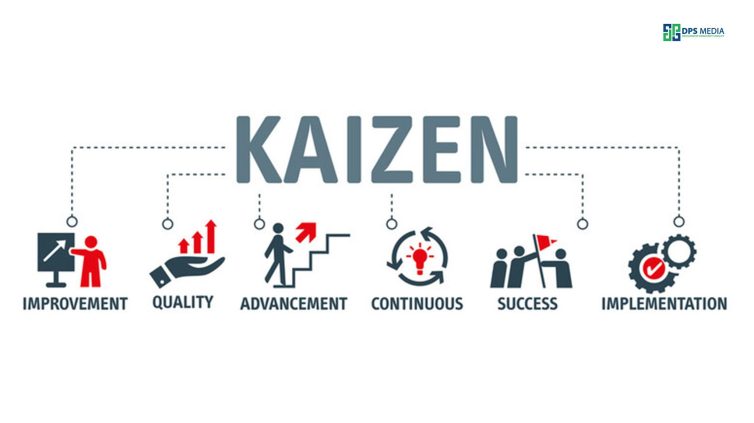

Kaizen What is it? And how does it have the power to help Toyota survive and develop for nearly 150 years without almost ever laying off an employee? If you are looking for answers to the above question, let's find out through the following article!
In this article, DPS will explain in detail the issues surrounding Kaizen in the following order:
- Kaizen What is it?
- Câu chuyện thực tế – Toyota áp dụng Kaizen to administration.
- What benefits do businesses gain when applying Kaizen?
- Implementation steps Kaizen.
- Factors that determine success when implementing the philosophy Kaizen.
- The principles of Kaizen What does it mean when applied?
1. What is Kaizen?
When it comes to quality improvement, you cannot ignore Japan. This is a leading country in this capability. Many businesses in Japan have successfully applied philosophies and business cultures. And Kaizen is one of them. So Kaizen What is it?
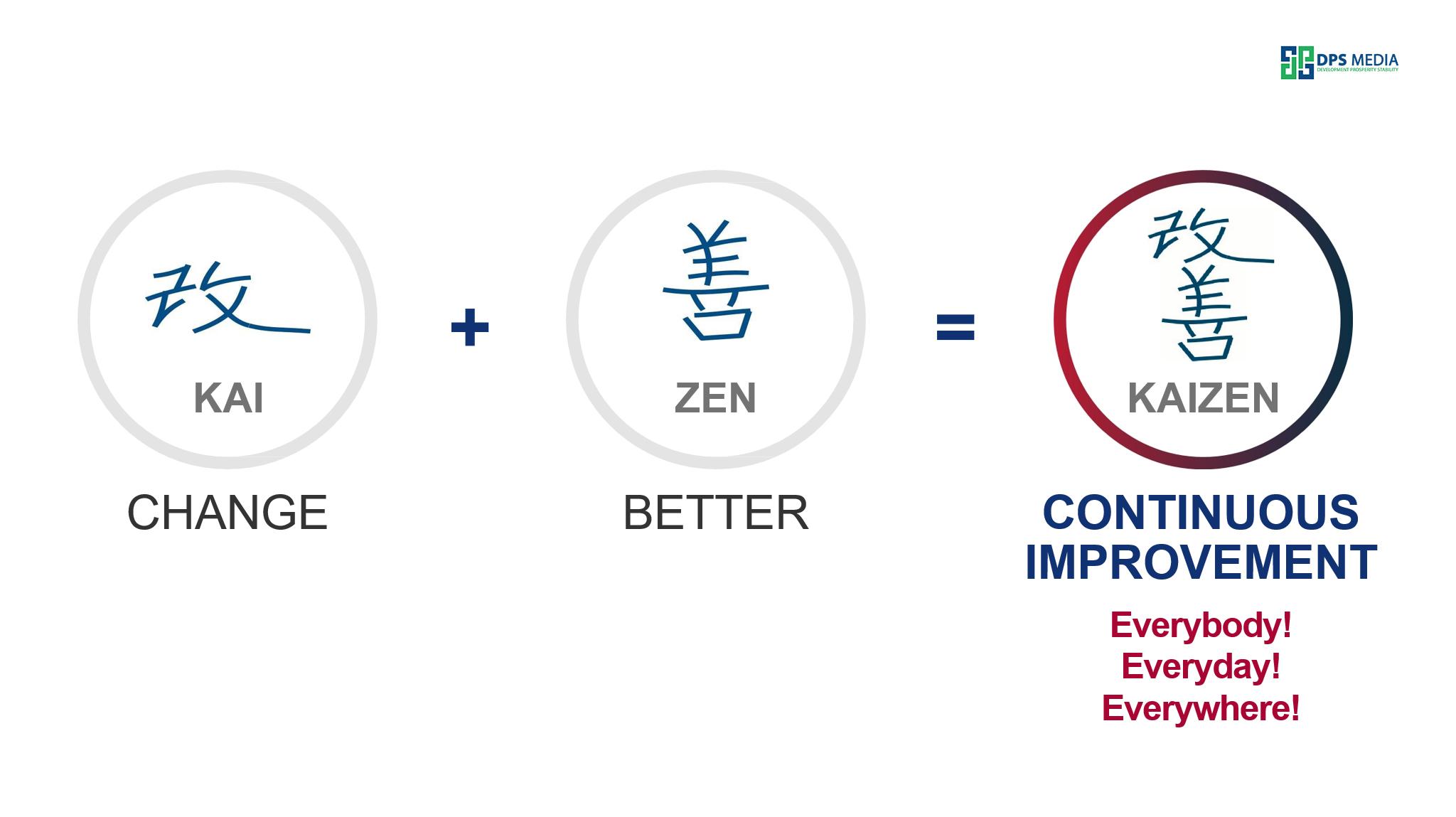
Kaizen is actually an economic term originating from Japan. It is formed by combining two words. While “Kai” means change and “Zen” means better. In summary, Kaizen it means “change for the better” or you can understand it as “continuous improvement”.
This is one of the famous business philosophies in the land of the rising sun since the 1950s (Álvarez-García, 2018). Kaizen not only successfully applied by businesses in Japan but also used worldwide. Therefore, this term is translated into English as ”continuous improvement” (Carnerud, 2018) – “continuous improvement”.
Many people still mistakenly believe Kaizen with the term “Innovation” in Western countries. In reality, the change of Kaizen focuses on people, with improvements on a rather small scale that gradually increase and achieve goals over a long period of time. This is completely different from the “Innovation” applied in the West.
2. Câu chuyện thực tế – Toyota áp dụng Kaizen vào quản trị.

Throughout its history of formation and development, Toyota has faced numerous upheavals and challenges. Notable examples include the 2008 financial crisis and the severe impacts from the devastating earthquake in Japan and the historic tsunami in Thailand. However, even in the most difficult times and when facing the risk of bankruptcy, Toyota was determined to maintain the “no employee layoffs” policy.”
2.1. Accepting to pay an extra 220 million USD/year in loan interest and preferring to cut costs rather than lay off employees.
During the Asian financial crisis in 1997, Toyota Thailand experienced four consecutive years of losses without cutting any jobs.
Quyết định này được đưa xuống từ người nắm giữ cương vị cao nhất của Toyota lúc bấy giờ. Đó là chủ tịch Hiroshi Okuda. Ông Okuda đã ra lệnh: “Cắt giảm tất cả các chi phí, nhưng không được chạm vào bất kỳ người nào”.
It was also because of this policy that in August 1998, Moddy downgraded Toyota's credit rating to AA1 from AAA. This means that Toyota has to borrow at higher interest rates and spend up to 220 million USD annually. Nevertheless, Toyota does not commit to abandoning its policy of job security for its employees.
2.2. Explaining why Toyota has existed for nearly 150 years without almost ever firing anyone?
Kaizen applied by Toyota. This is originally a system born at the production site. But this philosophy is also seen as a system for training people to think. Through this, Toyota creates opportunities for employees to utilize their intelligence.
For someone to take action, they must be the one to contribute ideas. When they come up with ideas themselves, they will be confident and know how to act positively.
Câu hỏi đặt ra là làm thế nào để một người đóng góp ý kiến? Đơn giản, người lãnh đạo hãy cố tình “làm khó” họ một chút. Một khi đối diện với thử thách hay khó khăn thì con người buộc phải suy nghĩ và đưa ra cách giải quyết vấn đề.
2.3. An interesting story about the birth of the Soluna car line

When starting to design and build the strategic car line in Asia, the Tercel line (also known as Soluna in Thailand). Mr. Takeshi Yoshida, the chief engineer, came up with the following interesting approach:
The Soluna line was intended to be sold in Thailand. The requirement for the engineers was to design a model with a contemporary selling price lower than the Corolla line. However, in the perception of many employees, Corolla was considered the lowest tier among Toyota's car lines.
Therefore, employees could not imagine what kind of vehicle would be produced if it were below even the Corolla line. So when asked: ”Can any part of the Corolla be removed?” everyone answered that it was impossible.
Not long after, Mr. Yoshida deliberately created a very cheap and poor-quality car to show them. When they “admired” this “ragged” car, a series of opinions were given.
From Mr. Yoshida's bad idea, many good ideas were generated by everyone. As a result, the Soluna model was born.
Toyota-style Kaizen is fundamentally based on human intelligence. The role of the leader is to create an environment to “draw out and gather” that intelligence. Accumulating small Kaizens will yield surprising long-term results.
3. What benefits do businesses gain from applying Kaizen?

When Kaizen when flexibly and reasonably applied to a business, it will bring many tangible as well as intangible benefits. So what are the benefits Kaizen What are they? Let's find out with DPS!
3.1. Tangible benefits for businesses
There are 2 most typical tangible benefits for businesses when successfully applying Kaizen.
Firstly, your business will reduce waste; at the same time, it will increase productivity for your company. In Toyota's case, Kaizen it helped the company cut down on wastes such as: inventory, waiting time, transportation, and excessive production at the workshops.
Secondly, the business can also improve its operations during the process. In fact, at Toyota's production workshops, workers do not waste time sorting parts. They simply use plastic baskets for sorting. Additionally, they even build their own transport vehicles from available parts on the line and just need to install the engine. Thanks to this, Toyota was able to save about $3,000 on the cost of purchasing transport vehicles.
It can be seen that the business will be able to accumulate even the smallest improvements over a long period of time; thereby creating greater results.
3.2. Intangible benefits for the development of businesses
Not only does it bring tangible benefits, but Kaizen it also brings three outstanding intangible benefits to the business.
First, each employee is encouraged and motivated to come up with good ideas that bring effective improvements to the company.
The second benefit is enhancing the team spirit of all employees. At the same time, it also increases internal unity within the business.
Finally, it is about building a culture of saving and continuous improvement in the business.
4. Steps to implement Kaizen.
By now, you probably have a basic understanding Kaizen of what it is, right! Next, DPS will introduce how you can effectively apply this philosophy to your business!
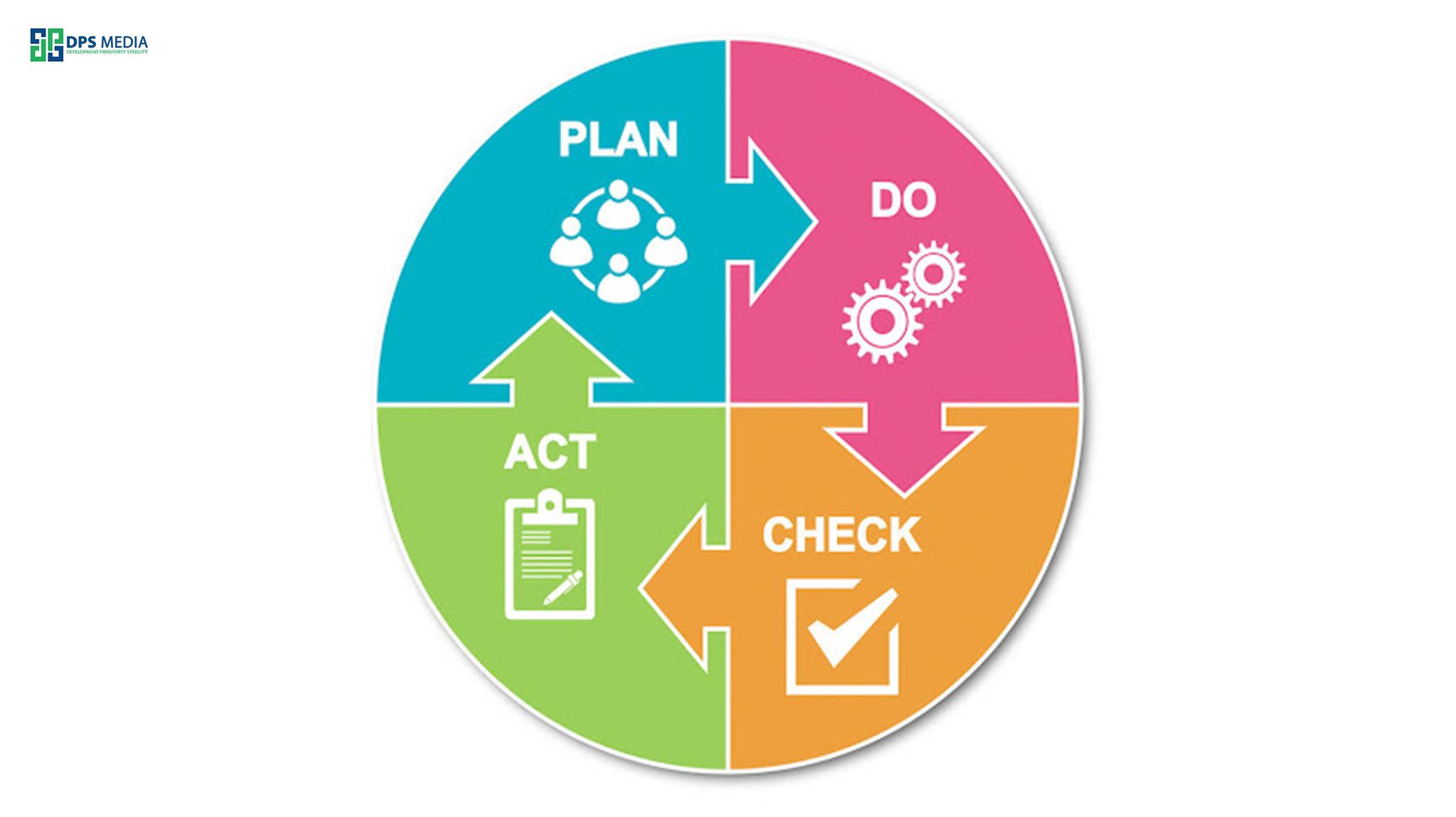
Kaizenis implemented based on the cycle PDCA (Plan – Do – Check – Action). And it is encapsulated in 8 steps. Specifically, the steps include Kaizen include:
Step 1: Select the scope of Kaizen application.
Businesses should pay attention when choosing the scope to apply. Kaizen. Here, the scope can be a production line or a specialized department. And you should ensure feasibility when implementing improvements.
To achieve greater certainty, try testing this philosophy at a specific point; then you can gradually expand until you reach the scale of the entire business.
Step 2: Understand the current situation and set goals for the business.
Before developing a communication strategy IMC or any other strategy, you always need to understand and assess the actual situation of your business. From there, you can set a unified, well-founded, and more feasible goal.
This will help your business avoid waste, make effective use of resources, and prevent unfinished plans.
You should remember that Kaizen is a philosophy, not a tool. Therefore, it requires a long-term commitment and effort from every member and every level within the business.
Step 3: Analyze the collected data and identify the root cause.
After collecting all relevant and necessary data, the leadership should meet to review and assess the current state of the business. Most importantly, they can work together to identify the root causes of the problem.
Step 4: Based on data analysis, determine the implementation measures.
Once the root cause of the issue is found, the next step is to propose solutions. Alongside the solutions are the criteria and tools to measure the achieved results.
Step 5: Implement Kaizen measures.
This is the step where the philosophy Kaizen is applied according to the initial plan set out. During implementation, the leadership should create an environment that encourages employees to contribute ideas. At the same time, they are also responsible for gathering suitable suggestions, conducting regular checks, and supervising the practical application within the business.
Step 6: Confirm the results of the measures implemented.
Once the measures have been implemented, the business needs to collect relevant data. The purpose is to measure and evaluate the results. At this step, you will use appropriate tools to compare the achieved results with the criteria set in Step 4.
Step 7: Establish or revise standards to overcome shortcomings.
Once the results have been evaluated, the business may identify some shortcomings or areas that are not suitable when applying Kaizen to the practical operations of the business. Immediately, the leadership can make adjustments or adopt more appropriate measures to avoid applying Kaizen mechanically into your business.
Step 8: Review the above processes and determine the next project
As DPS emphasized above, Kaizen is a philosophy that requires a relatively long time to see results. Keep that in mind and the business should not be impatient but must patiently carry out even the smallest things and deeply learn from each implementation. By doing this, surely in the long run, the business can achieve even greater accomplishments.
5. Factors that determine success when implementing the Kaizen philosophy.
Understanding Kaizen what it is is one thing. But applying it in practice and succeeding is another matter. Because this philosophy is also affected by the following 3 crucial factors:
5.1. Commitment from top leadership
In the philosophy Kaizen, the role of the leader is especially emphasized. Because the leader is the one who steers the “boat.” They need to create an environment where employees can generate ideas such as:
- Teamwork.
- Network-based management.
- Invest in intellectual capital.
- Employee training.
5.2. The role of managers and team leaders
For team leaders or managers, they need to continuously maintain and improve current standards in technology as well as production management. This is aimed at achieving higher labor productivity. As a result, business outcomes improve.
5.3. Efforts and contributions from everyone
The success of the application Kaizen in the business is greatly determined by the participation and contribution of all employees. Regardless of their level, they must all recognize the importance of this philosophy. Every employee in the organization strives to participate and contribute ideas to establish a new mindset system and unite in building a proper business environment. The saying: “If you want to go fast, go alone. If you want to go far, go together” is very true in this case.
6. What are the principles of Kaizen when applied?

Therefore, philosophy Kaizen has become as widely popular as it is today because it possesses timeless principles. Once a business has adopted it Kaizen it must be strictly adhered to. Regardless of whether your business is small or large. More specifically, Kaizen has the following 10 principles:
Principle 1: Always focus on customer benefits
All products or services created by the business must meet the needs of the target customers. Therefore, businesses need to focus on continuously improving the quality of their products or services, even if only slightly. At the same time, increase the benefits brought by the product; with the ultimate goal of achieving maximum customer satisfaction and delight.
Principle 2: Continuous improvement
Achieving the initial goal does not mean the improvement process is over. This is only the end of one phase; before moving on to the next phase.
Because customer needs will continue to increase in the future. Therefore, if a business does not want to be eliminated from the market, it must continuously improve to enhance product quality. This not only helps the business save time and costs, but also allows it to stay ahead of trends or even create new ones. That is, to create demand for customers even before they realize their own needs.
Principle 3: Build a no-blame culture
Each employee is assigned a specific task. When mistakes are made or tasks are not completed, responsibility must be assigned to the right person. Do not blame others or give unjustified excuses.
Principle 4: Promote an open corporate culture
An open corporate culture here means that employees dare to face their own mistakes and shortcomings. If an employee needs help from colleagues or superiors, they should proactively seek help from everyone.
Therefore, businesses need to establish an internal communication network where employees can help, learn from, and share experiences with each other.
Principle 5: Encourage teamwork based on the Kaizen philosophy
Businesses should aim to build a personnel structure based on effective working teams, instead of individual work.
When forming teams, clear delegation of authority is necessary. At the same time, they need to have agreements in place to resolve conflicts that arise within the team.
In this, the team leader needs to have leadership skills, while each team member needs to respect the agreements and each other's personalities.
Principle 6: Integrate multiple departments and functions in the same project
When carrying out any project, businesses should allocate and combine human resources from different departments. If necessary, you can also take advantage of external resources.
Principle 7: Establish proper relationships among all employees
To avoid creating adversarial or hostile relationships, businesses need to invest in communication skills training programs for staff. Additionally, businesses can organize team-building sessions to strengthen relationships among employees.
Building relationships among employees is also similar to building the culture of your business.
Principle 8: Foster discipline and self-awareness
Develop and train employees to have a sense of discipline as well as the spirit of self-awareness in complying with company rules.
Besides, employees also need to put work interests first. From there, they can self-assess and review themselves. This is aimed at helping them improve and overcome their own weaknesses.
Principle 9: Communicate information to all levels and employees
If you want to achieve high results at work, businesses should be transparent with their employees.
Because information is the most important factor that permeates and “flows” throughout the business process. Well-communicated internal information is the perfect way for businesses to share common difficulties and challenges with every employee in the organization.
Principle 10: Promote productivity and work efficiency
Simultaneously implement and consolidate internal training methods across all departments in the business.
In each project, it is necessary to assign specific and clear roles to each position for every team member. Each individual must utilize their abilities, proactively contribute ideas, and provide feedback.
When achievements are made, businesses need to promptly recognize and reward all team members. This will stimulate capabilities and enhance work efficiency across the entire company.
Hopefully, the above article has provided you with useful information regarding the philosophy. Kaizen. Wish you success in applying this philosophy to your business!
References:
Álvarez-García, J. D.-S. (2018). Systematic bibliometric analysis on Kaizen in scientific journals. The TQM Journal.
Carnerud, D. J. (2018). Kaizen and continuous improvement–trends and patterns over 30 years. The TQM Journal.