

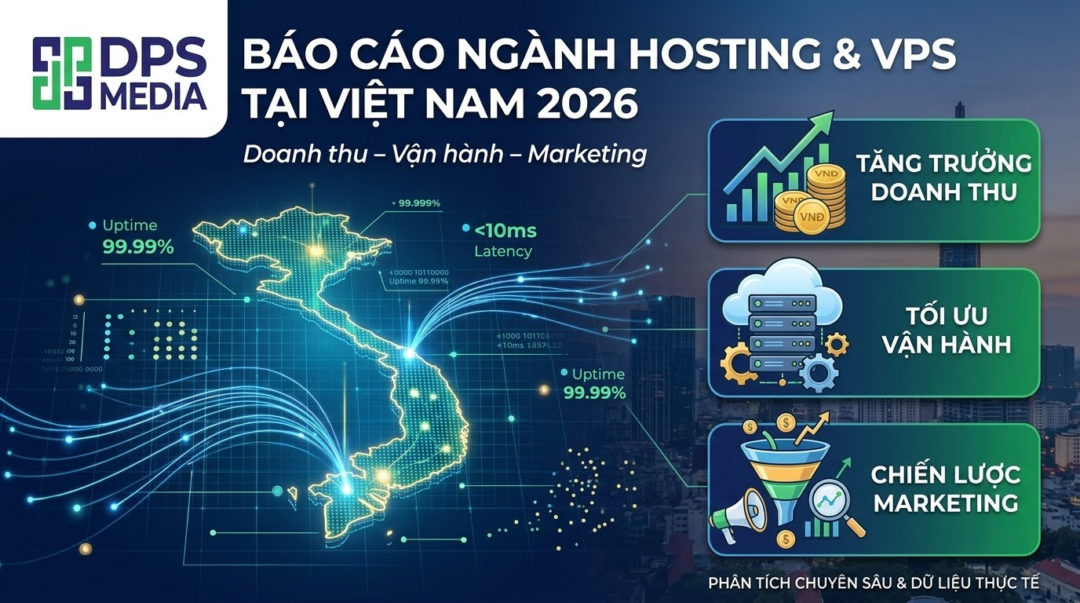

In-depth Analysis Report on the Cloud Computing, Hosting, and Virtual Private Server (VPS) Industry in Vietnam 2026: Revenue Drivers, Operational Structure, and Comprehensive Marketing Strategies
1. Foreword and Positioning of the Digital Hosting Industry in 2026
Entering 2026, Vietnam's macro-economic and technological landscape is undergoing an unprecedentedly deep restructuring process.
From a nation primarily known as a hub for low-cost software outsourcing and hardware manufacturing, Vietnam has risen strongly to assert its position as one of the most dynamic and fastest-growing digital hubs in Southeast Asia.
This transformation did not happen by chance but is the result of a strategy converging multiple factors: the explosion of the digital economy, government-driven policies, and the influx of foreign direct investment (FDI) into core infrastructure.
At the center of this digital transformation vortex, the Cloud Computing, Virtual Private Server (VPS), and Web Hosting industries act as a vital circulatory system.
These services no longer just provide passive storage space but have evolved into active computing platforms, directly supporting the development of Artificial Intelligence (AI), Big Data Analytics, E-commerce, and Fintech.
The fact that major global corporations, as well as hundreds of thousands of domestic small and medium enterprises (SMEs), are ramping up the migration of workloads to cloud platforms has turned this industry into one of the sectors with the highest growth margins and fiercest competition.
This in-depth analysis report is designed to deconstruct the internal structure of the Hosting, VPS, and Cloud market in Vietnam in 2026.
By applying quantitative and qualitative analysis methods, this document explores three fundamental pillars determining the success or failure of providers: (1) Revenue drivers and market size; (2) Operational structure, from the era of Hyperscale Data Centers to digital standards and sustainability; and (3) Sophisticated Marketing strategies, pricing, and go-to-market approaches being used to capture market share in an interconnected world.
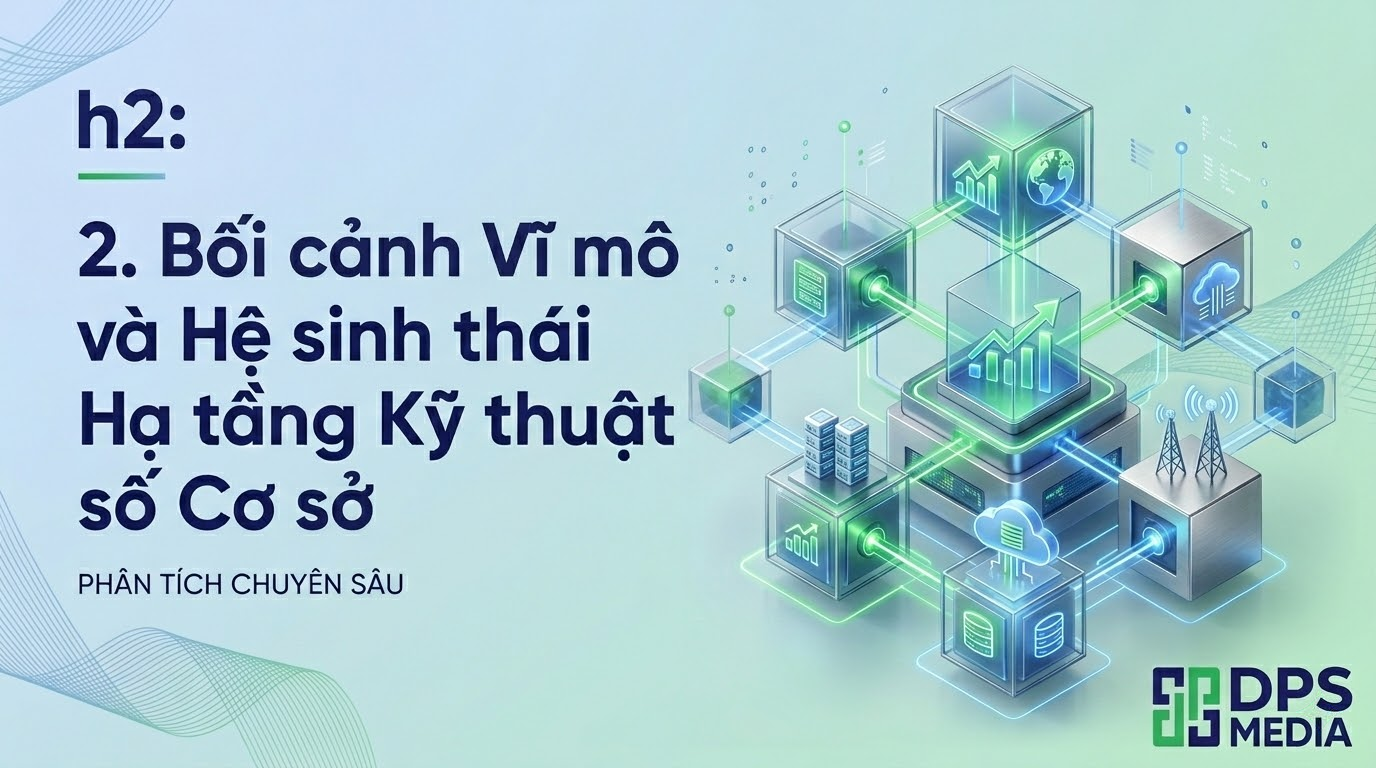
2. Macro Context and Digital Infrastructure Ecosystem
To clearly understand the revenue growth trajectory of Hosting and VPS services, analyzing macro indicators and the quality of connection infrastructure is a prerequisite.
The foundation of all cloud services is the national internet system, and Vietnam has made remarkable strides in this field as of 2026.
2.1. Drivers from the Digital Economy and Internet Penetration
Currently, the digital economy is acting as the main growth engine for Vietnam.
Data from the Ministry of Information and Communications shows that the digital economy has recorded a growth rate of approximately 20% per year, contributing up to 18.3% to the Gross Domestic Product (GDP).
The expansion of the digital economy means an increase in e-commerce platforms, delivery apps, ride-hailing services, and online payment systems—all of which require VPS and Cloud infrastructure with flexible scalability and absolute reliability.
The nation's digital infrastructure has reached an incredibly mature state.
The internet penetration rate in Vietnam currently stands at 79.1% with a user base exceeding 78 million.
More importantly, high-quality connection infrastructure has reached deep into the population, with over 82.4% of households having access to broadband fiber optic internet, exceeding the 80% target previously set by the government for 2025.
This dense internet coverage creates billions of data touchpoints every day.
As user traffic increases exponentially, businesses can no longer rely on traditional Shared Hosting services, which are prone to network congestion.
Instead, they are forced to upgrade to high-speed VPS or dedicated Cloud Server services to maintain a seamless user experience.
2.2. Upgrading Fiber Optic Infrastructure and Multinational Telecommunications
The cloud storage ecosystem cannot operate effectively without high-speed physical connection systems.
Recognizing this, the government and telecommunications corporations are concentrating efforts on reshaping the nation's fiber optic map.
Vietnam is in the process of implementing an ambitious plan: deploying 10 new domestic and international submarine cable routes between now and 2030.
One of the most notable projects is the effort by the Ministry of Science and Technology (MOST) to establish a cross-border terrestrial fiber optic route connecting Vietnam, Laos, Thailand, and Singapore, with massive bandwidth ranging from 2 to 12 terabits per second.
This diverse connectivity network brings three core benefits to the Hosting and VPS industry: first, it eliminates the risk of submarine cable breaks that frequently disrupted services in the past; second, it reduces latency when routing international data; and third, it strengthens Vietnam's position as a secure and stable data transit hub for the entire Southeast Asian region.
Alongside fiber optics, the expansion of 5G mobile networks is triggering a new era of Edge Computing.
The surge in Internet of Things (IoT) devices and Smart City projects requires data to be processed right at the network edge to ensure real-time performance.
This drives telecommunications providers to develop decentralized data centers in tier-two satellite cities, opening up a lucrative niche market for ultra-low latency local VPS solutions.
2.3. Restructuring Administrative Space and Mapping Data
A micro-example illustrating the change in data infrastructure in Vietnam is the restructuring of administrative units.
The government's reorganization from 63 provinces and cities down to 34 provincial-level administrative units (including 28 provinces and 6 centrally-governed cities), along with mergers reducing the number of commune-level administrative units from 10,310 to 3,321, has forced major cloud platforms to update their systems.
For instance, AWS's Amazon Location Service has restructured its entire map data to reflect this change.
A secondary consequence of this event is that domestic logistics, e-commerce, and public service enterprises are heavily utilizing computing resources (via APIs on VPS or Cloud) to standardize customer databases, re-plan delivery areas, and update addresses.
This process creates a spike in server resource consumption in the short and medium term.
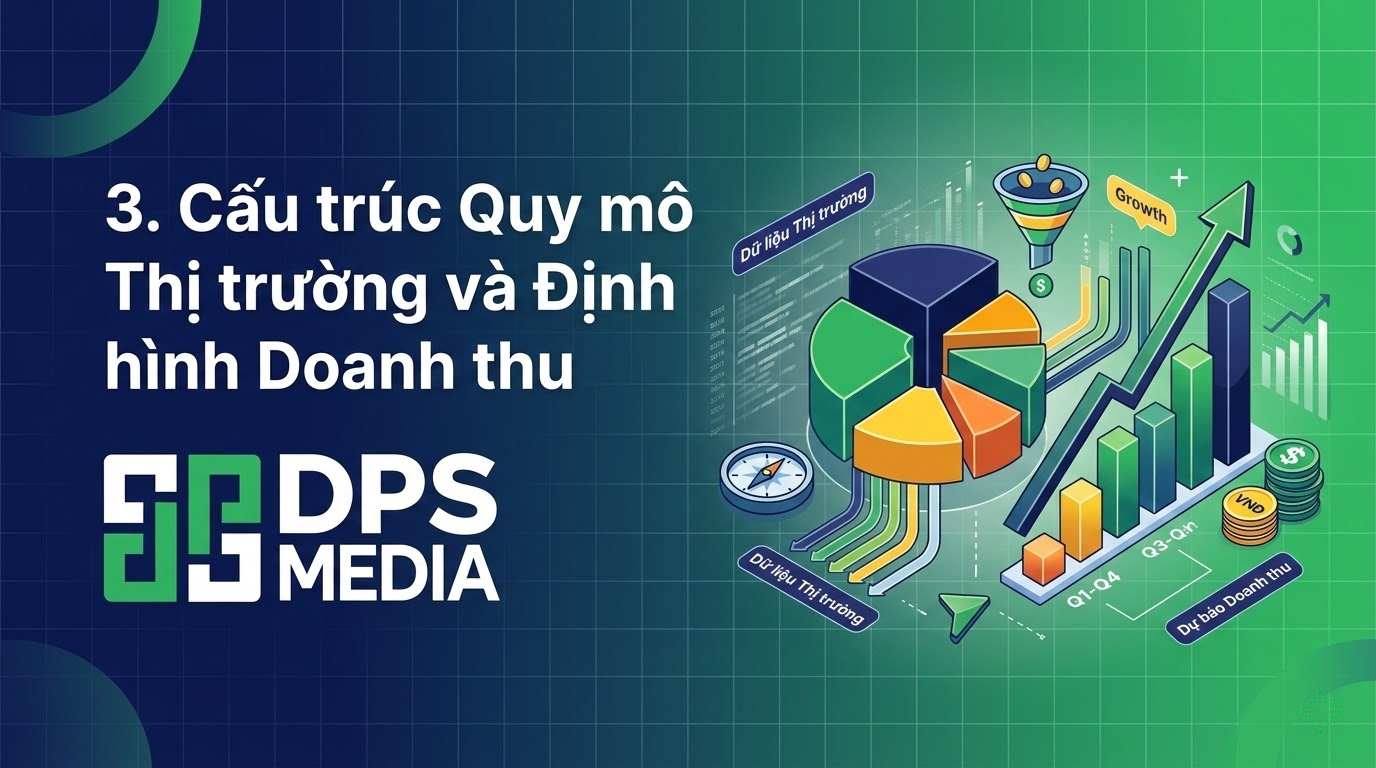
3. Market Size Structure and Revenue Shaping
The combination of massive domestic data consumption demand and technological investment flows has pushed the scale of Vietnam's Cloud Computing and Hosting market to new heights.
Overall revenue analysis provides a quantitative look at the industry's attractiveness.
3.1. Cash Flow Analysis and Compound Annual Growth Rate (CAGR)
Data from international market research organizations all agree on a vertical growth trajectory, despite slight differences in valuation methodologies.
According to a report by P&S Intelligence, the Vietnam cloud computing market size is valued at 3.5 billion USD by 2025.
Entering 2026, this figure is projected to hit the $4.0 billion mark, continuing to accelerate to reach a valuation of $8.6 billion by 2032.
This expansion process is expected to maintain a Compound Annual Growth Rate (CAGR) of 13.7% throughout the forecast period.
From a more cautious yet still positive perspective, reports from TechSci Research and IMARC Group assess the market size at approximately $3.57 to $3.71 billion at the current stage and expect it to surpass the threshold of $6.98 to $9.1 billion in the 2030-2033 period, maintaining a solid CAGR of approximately 10.94%.
If the underlying infrastructure segment is isolated, Vietnam's Data Center Market is also witnessing an equally explosive boom.
Valued at $1.41 billion in 2025, the data center business segment is expected to break out with a record high CAGR of 17.5% to reach $4.37 billion by 2032.
This massive cash flow reflects the trend of businesses shifting costs from self-investment and fixed asset depreciation (CapEx – purchasing physical servers, building server rooms) to a flexible operating cost model (OpEx – renting cloud resources based on usage needs).
3.2. Revenue Structure by Deployment Model
The market is witnessing a clear fragmentation of demand based on the security characteristics and budgets of different customer groups.
Analyzing deployment models helps Hosting/VPS providers optimize their product portfolios.
| Deployment Model | Projected Revenue Share (2025 – 2026) | Key Customer Groups | Core Growth Drivers |
| Public Cloud | 50% of total market share | Small and Medium Enterprises (SMEs), Startups, E-commerce | Long-term cost optimization, automated setup capabilities, extremely fast horizontal scalability (scale-out), minimizing IT administration burdens. |
| Hybrid Cloud | Fastest growth (CAGR ~ 14%) | Financial Institutions, Banking (BFSI), Healthcare, Government Agencies | The perfect balance between the flexibility and big data analytics capabilities of Public Cloud and the closed security and sensitive data isolation features of Private Cloud. Cybersecurity Law compliance requirements. |
| Private Cloud | Stable share | Multinational Corporations, Telecommunications, Heavy Industry | Absolute control over physical hardware, strictly controlled latency, micro-level network architecture customization (micro-segmentation). |
The Public Cloud model continues to dominate, capturing half of the overall market share.
This dominance is an inevitable consequence in the context where the SME sector accounts for more than 96% of the total number of active businesses in Vietnam.
Limited financial resources combined with active support from government digital transformation programs have made affordable, accessible VPS services a vital choice for the SME sector.
However, the most notable shift belongs to Hybrid Cloud.
The need to balance security risks with the speed of innovation is driving banks and financial institutions to invest heavily in this hybrid architecture.
3.3. Revenue Allocation by Service Type and Industry
When viewed through the lens of services, the market offers a diverse picture of how computing technologies are consumed:
SaaS (Software as a Service): Remains the largest revenue-contributing segment with about 45% market share in 2025.
The massive adoption of Customer Relationship Management (CRM) software, Enterprise Resource Planning (ERP) systems, and remote collaboration tools is the accelerating engine for SaaS.
IaaS (Infrastructure as a Service): This is the core service group including VPS virtual servers, Block Storage space, and network resources.
IaaS is projected to be the fastest-growing segment with a CAGR of 13.9% in the coming period.
The driver for IaaS comes not only from pure digital transformation but also from the need to set up environments for AI projects, Machine Learning training, and Big Data mining.
PaaS (Platform as a Service): Provides essential tools for software development without worrying about the underlying infrastructure.
The TechSci Research report even identifies PaaS as the most explosively developing segment as businesses shift to microservices architecture and containerization (such as Kubernetes).
In terms of industries, the Banking, Financial Services, and Insurance (BFSI) sector continues to be the “cash cow” bringing in the largest revenue for Cloud providers.
With more than 90% of transaction volumes at many credit institutions currently conducted via digital channels, powerful server infrastructure to ensure high availability and transaction safety is a mandatory requirement.
The Healthcare, Telecommunications, Retail, and Public Administration sectors are also following closely with large budgets dedicated to process digitization.
4. Competitive Landscape and Cloud/VPS Market Share Picture
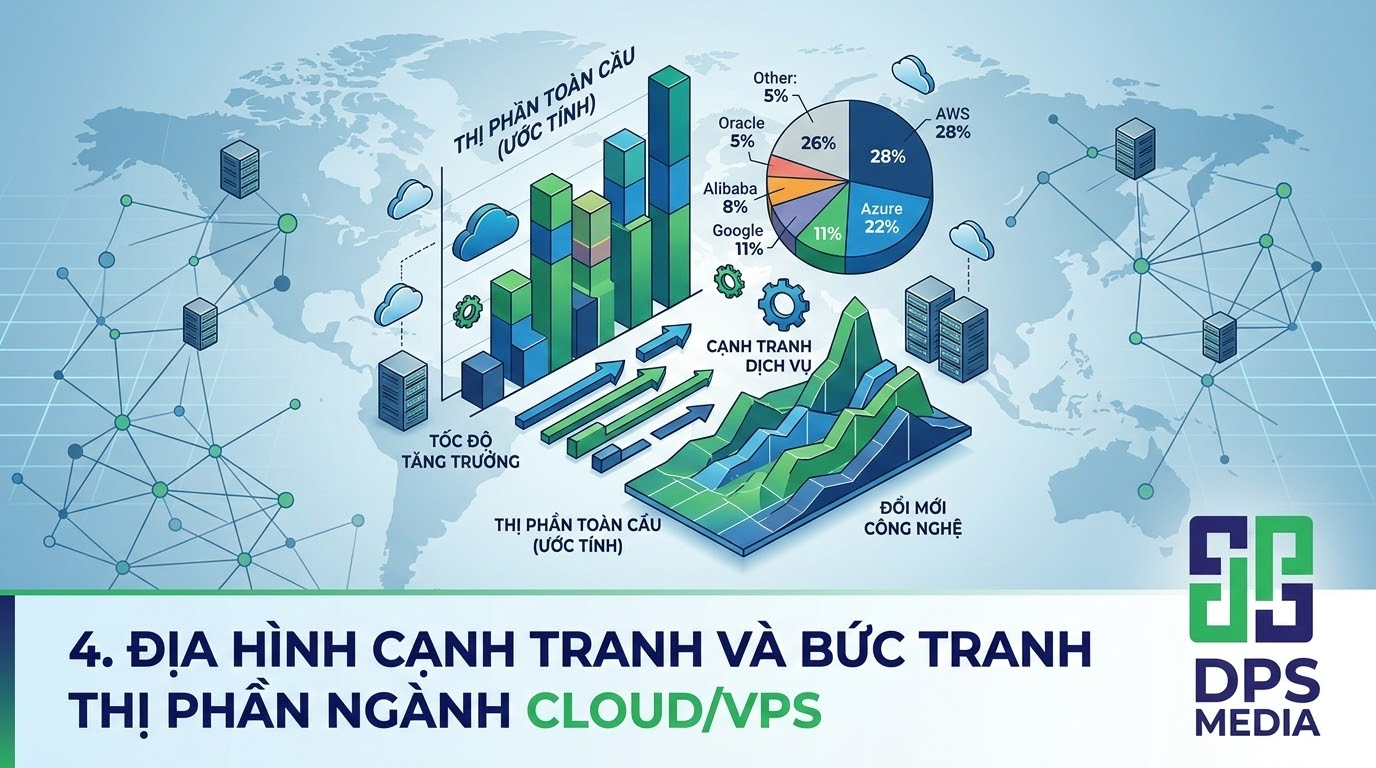
The Hosting, VPS, and Cloud market in Vietnam in 2026 is a multipolar arena, witnessing intersection, cooperation, and direct confrontation between international “Hyperscaler” giants and domestic tech-telecom enterprises strongly backed by the government.
The market structure is defined by analysts as “moderately fragmented,” indicating that opportunities remain wide open and no single power has yet established a monopoly position.
4.1. Domestic Market Share Ambitions and Efforts of the Telecommunications Sector
Within the framework of the National Digital Transformation Program, the Vietnamese Government has set an extremely bold goal: by 2025, 100% of government agencies must complete the transition to using cloud computing, and more importantly, 70% of the domestic cloud service market share must be served by Vietnamese enterprises (Make in Vietnam).
Although experts assess the 70% target as a massive challenge given the technological dominance of foreign firms, the efforts of the domestic business sector are yielding clear quantitative results.
The domestic service ecosystem currently brings together 39 cloud service providers and owns about 27 data centers through 11 key infrastructure enterprises.
From only providing single storage services and basic Hosting, Vietnamese enterprises have successfully built a multi-dimensional ecosystem with more than 30 different cloud products and services, basically fully meeting the demand chain of the digital economy.
The market share for data center and server infrastructure (the physical platform for providing VPS and Cloud) is held firmly by telecommunications giants.
| Data Center / Infrastructure Provider | Estimated Market Share (%) | Typical Capacity and Positioning Platform |
| Viettel IDC (Viettel – CHT) | 26.6% – Aggregate | The absolute leading provider, owning a chain of the 5 largest Rated-3 Data Centers nationwide with an area of 35,000 m2. Currently building a 140 MW super-infrastructure. |
| HTC-ITC (Hanoi Telecom) | 18,9% | Owns an international standard transmission network and data centers, providing capacity for derivative service providers. |
| VNPT / VNTT5 | 15,5% | Based on the advantage of the national fiber optic infrastructure, providing synchronized cloud solutions for state administrative agencies. |
| QTSC Telecom Center | 11,8% | Mainly serving the Quang Trung Software City area and the network of corporate customers in the Southern region. |
| VNG Cloud | 5,5% | Positioned as a specialized solution for high performance. Recently merged with the GreenNode brand to expand its capacity to provide GPU computing infrastructure for Artificial Intelligence. |
Major providers such as Viettel IDC, FPT Smart Cloud, and CMC Cloud are fully exploiting local competitive advantages that international firms find difficult to perfectly meet.
These include the ability to absolutely comply with data residency laws in Vietnam, the ability to issue valid financial invoices according to tax authority regulations, along with direct technical support systems in Vietnamese and deep understanding of local business operating processes.
4.2. Mass Market Hosting and VPS Service Providers
Separate from the infrastructure war of the giants, in the end-user, individual developer, and E-commerce Startup segments, the race for Hosting and VPS market share is occurring fiercely among specialized service providers.
Brands such as Vietnix, VinaHost, P.A Viet Nam, HostVN, iNet, and CloudFly have established solid loyal customer bases.
Market share differentiation in this group is based not on data center scale but on customer support quality, pricing policies, and the integration of added values.
For example, VinaHost asserts its position through stability with over 15 years of experience and providing extremely diverse configurations for all segments.
Meanwhile, CloudFly has emerged with high flexibility, allowing customers to pay for resources hourly or monthly as desired, embodying the flexible spirit of cloud computing.
P.A Viet Nam focuses strongly on high-speed Cloud Server and VPS solutions using NVMe SSD drives, positioning itself as a strategic partner helping E-commerce websites overcome slow loading issues, thereby optimizing SEO rankings on Google.
4.3. Counterweights from International “Hyperscalers”
The presence of the foreign sector cannot be ignored.
Despite facing legal barriers regarding data sovereignty, the power triangle of AWS (Amazon Web Services), Google Cloud Platform (GCP), and Microsoft Azure maintains an intense appeal for multinational tech corporations operating in Vietnam, as well as developers already familiar with their rich ecosystem of tools.
The absence of physical Availability Zones directly within Vietnamese territory is a bottleneck, forcing these services to route data through nodes in Singapore, Tokyo, or Hong Kong, thereby causing certain latency challenges for real-time applications.
Nevertheless, international corporations are actively changing their strategies to “take root” deeper.
A prime example is Alibaba's announcement of plans to establish a data center complex in Vietnam, while ST Telemedia Global Data Centres (STT GDC) and Gaw Capital are actively cooperating and forming joint ventures with domestic enterprises to build international-standard infrastructure right in Ho Chi Minh City.
5. Operational Architecture, Core Technology, and Service Level Agreements (SLA)
The qualitative transformation of the VPS and Cloud industry in Vietnam is reflected not only in revenue but also clearly in the evolution of system architecture and operational capacity.
2026 marks the point where traditional server rooms are giving way to fully automated super-platforms.
5.1. The Era of Hyperscale Data Centers
The market is witnessing a structural shift from scattered deployment of small-scale colocation facilities to concentrating capital into Hyperscale Facilities.
These Hyperscales are characterized by their massive scale, the ability to supply tens of megawatts of power, and are specifically designed to meet the computing power needs of the AI era.
Several mega-projects are reshaping the national digital infrastructure map, including:
Viettel IDC's Mega-project: Commencing in April 2025 at Tan Phu Trung Industrial Park (HCMC), this is considered Vietnam's first true Hyperscale data center.
With a total design capacity of up to 140 MW and space for 10,000 racks, this project is expected to be completed by 2030, creating a solid cornerstone for the national storage ecosystem.
CMC Corporation's Project: This corporation has received investment policy approval for a $250 million mega-project at the HCMC High-Tech Park.
The project starts with an initial capacity of 30 MW and has architectural space allowing for expansion up to 120 MW.
CMC's entire infrastructure investment plan from now until 2028 is expected to cost approximately $500 million.
VNG and STT GDC Partnership: Together developing a new data center in the Southern region with a capacity of 60 MW.
Global AI Alliance: Most notable is the proposal to build a $2 billion Hyperscale Data Center dedicated to Artificial Intelligence in HCMC, initiated by the alliance of G42 (UAE), Microsoft, FPT, and VinaCapital.
These massive infrastructure blocks, with a heavy concentration in the Southern region (holding the largest market position) and the Northern region (the fastest-growing area), create economies of scale.
This allows providers to allocate costs more efficiently, thereby lowering Cloud VPS service prices to an accessible level for both students and Startups.
5.2. Virtualization Technology and Cloud-Native Architecture
At the Software Architecture level, domestic cloud platforms are adopting the world's most advanced virtualization technologies.
Open Source Virtualization Platform (OpenStack): Typically FPT Smart Cloud, which put the OpenStack system into practical operation in 2020.
As of the current time, FPT's OpenStack infrastructure scale spans multiple data centers in both Vietnam and Japan, managing more than 1,000 hypervisors and serving over 3,000 corporate customers across 15 countries.
Mastering OpenStack architecture allows firms to avoid vendor lock-in with expensive licenses from foreign software companies like VMware, while providing high customization capabilities to offer complex PaaS and AI SaaS services.
Ultra-high Performance Hardware: Providers like CMC Cloud are using KVM architecture combined with Software-Defined Storage (SDS) and Software-Defined Networking (SDN).
Hardware systems are constantly refreshed with Intel Sapphire Rapids or AMD Max processor lines.
In particular, Hard Disk Drive (HDD) storage standards have been completely phased out from high-end segments; replaced by 100% All-Flash systems using NVMe SSD standards.
This is the core factor helping current VPS services achieve superior read/write (I/O) speeds, ensuring database access and website loading times are below Google's 3-second golden standard.
GPU Servers for Artificial Intelligence: Catering to the thirst for AI computing power, FPT Smart Cloud introduced the AI Factory platform containing up to 2,000 NVIDIA H100/H200 GPUs, fully managed by a specialized, fine-tuned OpenStack infrastructure.
Similarly, the GreenNode brand (following its merger with VNG Cloud) focuses on providing High-Performance Compute (HPC) infrastructure optimized for training and inference of Large Language Models (LLMs) for Vietnamese tech startups.
5.3. Service Quality Standards (SLA) and Technical Support Systems
In a context where system outages can cause millions of dollars in losses per hour for e-commerce businesses or banks, the Service Level Agreement (SLA) has become the most important legal document in Cloud supply contracts.
Leading platforms in Vietnam such as CMC Cloud and FPT Smart Cloud currently apply a common, extremely strict SLA standard: Uptime reaching 99.99% for virtual server services and Web Application Firewall (WAF) services.
To achieve this “four nines” figure, the system architecture must be designed in clusters, with automatic failover between nodes when hardware errors occur, and data must be synchronously distributed across at least three Tier-3 standard data centers.
Regarding IT Service Management (ITSM), the technical support model no longer operates only during office hours.
The Contact Center and Help Desk systems of providers like CMC and FPT are set up to be on duty 24/7/365.
Customers are provided with a multi-channel ecosystem for interaction, from traditional Hotlines and Email to Live chat and internal Ticket support systems deeply integrated into the Zalo platform.
Extended services such as “Incident Management,” IT Asset Tracking, and Management Automation help minimize unintended downtime and assist customers in maximizing Return on Investment (ROI).
The strong growth of the CCaaS (Contact Center as a Service) era, expected to break through in revenue from $6.7 billion to $15.82 billion globally by 2029, also indicates that integrating AI into the customer care processes of hosting companies will help diagnose and handle network errors automatically faster than ever.
6. Green Transformation (ESG) and Sustainable Data Centers
When a Hyperscale data center operates, the amount of electricity it consumes can be equivalent to that of a small city.
Therefore, in 2026, the industry's operational strategy aims not only at speed but also places emphasis on Environment, Social, and Governance (ESG).
Building “Green Data Centers” is no longer a mere PR (Public Relations) concept, but a vital solution to resolve bottlenecks in the power supply capacity of the national grid and meet the partnership criteria of global partners.
Viettel IDC emerges as a pioneering model in the decarbonization journey.
Since 2020, this enterprise has proactively implemented renewable energy integration through a 182 KWp solar panel system at its Binh Duong facility, directly connecting to the grid to provide power for operating servers.
These efforts are accompanied by a radical upgrade of Uninterruptible Power Supply (UPS) systems to energy-saving Eco-conversion mode.
Moving into the modernization phase, smart architectural designs are put into practical application.
Typically, at Viettel IDC's Hoa Lac data center, a unique “honeycomb” architecture has been constructed.
This structure is not only aesthetically valuable but also optimizes natural airflow circulation and provides excellent thermal insulation from the external environment.
Regarding cooling technology, the use of Economizer cooling systems combined with magnetic-bearing centrifugal cooling helps the center improve cooling efficiency by up to 40% compared to traditional mechanical air conditioning solutions.
The final piece of the energy optimization strategy is the role of Artificial Intelligence.
The Data Center Infrastructure Management (DCIM) platform uses AI to analyze temperature, humidity, and CPU load data from thousands of VPS in real-time to flexibly regulate cooling flow and electrical current with the highest precision.
At the software layer, providers launching “Green Cloud” solutions encourage businesses to optimize source code and automatically scale-in redundant server systems during off-peak hours, thereby cutting useless power consumption and minimizing electronic waste.
The green energy puzzle, if solved successfully, will help Vietnam avoid the trap of power grid overload and become a leading “Green – Safe” destination for tech giants.
7. Legal, Data Compliance, and Cybersecurity Barriers
The operating environment of the Cloud Computing and Hosting industry in Vietnam is being strongly dominated by strict legal policies related to cyberspace.
This legal framework both creates barriers and establishes a natural protection mechanism for the domestic storage market.
The most powerful game-changing factor is the Law on Cybersecurity and the Personal Data Protection Decrees (PDPD) which have officially taken full effect.
These legal regulations require businesses operating in critical sectors such as telecommunications, e-commerce, social networks, healthcare, and especially financial technology (Fintech) to store (Data Residency) sensitive user data within the territory of Vietnam.
The second-order effect of this policy is enormous.
For foreign corporations wanting to enter Vietnam's rising digital market, arbitrarily choosing an AWS data center in Singapore or GCP in Tokyo is no longer a viable technical decision, as it carries potential legal risks.
Barriers regarding issuing legal invoices under Vietnamese tax law and the difficulty of working with technical support systems that lack local understanding further increase friction costs.
This pushes foreign enterprises into a position where they must seek domestic Cloud providers like FPT, Viettel, CMC, or VNG as strategic infrastructure partners.
In addition to data sovereignty, the information security landscape itself is changing rapidly.
Thales' 2026 Data Threat Report pointed out a terrifying shift: Artificial Intelligence is no longer purely a driver of innovation but has become a top insider threat.
The survey shows that up to 61% of organizations identify AI as the most urgent data security risk.
This leads to an explosion in demand for system protection solutions bundled with storage services.
Modern Hosting and Cloud providers are required to integrate next-generation Web Application Firewalls (WAF), such as the FPT Cloud WAF solution in partnership with CyRadar or WAPPLES in partnership with Penta Security, while also providing Vulnerability Assessment and Distributed Denial of Service (DDoS) Protection directly from the core network infrastructure.
A provider having an infrastructure architecture that complies with security standards is a prerequisite (Deal-breaker) for signing contracts with the government and BFSI sectors.
8. Marketing Strategies, Demand Stimulation, and Go-to-Market Strategy
As computing resources (CPU, RAM, Bandwidth) are increasingly commoditized into standard goods, the battle for Hosting and VPS market share no longer lies in who has stronger servers, but in who possesses the most astute Marketing capabilities and the deepest customer understanding.
2026 witnesses providers deploying multi-layered, highly specialized Marketing strategies to lock customers into their ecosystems.
8.1. Penetration Pricing and the Art of Cross-selling
In the Mass Market segment and the SME block, which are inherently price-sensitive, the fiercest competitive weapons remain super promotions and penetration pricing strategies.
The core objective of brands is to accept extremely thin profit margins (even breaking even) on the first transaction to attract new users, thereby maximizing Customer Lifetime Value (LTV) through annual renewal fees and cross-selling services.
The market continuously witnesses “price-breaking” programs to stimulate demand during holidays or year-end shopping cycles.
For instance, the vNode brand in early 2026 launched discount codes of up to 65% for all specialized VPS service lines (NVMe VPS, AMD Max, Platinum, n8n VPS, and Forex VPS), and a record deep discount of 80% for traditional Web Hosting systems with payment terms of 12 months or more.
This tactic helps the provider mobilize a huge amount of upfront cash for infrastructure reinvestment, while creating a switching barrier to retain customers.
Similarly, Vietnix pursues a “Bundling Marketing” model.
In addition to discount rates from 30% to 70%, Vietnix focuses on increasing the perceived value by bundling a series of expensive utilities that developers usually have to purchase separately: DirectAdmin Personal Plus licenses, premium Theme/Plugin sets specialized for WordPress, and free SSL security certificates.
This approach comprehensively addresses the “pain point” of operating costs for e-commerce startup individuals.
On a larger scale, FPT Smart Cloud and Viettel IDC use “Pay As You Go” pricing models (billing by the hour with extremely low starting prices, only 265 VND/hour) or “Spot Instances” (reducing costs by up to 90% for servers utilizing idle resources), helping to break down the psychological barrier of cost concerns when startups begin their journey of moving systems to the cloud.
8.2. Developer-Centric Marketing
The generation of Decision-Makers for IT infrastructure procurement is changing.
Instead of focusing on convincing Chief Financial Officers (CFOs) or Chief Information Officers (CIOs), today's B2B Marketing campaigns aim directly at System Engineers, DevOps Experts, and Developers.
This phenomenon is known as Product-Led Growth.
Developers in Vietnam in 2026 are familiar with Cloud-native architectures, setting up Infrastructure-as-code using Terraform, or automated Application Programming Interface (API) systems (REST, GraphQL, CI/CD pipelines).
Capturing this mindset, the communication messages of FPT Cloud, CMC Cloud, or GreenNode do not just mention physical hardware capacity or speed, but emphasize the Developer Experience (DX) tool ecosystem.
Introducing automated deployment platforms like FPT Kubernetes Engine (FKE) or AI Studio systems that allow training models directly via a command-line interface generates excitement and loyalty from the tech engineering community.
For users without deep Linux system administration skills, providers position their products with intuitive Control Panels such as cPanel, aaPanel, or DirectAdmin to ensure “Anyone can operate a website.”.
8.3. B2B Positioning through Summits and Industry Training
A reality in the Cloud Enterprise business is that the Sales Cycle lasts from several months to several years, requiring trust at a strategic level.
Therefore, pay-per-click (PPC) ads are not the only channel.
Instead, Event Marketing becomes a vital marketing channel for domestic Cloud corporations to showcase technological strength and build relationships with C-level management.
Global Event (Vietnam Cloud Datacenter Convention – VNCDC 2026): Considered the largest and most important professional event in the digital storage sector in Vietnam.
The conference brings together more than 1,000 high-level delegates, global tech corporation leaders, lawmakers, and pioneering minds in data center cooling systems.
With over 35 world-class speakers, this is a major stage for providers like Viettel, FPT, and CMC to demonstrate their AI ambitions, discuss resolving power grid infrastructure bottlenecks, and affirm to foreign investors that “Vietnam's infrastructure is ready for regional scale.”.
Presenting as a sponsor or keynote speaker at VNCDC is the strongest affirmation of a Cloud provider's status.
Marketing Through E-commerce Channels (VOMF & Online Marketing Congress): Recognizing the close link between server performance and online order conversion rates, Hosting/VPS providers actively penetrate the Marketing and E-commerce circles.
Vietnix became a co-organizer of the “Online Marketing Congress 2025/2026”, while the “Vietnam Online Marketing Forum” (VOMF 2025/2026) at the University of Economics Ho Chi Minh City (UEH) also gathered insights from giants like Google and Haravan.
By delivering speeches on enhancing customer experience, optimizing page load times to increase SEO rankings, or applying Customer Data Platforms (CDP) and AI, Cloud providers have positioned themselves as “growth strategy consultants,” subtly raising brand awareness among CMOs and sales directors, moving beyond the boundaries of traditional IT resource selling.
8.4. Compliance-Led Marketing Strategy
To counter the strong pull from global brands like AWS or Google Cloud, domestic Hosting and Cloud enterprises have turned “legal barriers” into a “Unique Selling Proposition” (USP).
The marketing messages of this group continuously drill into the ability to ensure information security, compliance with the Cybersecurity Law, and the legality of invoices and documents.
Particularly in the Banking sector (BFSI), a provider promoting that they own the only data center achieving the PCI DSS international card payment security standard (such as CMC Cloud) creates an almost unbeatable negotiation advantage.
Enterprise customers, although they might have to pay slightly higher costs, are willing to pay for the “Legal Peace of Mind” that domestic brands provide.
9. Conclusion and Mid-term Strategic Development Recommendations
The overall picture of the Cloud Computing, Virtual Private Server (VPS), and Web Hosting industry in Vietnam in 2026 is a clear testament to the transformation from a tech outsourcing market to a complete creative ecosystem.
Facing the opportunity to expand the scale from $4.0 billion to $8.6 billion by 2032, the market landscape is being built on the solid foundation of three pillars: Capturing revenue cash flow momentum, Perfecting technical hyper-infrastructure architecture, and Sharpness in the art of customer attraction.
Regarding the revenue-shaping structure: The double-digit growth trajectory (CAGR 13.7%) is not purely a summation of budgets.
It represents a great migration of national workloads from physical server rooms to virtual space through Public Cloud and Hybrid Cloud models.
While telecommunications giants (Viettel IDC, CMC, VNPT, FPT) are focusing on consolidating a 70% domestic market share defense against foreign pressure using local advantages and large-scale data infrastructure, Hosting/VPS specialized enterprises (Vietnix, VinaHost, vNode, PA Vietnam) are fully exploiting niche ecological pockets through fine-tuned products serving developers and SMEs.
Orienting and accurately meeting the customization needs of the Financial sector (BFSI), Healthcare, and E-commerce will determine the sales proportion of brands.
Regarding Operational Structure: The 21st century no longer has room for compromise on speed and disruption.
Competitive capacity has shifted from optimizing Shared Hosting to solving the large puzzle of Hyperscale Facilities integrated with GPU processing power for AI.
With 99.99% SLA standards and NVMe memory architecture, the technological factor has almost reached performance saturation.
The most fierce operational challenge in the next half-decade lies not in semiconductors, but in the green energy problem.
Sustainable Data Center systems, with optimized aerodynamic architectural designs, low PUE, solar energy applications, and advanced cooling systems, will both cut hidden Operating Expenses (OpEx) and meet strict ESG standards from foreign capital flows.
Regarding Market Approach: Marketing in the 2026 cloud era requires simplification in the purchasing process and depth in technological consultancy.
The marketing game has split into two fronts: on one hand, maintaining a matrix of penetration pricing and deep discounts accompanied by added utilities to sweep the mass startup market; on the other hand, penetrating deep into policy-shaping summit series (VNCDC, VOMF) to spread status at the large enterprise level.
The ability to speak “the same language” as software engineers (Developer-Centric) and the ability to transform security compliance barriers into trustworthy marketing messages are the keys to unlocking the revenue treasury.
Looking toward the future, the computing storage game in Vietnam has moved beyond the concept of providing raw electronic resources.
The convergence of Artificial Intelligence, environmental sustainability, and absolute data security is reshaping a new market order.
Domestic Hosting and VPS platforms that can create a technological architecture strong enough to reach global levels, accompanied by a customer care ecosystem deeply infused with local touch, will not only survive but completely master Vietnam's multi-billion dollar digital space in the coming decade.
References:
- Vietnam Cloud Computing Market Size, and Growth Report, 2032
- Vietnam Data Center Market Size, and Growth Report, 2032 – P&S Intelligence
- Top Cloud Providers to Consider When Entering Vietnam in 2026 – GreenNode
- Vietnam Data Centers – International Trade Administration
- High-speed VPS: Best choice for websites in the 2025-2026 period – PA Vietnam
- Amazon Location Service Updates for Vietnam’s New Administrative Boundaries – AWS
- Vietnam Cloud Computing Market Size & Forecast | 2030F – TechSci Research
- Vietnam Cloud Computing Market Size and Share, 2033 – IMARC Group
- FPT Cloud – Cloud Platform for Breakthrough Innovation
- Vietnam Data Center Server Market Size, Demand 2026 – 2031 – Mordor Intelligence
- Cloud Computing and the Market Share Expansion Strategy of Vietnamese Enterprises – Nhan Dan Newspaper
- Vietnam Data Center Market Analysis Report 2026: Market to Grow by a CAGR of 15.20 to 2034, Driven by Government Incentives, Popularity of Virtual Assistants, and Strategic Partnerships
- TOP 10+ BEST Hosting in Vietnam 2026 [Latest] – Nhanhoa
- [2026] Top 10 Best Cloud Server Rental Providers – VinaHost
- Promotion Programs in 2026 – Vietnix
- Which Cloud VPS is good for E-commerce startups in 2025-2026? – PA Vietnam
- AWS, Google Cloud, or Azure: Which cloud platform should you choose for your business? – Viblo
- Meet FPT Smart Cloud: Driving the Future of AI and Cloud in Vietnam and Beyond | Blog
- CMC Cloud | Leading Cloud Computing Technology Solutions …
- New Year Sale 2026 – Hosting & VPS Shocking Discounts Up To 80% | Written by Canh Deals
- 2026 Cloud Managed Data Center Services Guide – IT GOAT
- Contact Center Trends for 2026: CCaaS, AI, and the Shift From Legacy to Cloud – CX Today
- Data centre shift is a green challenge – Vietnam Investment Review – VIR
- Vietnam embraces digital infrastructure, green data centers, and AI – Hogan Lovells
- Green Data Centers: An Inevitable Trend in the Digital Age – Viettel IDC
- Vietnam Cloud & Datacenter (Ho Chi Minh) Convention 2026 – Cloud Data Center Events
- 2026 Data Threat Report: AI Emerges as Insider Threat | Thales
- Online Marketing Congress 2025: Connecting Communities – Igniting Breakthroughs – Vietnix
- Viettel Cloud Server good price from only 265đ/hour, 129K/month
- Why Vietnam Is the Top Choice for Software Outsourcing in 2026 – S3Corp
- Top 42 API Development Companies in Vietnam (2026) – ensun
- Vietnam Online Marketing Forum 2025 (VOMF 2025) Program – UEH
- Digital Transformation in Vietnam: Key Insights for Companies in 2026 – Saigon Technology
- Cloud Computing – Opportunity for the Vietnam Market? – ESC – Domain Registrar
- Market insights for exporting Critical technology to Vietnam – Go Global Toolkit
- VPS increases market share, leading the brokerage rankings in Q3/2025 – Bao Moi
- Top 19 Hyperscale Data Center Companies in Vietnam (2026) | ensun
- Viettel IDC and tech corporations organize sustainable cloud computing conference
- Newsroom | FPT Software
- Cloud platform for breakthrough innovation – FPT Cloud
- SLA Software in 2026: The Complete Guide to Service Level Management – Monday.com
- CMC Cloud Design Environment
- VSAT & LEO Africa : High SLA Connectivity for Digital Transformation
- Top Software Developers in Vietnam – Mar 2026 Rankings | Clutch.co
- AWS Global Infrastructure – Regions az