


Four Great Cultural Capitals: 7 Discoveries About the Power of East Asian Culture Premium
Four Great Cultural Spheres not merely a geographical term but also a profound academic concept referring to a cultural region with global influence.
Nó mô tả một “Vùng văn hóa chữ Hán” (Cultural Sphere) bao gồm bốn quốc gia tiêu biểu: Việt Nam, Trung Quốc, Triều Tiên (Hàn Quốc và Triều Tiên) và Nhật Bản.
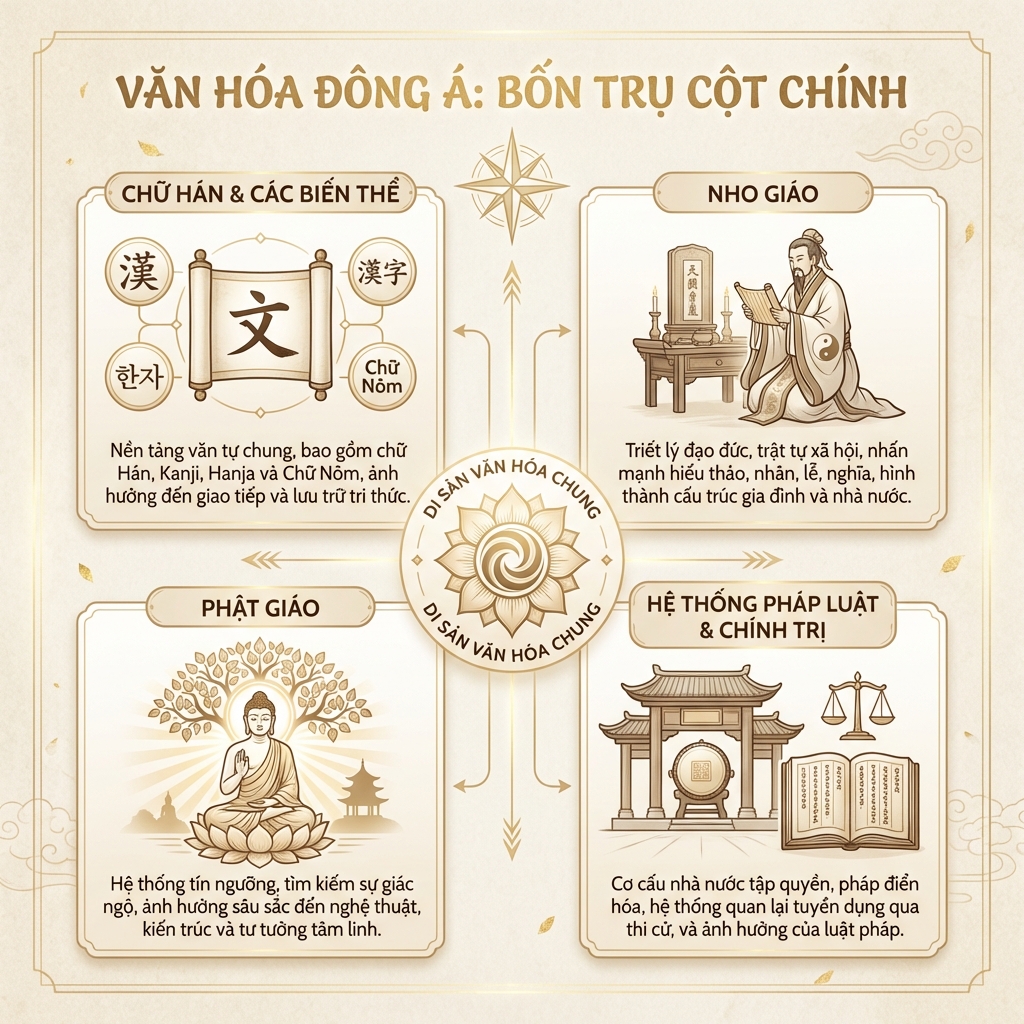
Khái niệm này ban đầu được nhà sử học Nhật Bản Nishijima Sadao đề xuất dưới tên gọi “Đông Á văn hóa quyển” vào năm 1962, một dấu mốc quan trọng trong nghiên cứu phương Đông.
This name is based on common intersections in writing systems, ideology, and enduring social structures. In this in-depth research article, we will analyze 7 core factors.
We will also clarify Vietnam's unique position in the thousand-year proud cultural flow of the modern East Asian region.
1. Chữ Hán và Hệ Thống Ngôn ngữ “Sino-Xenic”
Chinese characters are the invisible but strongest connecting thread of Four Great Cultural Spheres. For over two millennia, they have been the medium for transmitting knowledge and law.
Although each country has its own pronunciation, the core meaning of the characters is still wondrously understood in common through ancient scholarly texts.
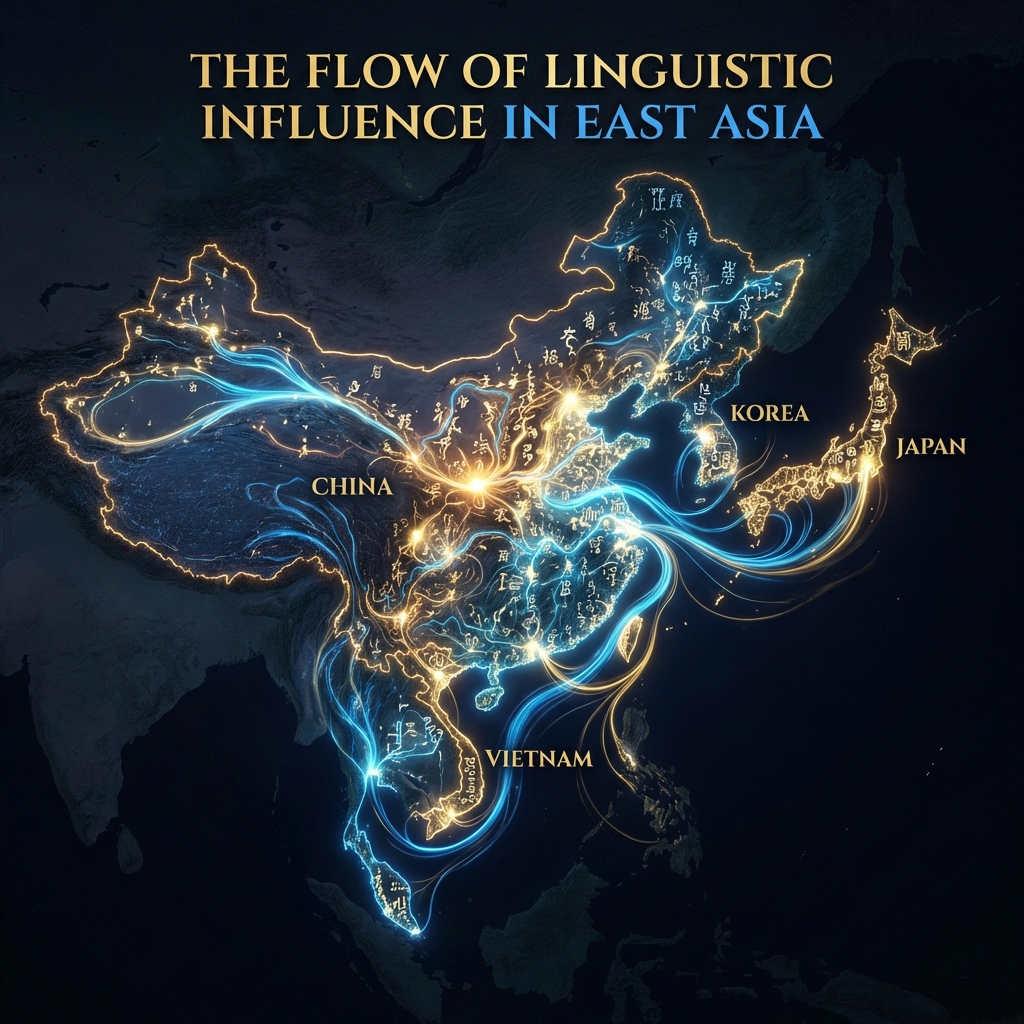
Hiện tượng “vay mượn có hệ thống” này được các nhà ngôn ngữ học gọi là “Sino-Xenic”. Các nghiên cứu cho thấy khoảng 60-70% từ vựng tiếng Việt có gốc từ tiếng Hán cổ.
Similarly, this figure is 60% in Korean and nearly 50% in Japanese. This creates a common thought foundation for billions of people in the region.
2. Confucianism: Moral Structure and Social Order
Nho giáo đóng vai trò là “xương sống” về tư tưởng cho toàn bộ khối Four Great Cultural Spheres. Values such as Benevolence, Propriety, Righteousness, Wisdom, and Trust have shaped the family.
It also profoundly influenced state governance models in Vietnam, Korea, and Japan. Unlike the West which emphasizes the individual, East Asian culture prioritizes the community.

This creates enduring social stability over many centuries. The civil service examination system is a feature of Confucianism that was thoroughly applied in ancient Vietnam.
It not only helped select talents but also promoted a fervent movement of learning, respecting teachers and valuing morality in traditional East Asian society.
3. Buddhism and Taoism: Profound Spiritual Intersection
If Confucianism manages society, then Buddhism and Taoism are the thousand-year spiritual abodes of the people Four Great Cultural Spheres.
Mahayana Buddhism entering this region underwent transformations to perfectly adapt to the indigenous beliefs of each distinct nation.
Ancient temples with curved roofs are vivid evidence of the peak artistic intersection between countries in this region.
Taoism with its non-action philosophy also strongly influenced the life views and exquisite traditional medicine of Vietnamese, Chinese, Korean, and Japanese people.
4. Political Structure and Tributary System
In history, the tributary system was not merely diplomacy but also an extremely important channel for cultural and technological exchange.
Vietnam and Korea still proactively adopted advanced administrative and legal models from the North to strengthen national independence.
Famous legal codes such as the Hồng Đức Code demonstrate flexible adaptation to suit Vietnamese national practices across many glorious dynasties.
Discipline and loyalty to the organization have become competitive advantages for these nations, similar to reports about 2026 Fashion Industry Report: The Social Commerce War.
5. Chinese Literature: Shared Treasure of Knowledge
Literature is where national pride blossoms most clearly. Genres of Tang poetry were masterfully mastered by Vietnamese and Korean scholars.
Works like Truyện Kiều or The Tale of Genji still evoke the common poetic laws of this culturally rich traditional region.
Việc sử dụng chung hệ thống chữ viết học thuật cho phép các trí thức Đông Á trao đổi văn chương qua hình thức “bút đàm” đầy tao nhã và uyên bác.
This is a unique phenomenon in human cultural history, evidencing the undeniable binding power of Chinese characters over a thousand years.
6. Customs and Festivals: Synchronous Cultural Pulse
You can easily find astonishing similarities in traditional holidays in these countries Four Great Cultural Spheres.
Lunar New Year and Mid-Autumn Festival are both sacred milestones for people to turn to their roots and closest family.
Although Japan has shifted to celebrating the Gregorian New Year, the essence of traditional festivals is still preserved through solemn rituals.
Using chopsticks and the habit of drinking tea are common features that make Vietnamese people feel at home when traveling in this East Asian region.
7. Vietnamese Identity: Proud Adaptation and Distinction
Vietnam has always maintained a strong and distinct national identity. The creation of Chữ Nôm is vivid proof of the Vietnamese cultural independence spirit.
Chữ Nôm is not only a linguistic medium but also a symbol of Vietnam's self-reliance will against external influences.
Vietnamese people absorb the essence but always filter out what is unsuitable, similar to the way we analyze about Digital Transformation for Small Businesses: Why Baserow is the Perfect Spreadsheet Alternative? today.
Conclusion: The Position of the Four Great Cultural Spheres in the 21st Century
Looking back at history, Four Great Cultural Spheres is the launchpad for the miraculous development of East Asia in today's digital era.
Vietnam is increasingly affirming its stature through preserving precious heritage and ceaselessly innovating in the most creative way.
Understanding common and unique values will help us integrate internationally more solidly than ever on the path to sustainable development.
You can learn more about Sino-Xenic cultural sphere (Wikipedia) to grasp a comprehensive view of the region's history.
Research Information and Methodology
| Factors | Detailed Content |
|---|---|
| Research methods | Comparative historical analysis, Sino-Xenic linguistics |
| Research subjects | Vietnam, China, Korea, Japan |
| Reference data | Nishijima Sadao (1962), Contemporary East Asian scholarship |
| Implementing unit | DPS Media Culture Research Group |
PESTLE Analysis: East Asian Cultural Region
| Factors | Detailed analysis |
|---|---|
| Political (Politics) | The rise of East Asian powers and regional cooperation based on similar history. |
| Economic (Economy) | Economies based on Confucian diligence and discipline create synergy. |
| Social (Society) | Rapid population aging but family structure remains the strongest foundation. |
| Technological (Technology) | Leading globally in AI and digitalization fields with high systemic thinking. |
| Legal (Legal) | Transition to modern rule of law while retaining traditional management characteristics. |
| Environmental (Environment) | Climate change challenges linked to ancient Tianren Heyi philosophy. |
Hope this research has given you a panoramic view of Four Great Cultural Spheres. Don't forget to share and contribute opinions to enrich the treasure trove of knowledge. [1]