


Are you struggling to find effective marketing methods for your eatery or restaurant to increase revenue? But you don't know which marketing strategy suits your business model? Then let's explore an effective restaurant marketing plan and eatery marketing methods through the following article!
Why is a marketing strategy for eateries and restaurants so important for restaurants and eateries?
In an increasingly competitive culinary market, marketing is not just a supporting tool but also a decisive factor for a restaurant's survival. So why is marketing so important? The reason is that marketing helps restaurants and eateries:
Increase brand recognition
Marketing helps restaurants build a distinctive image, different from competitors. This can be done by creating a unique brand story, impressive logo design, or memorable experiences for customers.

Through various marketing channels, restaurants can reach more potential customers, thereby increasing brand awareness.
Attract new customers
Creative marketing campaigns and attractive promotions will stimulate customer curiosity and encourage them to experience the restaurant's services.
Marketing helps convert those interested in the restaurant into actual customers by providing useful information, positive reviews from previous customers, or special offers.
Retain existing customers
Through customer care and gratitude programs, the restaurant can build sustainable relationships with customers, encourage them to return, and refer friends.
Attractive promotions and combos will help increase the average bill value of each customer.
Meet customer needs
Through market research activities, the restaurant can grasp the needs and preferences of customers, thereby adjusting products and services to better meet them.
Customer feedback through marketing channels will help the restaurant identify areas for improvement, thereby enhancing service quality.
Create a competitive advantage
Marketing helps the restaurant assert its position in the market, creating a competitive advantage over rivals.
Marketing helps the restaurant quickly catch up with new trends, thereby adjusting business strategies to adapt to market changes.
In summary, marketing plays an extremely important role in helping the restaurant achieve its business goals. An effective marketing strategy will help the restaurant increase revenue, build a strong brand, and maintain a competitive position in the market.
Effective restaurant marketing plan and eatery marketing methods
To build an effective marketing strategy for your eatery, you need to combine various factors, from understanding your customers to choosing the right communication channels. Here are some basic steps you can refer to:
Identify marketing objectives
- Mục tiêu ngắn hạn: Tăng doanh thu trong quý, thu hút khách hàng mới trong sự kiện,…
- Mục tiêu dài hạn: Xây dựng thương hiệu, trở thành địa điểm ẩm thực quen thuộc,…
Research target customers
- Khách hàng mục tiêu là ai? Sinh viên, dân văn phòng, gia đình,…
- Họ thích gì? Món ăn nào, không gian như thế nào, giá cả ra sao,…
- Họ tìm kiếm thông tin ở đâu? Mạng xã hội, ứng dụng đặt đồ ăn,…
SWOT analysis
- Điểm mạnh: Món ăn đặc biệt, không gian đẹp, dịch vụ tốt,…
- Điểm yếu: Vị trí không thuận tiện, giá cả cao,…
- Cơ hội: Xu hướng ẩm thực mới, sự kiện địa phương,…
- Thách thức: Đối thủ cạnh tranh, kinh tế khó khăn,…
Choose appropriate marketing channels
Marketing truyền thống: Tờ rơi, banner, chương trình khuyến mãi,…
Online marketing:
- Mạng xã hội: Facebook, Instagram, TikTok,…
- Website: SEO optimization, Google My Business
- Email marketing: Send newsletters, promotional programs
- Ứng dụng đặt đồ ăn: ShopeeFood, GrabFood, Gojek,…
- Marketing nội dung: Blog, video giới thiệu món ăn,…
Brand building
A successful restaurant brand is not just about having a unique name and logo. It is also a story told throughout the name, visual design, and restaurant space. An engaging story will create curiosity and a deep connection with customers. In addition, a beautifully and comfortably designed space will provide diners with wonderful culinary experiences, making them want to return many times.
Organize promotional programs
- Giảm giá: Áp dụng cho các món ăn, combo,…
- Tặng quà: Tặng voucher, quà tặng khi đạt doanh thu nhất định,…
- Sự kiện đặc biệt: Tổ chức các sự kiện như sinh nhật, lễ hội,…
Interaction with customers
To build a sustainable relationship with customers, frequent interaction is extremely important. Quickly responding to messages and comments on social media not only shows professionalism but also makes customers feel heard and cared for.
In addition, conducting regular customer surveys and building a loyalty program with many attractive incentives will help businesses better understand customer needs, thereby making appropriate improvements. As a result, businesses not only increase the satisfaction of current customers but also attract many new customers.

Effectiveness measurement
Closely monitoring business indicators such as the number of customers, revenue, and social media interactions is a continuous process that helps businesses accurately grasp their operational status.
Through in-depth analysis of collected data, businesses can evaluate the effectiveness of marketing campaigns and make timely strategic adjustments. This way, businesses not only optimize operational efficiency but also quickly adapt to market changes.
Evaluate and measure the effectiveness of restaurant marketing campaigns
After implementing marketing campaigns, evaluating and measuring effectiveness is extremely important so you can adjust strategies accordingly and optimize results. Here are some ways to evaluate and measure the effectiveness of restaurant marketing campaigns:
Identify KPI (Key Performance Indicators)
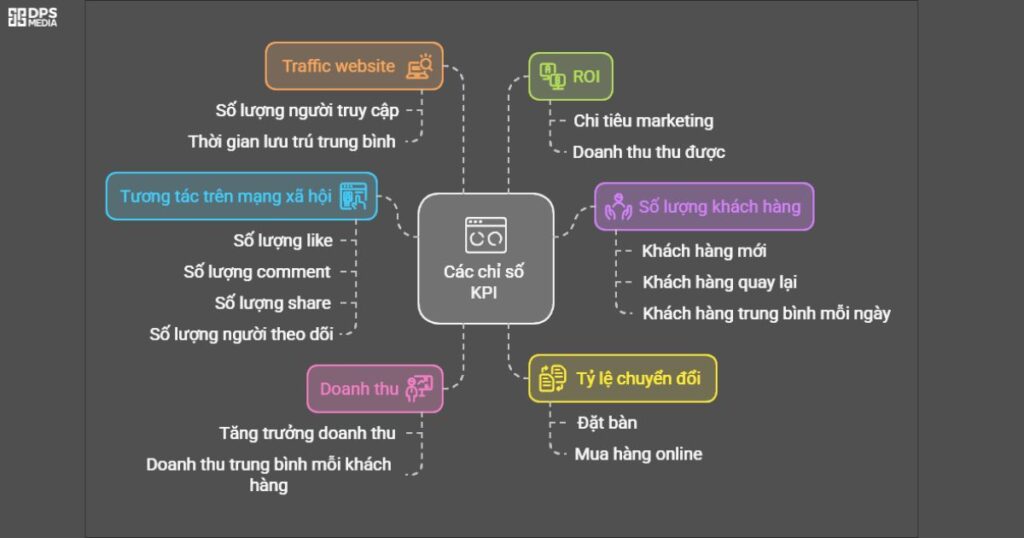
- Revenue: Revenue growth compared to the same period last year, average revenue per customer.
- Number of customers: Number of new customers, returning customers, average number of customers per day.
- Conversion rate: The rate of customers performing desired actions (e.g., booking a table, ordering online).
- Social media engagement: Number of likes, comments, shares, increase in followers.
- Website traffic: Number of website visitors, average time spent on the website.
- ROI (Return on Investment): Measure the effectiveness of marketing spending compared to revenue generated.
Use measurement tools
- Google Analytics: Used to track website traffic and user behavior.
- Facebook Insights: Used to track interactions on the fanpage and the effectiveness of ads.
- Instagram Insights: Similar to Facebook Insights but for Instagram.
- Các phần mềm quản lý nhà hàng: Giúp theo dõi doanh thu, số lượng khách hàng, hóa đơn,…
Data Analysis
- Compare data before and after campaign implementation: To evaluate changes and campaign effectiveness.
- Analyze by each marketing channel: To determine which channel brings the highest effectiveness.
- Analyze by customer segment: To better understand the behavior of each customer group.
Other evaluation methods
- Customer surveys: To collect customer feedback on the campaign.
- A/B testing: Compare the effectiveness of two different versions of a campaign.
- Monitor competitors: To compare the effectiveness of your campaign with competitors.
Adjust strategy
- Optimize effective channels: Increase investment in channels that deliver high results.
- Eliminate ineffective channels: Cut budget for channels that do not deliver expected results.
- Adjust content: Change marketing content to better suit customer preferences.
Nên sử dụng dịch vụ marketing – truyền thông tổng thể của agency nào để có chất lượng tốt nhất?
If you are looking for a reputable agency to use marketing and integrated communication services for your restaurant or eatery, DPS.MEDIA is one of the reliable names you can't ignore.
DPS.MEDIA provides a full range of marketing services, from brand building, content marketing, SEO, SEM, social media marketing to email marketing and data analysis.
DPS.MEDIA offers a variety of marketing service packages with costs suitable for each business scale.
Contact DPS.MEDIA now to learn more detailed information about our services!
See more: Outsourced Marketing Department in HCM: Comprehensive Solutions for Businesses